
Enhancing conductivity of silver-based conductive adhesives via biomass-derived aldehydes: Interfacial modification and network densification
IF 3.5
3区 材料科学
Q2 ENGINEERING, CHEMICAL
International Journal of Adhesion and Adhesives
Pub Date : 2026-05-01
Epub Date: 2026-01-03
DOI:10.1016/j.ijadhadh.2026.104259
引用次数: 0
Abstract
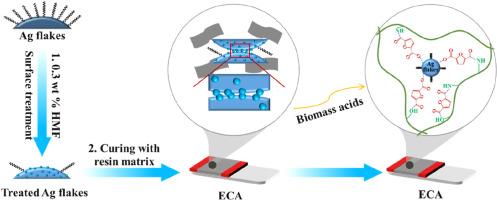
Electrically conductive adhesive (ECA) is a low-temperature bonding material that can replace toxic Sn-Pb solder. However, the electrical properties of ECA are severely deteriorated by insulating organic lubricants (e.g., oleic acid, stearic acid) on the surface of Ag flakes. Current methods for surface modification often rely on non-renewable or environmentally-concerning chemicals. This work proposes a sustainable and effective approach by utilizing biomass-derived aldehydes, such as hydroxymethylfurfural (HMF), for the interfacial modification of Ag flakes and concurrent densification of epoxy matrix. The resulting ECA achieved a minimum bulk resistivity of 2.49 × 10⁻⁵ Ω cm at an optimal HMF loading of 0.3 wt% (relative to Ag), achieving ∼26.5 % of decline, compared with that of untreated reference (3.38 × 10⁻⁵ Ω cm). Comprehensive characterizations (XPS, FT-IR) revealed that HMF was oxidized by oxygen during curing and generated carboxylic acid groups. These carboxyl groups participate in co-curing reactions with the epoxy matrix and enhanced the conductive network. The strategy also applied to other biomass-derived molecules, such as 2,5-furandicarboxylic acid (FDCA). This study provides a novel, green methodology that bridges the gap between high conductivity and sustainable material design in ECA.
通过生物质衍生醛增强银基导电粘合剂的导电性:界面改性和网络致密化
导电胶(ECA)是一种可替代有毒锡铅焊料的低温粘接材料。然而,在银片表面绝缘有机润滑剂(如油酸、硬脂酸)会严重恶化ECA的电学性能。目前的表面改性方法通常依赖于不可再生的或与环境有关的化学品。本研究提出了一种可持续和有效的方法,利用生物质衍生的醛,如羟甲基糠醛(HMF),用于银片的界面改性和环氧基的同步致密化。所得的ECA在最佳HMF负载为0.3 wt%(相对于Ag)时实现了2.49 × 10⁻⁵ Ω cm的最小体电阻率,与未处理的参考(3.38 × 10⁻⁵ Ω cm)相比,实现了~ 26.5%的下降。综合表征(XPS, FT-IR)表明,HMF在固化过程中被氧氧化,生成羧基。这些羧基参与了与环氧树脂基体的共固化反应,增强了导电网络。该策略也适用于其他生物质衍生分子,如2,5-呋喃二羧酸(FDCA)。本研究提供了一种新颖的绿色方法,弥合了ECA中高导电性和可持续材料设计之间的差距。
本文章由计算机程序翻译,如有差异,请以英文原文为准。
求助全文
约1分钟内获得全文
求助全文
来源期刊
International Journal of Adhesion and Adhesives
工程技术-材料科学:综合
CiteScore
6.90
自引率
8.80%
发文量
200
审稿时长
8.3 months
期刊介绍:
The International Journal of Adhesion and Adhesives draws together the many aspects of the science and technology of adhesive materials, from fundamental research and development work to industrial applications. Subject areas covered include: interfacial interactions, surface chemistry, methods of testing, accumulation of test data on physical and mechanical properties, environmental effects, new adhesive materials, sealants, design of bonded joints, and manufacturing technology.
 求助内容:
求助内容: 应助结果提醒方式:

 京公网安备 11010802042870号


