
Alanine scanning of the yeast killer toxin K2 reveals key residues for activity, gain-of-function variants, and supports prediction of precursor processing and 3D structure
IF 5.1
Q2 BIOCHEMISTRY & MOLECULAR BIOLOGY
Journal of Structural Biology: X
Pub Date : 2026-06-01
Epub Date: 2025-12-18
DOI:10.1016/j.yjsbx.2025.100142
引用次数: 0
Abstract
Yeast killer toxins (YKTs) are antimicrobial proteins secreted by yeast with potential applications ranging from food preservation to therapeutic agents in human health. However, the practical use of many YKTs is limited by specific pH requirements, low temperature stability, low production yields, and narrow target specificity. While protein engineering could potentially overcome these challenges, progress is hindered by a lack of detailed knowledge about sequence-function relationships and structural data for these often multi-step processed proteins. In this study, we focused on the YKT K2, encoded by the M2 satellite dsRNA in Saccharomyces cerevisiae. Using alanine scanning mutagenesis of the full open reading frame and structure predictions combined with molecular dynamics simulations, we generated a comprehensive sequence-structure–function map, refined the model for the proteolytic processing of the K2 precursor, and predicted the mature toxin structure. Our findings also demonstrate that K2 can be engineered toward enhanced toxicity and altered target specificity through single-site mutations. Furthermore, we identified structural homology between K2 and other killer toxins, including the SMK toxin from the yeast Millerozyma farinosa. Our cost-effective workflow provides a platform to broadly map YKT sequence-structure–function relationships.
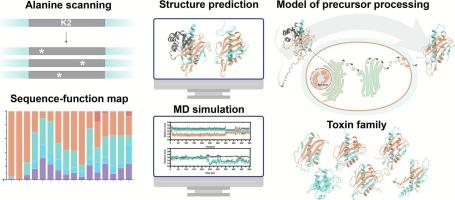
酵母杀手毒素K2的丙氨酸扫描揭示了活性,功能获得变体的关键残基,并支持前体加工和3D结构的预测
酵母杀手毒素(YKTs)是由酵母分泌的抗菌蛋白,具有从食品保鲜到人类健康治疗剂的潜在应用。然而,许多ykt的实际应用受到特定pH要求、低温稳定性、低产率和窄靶特异性的限制。虽然蛋白质工程可以潜在地克服这些挑战,但由于缺乏对这些通常是多步骤加工的蛋白质的序列-功能关系和结构数据的详细了解,进展受到阻碍。在本研究中,我们重点研究了酿酒酵母M2卫星dsRNA编码的YKT K2。利用丙氨酸扫描诱变的全开放阅读框和结构预测相结合的分子动力学模拟,生成了完整的序列-结构-功能图谱,完善了K2前体蛋白水解加工模型,并预测了成熟的毒素结构。我们的研究结果还表明,K2可以通过单位点突变来增强毒性和改变靶标特异性。此外,我们还鉴定了K2与其他杀伤毒素(包括来自粉孢千粉酶的SMK毒素)之间的结构同源性。我们具有成本效益的工作流程提供了一个广泛映射YKT序列-结构-功能关系的平台。
本文章由计算机程序翻译,如有差异,请以英文原文为准。
求助全文
约1分钟内获得全文
求助全文
来源期刊
Journal of Structural Biology: X
Biochemistry, Genetics and Molecular Biology-Structural Biology
CiteScore
6.50
自引率
0.00%
发文量
20
审稿时长
62 days
 求助内容:
求助内容: 应助结果提醒方式:

 京公网安备 11010802042870号


