
Di amine BODIPY and BOPHY as dual sensor of pH and selective to Cu2+
IF 3.9
3区 工程技术
Q2 CHEMISTRY, APPLIED
引用次数: 0
Abstract
This work reports the synthesis and characterization of two diamino functionalized dyes based on BODIPY and BOPHY, designed as dual optical sensors for pH and metal ions, especially Cu2+. Both compounds display environmentally modulated fluorescence, with reversible “on-off” behavior upon changes in pH and metal coordination.
Spectroscopic studies reveal that, in acidic media (pH ≤ 4), both dyes experience a notable increase in fluorescence (up to 25 or 250-times for BODIPY and BOPHY, respectively), along with color changes clearly visible to the naked eye. These effects are accompanied by hypsochromic shifts in the absorption bands, on the order of 30–80 nm, which are attributed to the protonation of the amino groups and the reduction of the pyramidal inversion of nitrogen. Moreover, both compounds display distinct optical responses upon exposure to various metal salts, with BODIPY showing selective and transient fluorescence activation in the presence of copper sulfate under near-neutral conditions. Detailed analyses suggest the formation of three distinct species during the Cu2+ interaction: (I) the native dye, (II) a highly fluorescent intermediate complex, and (III) a non-emissive decomposition product. The kinetics and stability of these species were found to be highly dependent on the solvent environment, particularly its protic/aprotic nature.
These findings underscore the potential of these small, structurally simple dyes as efficient dual-function sensors, offering broad applicability in environmental monitoring, biological imaging, and chemical sensing.
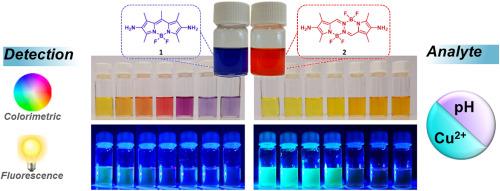
二胺BODIPY和BOPHY作为pH和Cu2+选择性的双传感器
本文报道了基于BODIPY和BOPHY的两种二氨基功能化染料的合成和表征,它们被设计为pH和金属离子(特别是Cu2+)的双光学传感器。这两种化合物都显示环境调制荧光,在pH和金属配位变化时具有可逆的“开-关”行为。光谱研究表明,在酸性介质(pH≤4)中,这两种染料的荧光都显著增加(BODIPY和BOPHY分别高达25倍或250倍),并伴有肉眼可见的颜色变化。这些效应伴随着30-80 nm吸收带的次变色,这是由于氨基的质子化和氮的锥体反转的减少。此外,这两种化合物在暴露于各种金属盐时显示出不同的光学响应,其中BODIPY在近中性条件下在硫酸铜存在下显示出选择性和瞬态荧光激活。详细分析表明,在Cu2+相互作用过程中形成了三种不同的物质:(I)天然染料,(II)高荧光中间配合物,(III)非发射分解产物。这些物种的动力学和稳定性高度依赖于溶剂环境,特别是其质子/非质子性质。这些发现强调了这些结构简单的小染料作为高效双功能传感器的潜力,在环境监测、生物成像和化学传感方面具有广泛的适用性。
本文章由计算机程序翻译,如有差异,请以英文原文为准。
求助全文
约1分钟内获得全文
求助全文
来源期刊
Dyes and Pigments
工程技术-材料科学:纺织
CiteScore
8.20
自引率
13.30%
发文量
933
审稿时长
33 days
期刊介绍:
Dyes and Pigments covers the scientific and technical aspects of the chemistry and physics of dyes, pigments and their intermediates. Emphasis is placed on the properties of the colouring matters themselves rather than on their applications or the system in which they may be applied.
Thus the journal accepts research and review papers on the synthesis of dyes, pigments and intermediates, their physical or chemical properties, e.g. spectroscopic, surface, solution or solid state characteristics, the physical aspects of their preparation, e.g. precipitation, nucleation and growth, crystal formation, liquid crystalline characteristics, their photochemical, ecological or biological properties and the relationship between colour and chemical constitution. However, papers are considered which deal with the more fundamental aspects of colourant application and of the interactions of colourants with substrates or media.
The journal will interest a wide variety of workers in a range of disciplines whose work involves dyes, pigments and their intermediates, and provides a platform for investigators with common interests but diverse fields of activity such as cosmetics, reprographics, dye and pigment synthesis, medical research, polymers, etc.
 求助内容:
求助内容: 应助结果提醒方式:

 京公网安备 11010802042870号


