
Multifunctional application of a sulfadiazine azo dye as electrochemical sensor, corrosion inhibitor, and forensic imaging agent
IF 3.9
3区 工程技术
Q2 CHEMISTRY, APPLIED
引用次数: 0
Abstract
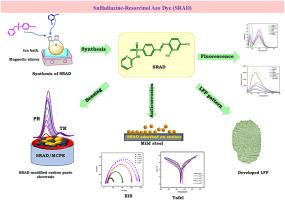
This study reports the development of a novel electrochemical sensor for the simultaneous determination of paracetamol (PR) and tryptophan (TR) using a carbon paste electrode modified with a synthesized sulfadiazine-resorcinol azo dye (SRAD). The SRAD compound was synthesized via a diazo coupling reaction and its molecular structure was confirmed using spectroscopic techniques. Electrochemical characterization demonstrated that the sulfadiazine-resorcinol azo dye modified carbon paste electrode (SRAD/MCPE) exhibits good performance for the concurrent quantification of PR and TR. The sensor achieved low limits of detection (7.9 μM for PR and 4.11 μM for TR), along with good Repeatability and stability. Operational parameters such as pH, scan rate, and interference effects were systematically optimized. In parallel, SRAD exhibited significant corrosion inhibition efficiency for mild steel in acidic media, functioning as good inhibitor with spontaneous Langmuir adsorption behavior. Surface analysis via SEM validated the protective film formation. Furthermore, the utility of SRAD was extended to forensic science, where the dusting method successfully visualized Level I and II latent fingerprint features under both normal and UV illumination.
磺胺嘧啶偶氮染料作为电化学传感器、缓蚀剂和法医成像剂的多功能应用
本研究采用合成磺胺嘧啶-间苯二酚偶氮染料(SRAD)修饰碳糊电极,建立了一种同时测定扑热息痛(PR)和色氨酸(TR)的电化学传感器。通过重氮偶联反应合成了SRAD化合物,并利用光谱技术对其分子结构进行了确证。电化学表征表明,磺胺嘧啶-间苯二酚偶氮染料修饰碳膏电极(SRAD/MCPE)具有良好的同时定量PR和TR的性能,该传感器具有较低的检出限(PR为7.9 μM, TR为4.11 μM),具有良好的重复性和稳定性。系统优化了pH、扫描速率、干扰效果等操作参数。同时,SRAD在酸性介质中对低碳钢表现出明显的缓蚀效果,是一种良好的缓蚀剂,具有自发的Langmuir吸附行为。SEM表面分析证实了保护膜的形成。此外,SRAD的应用还扩展到法医科学,在常规和紫外线照射下,该方法成功地可视化了I级和II级潜在指纹特征。
本文章由计算机程序翻译,如有差异,请以英文原文为准。
求助全文
约1分钟内获得全文
求助全文
来源期刊
Dyes and Pigments
工程技术-材料科学:纺织
CiteScore
8.20
自引率
13.30%
发文量
933
审稿时长
33 days
期刊介绍:
Dyes and Pigments covers the scientific and technical aspects of the chemistry and physics of dyes, pigments and their intermediates. Emphasis is placed on the properties of the colouring matters themselves rather than on their applications or the system in which they may be applied.
Thus the journal accepts research and review papers on the synthesis of dyes, pigments and intermediates, their physical or chemical properties, e.g. spectroscopic, surface, solution or solid state characteristics, the physical aspects of their preparation, e.g. precipitation, nucleation and growth, crystal formation, liquid crystalline characteristics, their photochemical, ecological or biological properties and the relationship between colour and chemical constitution. However, papers are considered which deal with the more fundamental aspects of colourant application and of the interactions of colourants with substrates or media.
The journal will interest a wide variety of workers in a range of disciplines whose work involves dyes, pigments and their intermediates, and provides a platform for investigators with common interests but diverse fields of activity such as cosmetics, reprographics, dye and pigment synthesis, medical research, polymers, etc.
 求助内容:
求助内容: 应助结果提醒方式:

 京公网安备 11010802042870号


