
Breaking the lifetime-efficiency trade-off in blue organic room-temperature phosphorescence through site-directed boronate engineering
IF 3.9
3区 工程技术
Q2 CHEMISTRY, APPLIED
引用次数: 0
Abstract
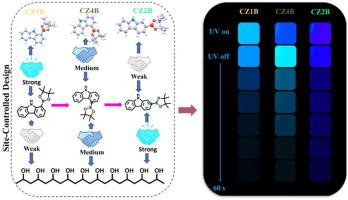
Organic room-temperature phosphorescent (RTP) materials with tunable lifetimes are of great interest for information display, anti-counterfeiting, and data storage. However, achieving both ultralong lifetimes and high quantum yields, particularly in the blue region, remains challenging due to their inherent trade-off. Herein, a site-dictated strategy is employed by introducing pinacol boronate ester (Bpin) groups at the 1-, 2-, and 4-positions of a carbazole scaffold (CZ1B, CZ2B, and CZ4B), and embedding the resulting phosphors into a poly(vinyl alcohol) (PVA) matrix. All three emitters exhibit visible blue RTP with tunable lifetimes ranging from 3.96 s (CZ1B) to 5.20 s (CZ2B)—among the longest reported—along with high phosphorescence quantum yields (17.94–26.95 %). Combined theoretical and experimental studies reveal that Bpin substitution site affects excited-state characteristics, spin–orbit coupling, and hydrogen-bonding interactions with the PVA host. Notably, CZ2B shows optimal excited-state separation, highest surface electrostatic potential, and strongest hydrogen bonding, leading to superior RTP performance. This study presents a precise structural approach to modulate both phosphorescence lifetime and efficiency, offering valuable insight for the development of long-lived blue RTP materials in advanced optical applications such as data storage and visual encryption.
通过定点硼酸工程打破蓝色有机室温磷光的寿命效率权衡
具有可调寿命的有机室温磷光(RTP)材料在信息显示、防伪和数据存储方面具有重要意义。然而,实现超长寿命和高量子产率,特别是在蓝色区域,由于它们固有的权衡,仍然具有挑战性。本文采用位点决定策略,在咔唑支架(CZ1B、CZ2B和CZ4B)的1-、2-和4-位置上引入吡纳酚硼酸酯(Bpin)基团,并将所得荧光粉嵌入聚乙烯醇(PVA)基质中。所有三种发射体都显示出可见的蓝色RTP,其可调寿命范围从3.96 s (CZ1B)到5.20 s (CZ2B) -在报道的最长寿命中-以及高磷光量子产率(17.94 - 26.95%)。理论和实验相结合的研究表明,Bpin取代位点影响了PVA宿主的激发态特性、自旋轨道耦合以及与PVA宿主的氢键相互作用。值得注意的是,CZ2B具有最佳的激发态分离、最高的表面静电势和最强的氢键,从而具有优异的RTP性能。本研究提出了一种精确的结构方法来调节磷光寿命和效率,为在数据存储和视觉加密等先进光学应用中开发长寿命蓝色RTP材料提供了有价值的见解。
本文章由计算机程序翻译,如有差异,请以英文原文为准。
求助全文
约1分钟内获得全文
求助全文
来源期刊
Dyes and Pigments
工程技术-材料科学:纺织
CiteScore
8.20
自引率
13.30%
发文量
933
审稿时长
33 days
期刊介绍:
Dyes and Pigments covers the scientific and technical aspects of the chemistry and physics of dyes, pigments and their intermediates. Emphasis is placed on the properties of the colouring matters themselves rather than on their applications or the system in which they may be applied.
Thus the journal accepts research and review papers on the synthesis of dyes, pigments and intermediates, their physical or chemical properties, e.g. spectroscopic, surface, solution or solid state characteristics, the physical aspects of their preparation, e.g. precipitation, nucleation and growth, crystal formation, liquid crystalline characteristics, their photochemical, ecological or biological properties and the relationship between colour and chemical constitution. However, papers are considered which deal with the more fundamental aspects of colourant application and of the interactions of colourants with substrates or media.
The journal will interest a wide variety of workers in a range of disciplines whose work involves dyes, pigments and their intermediates, and provides a platform for investigators with common interests but diverse fields of activity such as cosmetics, reprographics, dye and pigment synthesis, medical research, polymers, etc.
 求助内容:
求助内容: 应助结果提醒方式:

 京公网安备 11010802042870号


