
High-accuracy solution of the rovibrational Schrödinger equation for triatomic molecules
IF 1.2
4区 物理与天体物理
Q4 PHYSICS, ATOMIC, MOLECULAR & CHEMICAL
Journal of Molecular Spectroscopy
Pub Date : 2026-01-01
Epub Date: 2025-12-22
DOI:10.1016/j.jms.2025.112068
引用次数: 0
Abstract
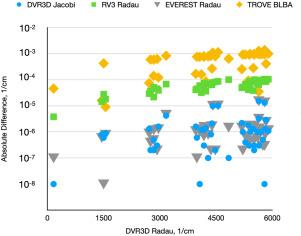
Modern meteorological studies and atmospheric monitoring are placing stringent requirements on the accuracy of high-resolution molecular spectroscopy at infrared and visible wavelengths. Experimental progress towards accurately determining infrared line centers to within kilohertz and line intensities to better than sub-promille accuracy requires corresponding progress in theoretical determinations. Recently, it has been demonstrated that modern rovibrational programs for diatomic molecules (DUO and LEVEL) can solve the Schrödinger equation with an accuracy of 1 part in 10 by analysis of numerical solutions of exactly solvable problems. The demand for such agreement in triatomic calculations is pressing. Nine to ten digit convergence for computed CO rovibrational energy levels is demonstrated herein using a variety of available variational nuclear motion programs based on the use of exact (within the Born–Oppenheimer approximation) kinetic energy operators. The programs DVR3D, in both Radau and Jacobi coordinates, EVEREST, RV3 and TROVE are compared. The agreement achieved corresponds to about 0.00005 cm which sets a new benchmark for accuracy. A comparison of DVR3D and EVEREST also shows agreement for computed Einstein A coefficients at the sub-percent level for the majority of transitions.
三原子分子旋转振动Schrödinger方程的高精度解
现代气象研究和大气监测对红外和可见光高分辨率分子光谱的精度提出了严格的要求。在红外线中心精确测定到千赫兹以内和线强度优于亚轮廓精度方面的实验进展要求理论测定取得相应的进展。最近,通过对精确可解问题的数值解的分析,证明了双原子分子的现代旋转振动程序(DUO和LEVEL)能以1 / 108的精度求解Schrödinger方程。在三原子计算中对这种一致性的要求是迫切的。基于精确(在Born-Oppenheimer近似内)动能算子的使用,本文使用各种可用的变分核运动程序演示了计算CO2旋转振动能级的九到十位数收敛。在Radau和Jacobi坐标系下,比较了EVEREST、RV3和TROVE程序。所获得的一致性相当于约0.00005 cm−1,这为精度设定了新的基准。DVR3D和EVEREST的比较也显示,对于大多数跃迁,计算出的爱因斯坦A系数在次百分比水平上是一致的。
本文章由计算机程序翻译,如有差异,请以英文原文为准。
求助全文
约1分钟内获得全文
求助全文
来源期刊
CiteScore
2.70
自引率
21.40%
发文量
94
审稿时长
29 days
期刊介绍:
The Journal of Molecular Spectroscopy presents experimental and theoretical articles on all subjects relevant to molecular spectroscopy and its modern applications. An international medium for the publication of some of the most significant research in the field, the Journal of Molecular Spectroscopy is an invaluable resource for astrophysicists, chemists, physicists, engineers, and others involved in molecular spectroscopy research and practice.
 求助内容:
求助内容: 应助结果提醒方式:

 京公网安备 11010802042870号


