
Polymeric colloidal motors prepared by nanoprecipitation-based processes
IF 7.6
2区 化学
Q1 CHEMISTRY, PHYSICAL
Current Opinion in Colloid & Interface Science
Pub Date : 2026-02-01
Epub Date: 2025-12-09
DOI:10.1016/j.cocis.2025.101986
引用次数: 0
Abstract
Polymeric colloidal motors are polymer-made tiny machines capable of converting external energy into mechanical motion. Their compositions and architectures have shown a critical effect on controlling the spontaneous creation of energy gradients in response to chemical or physical stimuli for driving autonomous movement in various liquid media or biological microenvironments, holding significant potential for biomedical applications. Advances in nanofabrication have enabled the engineering of polymeric colloidal motors with a variety of compositions and architectures. Recently, nanoprecipitation due to its simple and straightforward process has been exploited to construct polymeric colloidal motors that have the appealing convenience of tuning their compositions, architectures and properties, allowing customization of their motion performance to adapt to various application scenarios. This review highlights the most recent advances in polymeric colloidal motors prepared by nanoprecipitation-based processes. It illustrates the synthesis of polymeric colloidal motors via a programmable solvent-shifting and post-organic solvent removal process, their stimuli-responsive motion behaviors and application performance in biomedical fields. A future perspective on the construction of polymeric colloidal motors through nanoprecipitation is also proposed.
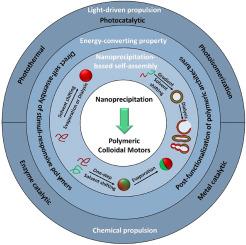
纳米沉淀法制备聚合物胶体马达
聚合物胶体马达是由聚合物制成的微型机器,能够将外部能量转化为机械运动。它们的组成和结构在控制能量梯度的自发产生以响应化学或物理刺激,在各种液体介质或生物微环境中驱动自主运动方面显示出关键作用,在生物医学应用方面具有重大潜力。纳米制造技术的进步使得聚合物胶体马达具有多种组成和结构成为可能。最近,纳米沉淀法由于其简单和直接的过程被用于构建聚合物胶体马达,这些马达具有调整其成分、结构和性能的吸引力,允许定制其运动性能以适应各种应用场景。本文综述了利用纳米沉淀法制备聚合物胶体马达的最新进展。通过可编程溶剂转移和后有机溶剂去除工艺合成聚合物胶体马达,阐述了其刺激响应运动行为及其在生物医学领域的应用性能。展望了利用纳米沉淀法构建聚合物胶体马达的前景。
本文章由计算机程序翻译,如有差异,请以英文原文为准。
求助全文
约1分钟内获得全文
求助全文
来源期刊
CiteScore
16.50
自引率
1.10%
发文量
74
审稿时长
11.3 weeks
期刊介绍:
Current Opinion in Colloid and Interface Science (COCIS) is an international journal that focuses on the molecular and nanoscopic aspects of colloidal systems and interfaces in various scientific and technological fields. These include materials science, biologically-relevant systems, energy and environmental technologies, and industrial applications.
Unlike primary journals, COCIS primarily serves as a guide for researchers, helping them navigate through the vast landscape of recently published literature. It critically analyzes the state of the art, identifies bottlenecks and unsolved issues, and proposes future developments.
Moreover, COCIS emphasizes certain areas and papers that are considered particularly interesting and significant by the Editors and Section Editors. Its goal is to provide valuable insights and updates to the research community in these specialized areas.
 求助内容:
求助内容: 应助结果提醒方式:

 京公网安备 11010802042870号


