Amr Arafa Elbadry, Marwa A Abogabal, Laila Elahwal
{"title":"Interscalene Block Versus Pericapsular Nerve Block and Superficial Cervical Plexus Block for Arthroscopic Shoulder Surgery.","authors":"Amr Arafa Elbadry, Marwa A Abogabal, Laila Elahwal","doi":"10.5812/aapm-165770","DOIUrl":null,"url":null,"abstract":"<p><strong>Background: </strong>Interscalene brachial plexus block (ISB) remains the gold standard for analgesia in arthroscopic shoulder surgery (ASS). However, ISB is associated with a higher incidence of hemidiaphragmatic paralysis (DP).</p><p><strong>Objectives: </strong>This study compares ultrasound-guided interscalene brachial plexus block (USG-ISB) with a combination of ultrasound-guided pericapsular nerve block (USG-PENB) and superficial cervical plexus block (SCPB) to evaluate analgesic efficacy and the incidence of DP.</p><p><strong>Methods: </strong>In this prospective, triple-blinded randomized trial, 42 American Society of Anesthesiologists (ASA) I - II patients undergoing elective ASS were randomized into two groups after induction of general anesthesia (GA): Group A (ISB, 10 mL 0.25% bupivacaine) or group B [pericapsular nerve block (PENB) 10 mL + SCPB 5 mL 0.25% bupivacaine]. Blocks were performed under ultrasound guidance. The primary outcome was the incidence of DP; secondary outcomes included pain scores, opioid consumption, pulmonary function, and patient satisfaction.</p><p><strong>Results: </strong>Compared with group A, group B demonstrated a delayed time to first request for rescue analgesia (13.24 vs. 8.38 hours; P < 0.001) and reduced 24-hour fentanyl consumption (135.71 vs. 192.86 mcg; P = 0.012). Pulmonary function was significantly better preserved in group B (P < 0.05). The incidence of DP was lower in group B (4.76% vs. 38.1%; P = 0.02). Pain scores at 6, 12, and 18 hours were also lower in group B (P < 0.05). Both groups showed no differences in hypotension, bradycardia, or patient satisfaction.</p><p><strong>Conclusions: </strong>The combination of PENB and SCPB provides analgesia non-inferior to ISB, while significantly reducing the incidence of DP and opioid requirements. For individuals at risk of respiratory impairment, this approach presents a lower-risk alternative without compromising pain control efficacy.</p>","PeriodicalId":7841,"journal":{"name":"Anesthesiology and Pain Medicine","volume":"15 6","pages":"e165770"},"PeriodicalIF":0.0000,"publicationDate":"2025-11-29","publicationTypes":"Journal Article","fieldsOfStudy":null,"isOpenAccess":false,"openAccessPdf":"https://www.ncbi.nlm.nih.gov/pmc/articles/PMC12749204/pdf/","citationCount":"0","resultStr":null,"platform":"Semanticscholar","paperid":null,"PeriodicalName":"Anesthesiology and Pain Medicine","FirstCategoryId":"1085","ListUrlMain":"https://doi.org/10.5812/aapm-165770","RegionNum":0,"RegionCategory":null,"ArticlePicture":[],"TitleCN":null,"AbstractTextCN":null,"PMCID":null,"EPubDate":"2025/12/31 0:00:00","PubModel":"eCollection","JCR":"Q2","JCRName":"Medicine","Score":null,"Total":0}
引用次数: 0
Abstract
Background: Interscalene brachial plexus block (ISB) remains the gold standard for analgesia in arthroscopic shoulder surgery (ASS). However, ISB is associated with a higher incidence of hemidiaphragmatic paralysis (DP).
Objectives: This study compares ultrasound-guided interscalene brachial plexus block (USG-ISB) with a combination of ultrasound-guided pericapsular nerve block (USG-PENB) and superficial cervical plexus block (SCPB) to evaluate analgesic efficacy and the incidence of DP.
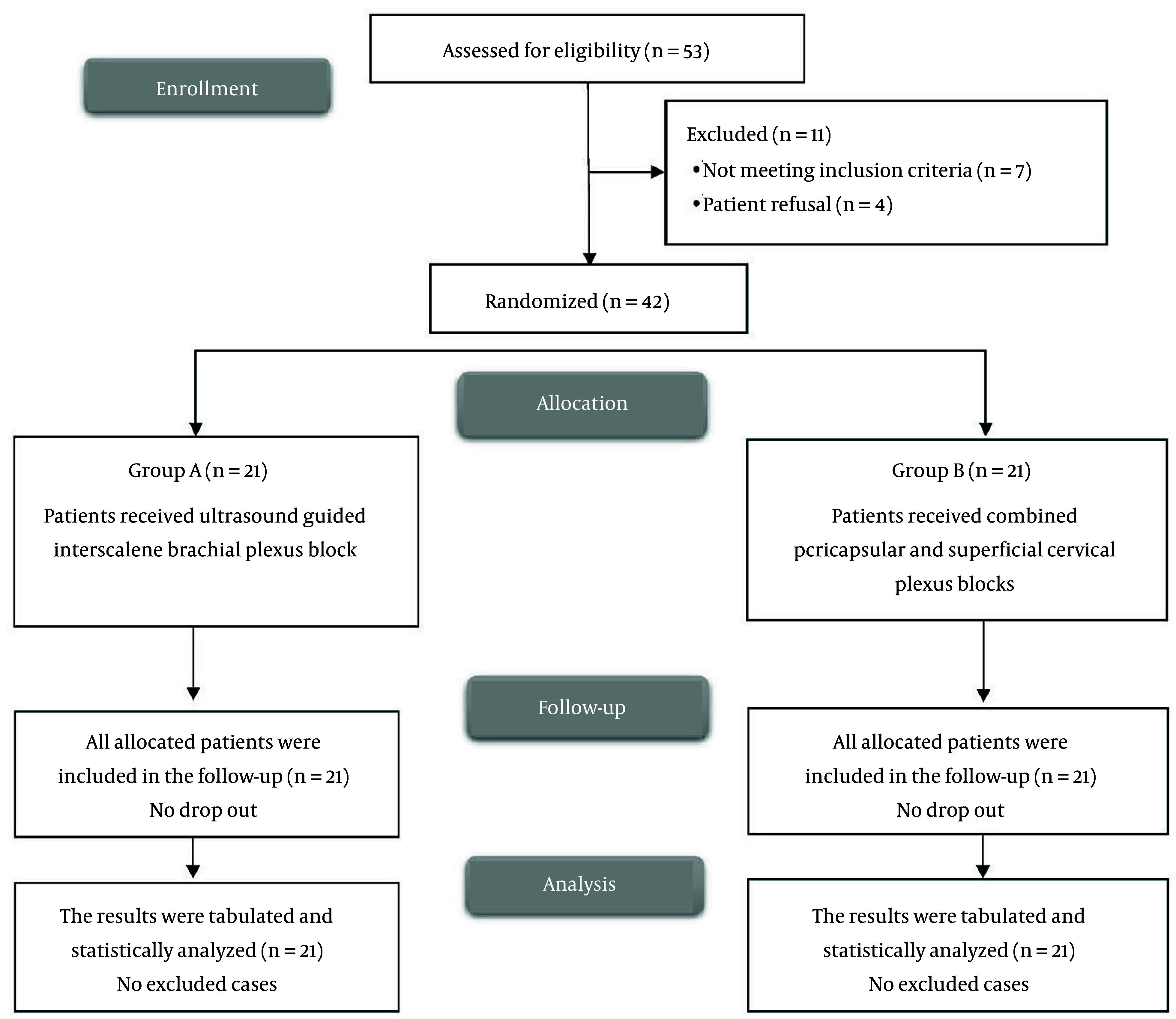
Methods: In this prospective, triple-blinded randomized trial, 42 American Society of Anesthesiologists (ASA) I - II patients undergoing elective ASS were randomized into two groups after induction of general anesthesia (GA): Group A (ISB, 10 mL 0.25% bupivacaine) or group B [pericapsular nerve block (PENB) 10 mL + SCPB 5 mL 0.25% bupivacaine]. Blocks were performed under ultrasound guidance. The primary outcome was the incidence of DP; secondary outcomes included pain scores, opioid consumption, pulmonary function, and patient satisfaction.
Results: Compared with group A, group B demonstrated a delayed time to first request for rescue analgesia (13.24 vs. 8.38 hours; P < 0.001) and reduced 24-hour fentanyl consumption (135.71 vs. 192.86 mcg; P = 0.012). Pulmonary function was significantly better preserved in group B (P < 0.05). The incidence of DP was lower in group B (4.76% vs. 38.1%; P = 0.02). Pain scores at 6, 12, and 18 hours were also lower in group B (P < 0.05). Both groups showed no differences in hypotension, bradycardia, or patient satisfaction.
Conclusions: The combination of PENB and SCPB provides analgesia non-inferior to ISB, while significantly reducing the incidence of DP and opioid requirements. For individuals at risk of respiratory impairment, this approach presents a lower-risk alternative without compromising pain control efficacy.
背景:斜角肌间臂丛阻滞(ISB)仍然是关节镜肩关节手术(ASS)镇痛的金标准。然而,ISB与高发生率的半膈肌麻痹(DP)相关。目的:比较超声引导下斜角肌间臂丛神经阻滞(USG-ISB)与超声引导下囊周神经阻滞(USG-PENB)联合颈浅丛神经阻滞(SCPB)的镇痛效果和DP发生率。方法:在这项前瞻性、三盲随机试验中,42例美国麻醉师学会(ASA) I - II期患者在全麻诱导(GA)后随机分为两组:A组(ISB, 10 mL 0.25%布比卡因)或B组[包膜神经阻滞(PENB) 10 mL + SCPB 5 mL 0.25%布比卡因]。在超声引导下进行阻滞。主要终点是DP的发生率;次要结局包括疼痛评分、阿片类药物消耗、肺功能和患者满意度。结果:与A组相比,B组患者首次请求急救镇痛时间延迟(13.24 h比8.38 h, P < 0.001), 24小时芬太尼用量减少(135.71 h比192.86 mcg, P = 0.012)。B组肺功能明显改善(P < 0.05)。B组DP发生率较低(4.76% vs. 38.1%, P = 0.02)。B组患者6、12、18 h疼痛评分均低于对照组(P < 0.05)。两组在低血压、心动过缓或患者满意度方面均无差异。结论:PENB联合SCPB的镇痛效果优于ISB,同时显著降低DP发生率和阿片类药物需求。对于有呼吸障碍风险的个体,这种方法提供了一种低风险的替代方法,而不会影响疼痛控制的效果。



 求助内容:
求助内容: 应助结果提醒方式:

 京公网安备 11010802042870号


