
Ginsenoside-based nanoliposomes co-delivering ergothioneine and coenzyme Q10 to combat skin aging via mitochondrial modulation
IF 5.9
2区 医学
Q1 BIOPHYSICS
Colloids and Surfaces B: Biointerfaces
Pub Date : 2026-04-01
Epub Date: 2025-12-28
DOI:10.1016/j.colsurfb.2025.115405
引用次数: 0
Abstract
Skin aging is closely linked to mitochondrial dysfunction, yet effective delivery of mitochondrial therapeutics to the skin remains a challenge. Here, we report ECG-Lipo, a mitochondria-modulating nanoliposome system that co-delivers hydrophilic ergothioneine (EGT) and lipophilic coenzyme Q10 (CoQ10) for rejuvenation therapy. ECG-Lipo was fabricated by flash nanoprecipitation using 1,2-dipalmitoyl-sn-glycero-3-phosphocholine (DPPC) and protopanaxatriol-type ginsenoside metabolites (PPTGM) as liposome-forming agents, yielding uniform nanosized unilamellar vesicles with high stability and encapsulation efficiency. Compared with free drug solutions, ECG-Lipo significantly enhanced skin penetration and cellular repair, as demonstrated by in vitro Franz diffusion assays, in vivo fluorescence imaging in mouse skin, and fibroblast migration assays. Molecular docking indicated that PPTGM exhibits stronger predicted interactions with the EGT transporter OCTN-1 than cholesterol through combined hydrophobic and hydrogen-bonding interactions, suggesting a potential structural basis for the observed biological effects. In oxidative stress-challenged human dermal fibroblasts, ECG-Lipo preserved mitochondrial integrity by maintaining mitochondrial signal and morphology, restoring membrane potential, and suppressing mitochondrial superoxide accumulation. These results highlight ECG-Lipo as a promising mitochondria-modulating nanoliposome system for transdermal delivery with potential for therapeutic intervention against intrinsic skin aging.
基于人参皂苷的纳米脂质体通过线粒体调节共同递送麦角硫因和辅酶Q10来对抗皮肤衰老。
皮肤老化与线粒体功能障碍密切相关,但有效地将线粒体治疗药物输送到皮肤仍然是一个挑战。在这里,我们报道了ECG-Lipo,一种线粒体调节的纳米脂质体系统,它共同递送亲水麦角硫因(EGT)和亲脂辅酶Q10 (CoQ10),用于年轻化治疗。以1,2-二棕榈酰- n-甘油-3-磷脂胆碱(DPPC)和原人参皂苷代谢物(PPTGM)为脂质体形成剂,采用纳米闪蒸沉淀法制备了电泳-脂质,得到了均匀的纳米单层囊泡,具有较高的稳定性和包封效率。体外Franz扩散实验、小鼠皮肤荧光成像和成纤维细胞迁移实验表明,与游离药物溶液相比,ECG-Lipo显著增强了皮肤渗透和细胞修复。分子对接表明,PPTGM与EGT转运体OCTN-1通过疏水和氢键结合的相互作用,比胆固醇表现出更强的预测相互作用,这提示了观察到的生物学效应的潜在结构基础。在氧化应激的人真皮成纤维细胞中,ECG-Lipo通过维持线粒体信号和形态、恢复膜电位和抑制线粒体超氧化物积累来保护线粒体完整性。这些结果突出了ECG-Lipo作为一种有前途的线粒体调节纳米脂质体系统,可用于透皮输送,具有治疗性干预皮肤固有老化的潜力。
本文章由计算机程序翻译,如有差异,请以英文原文为准。
求助全文
约1分钟内获得全文
求助全文
来源期刊
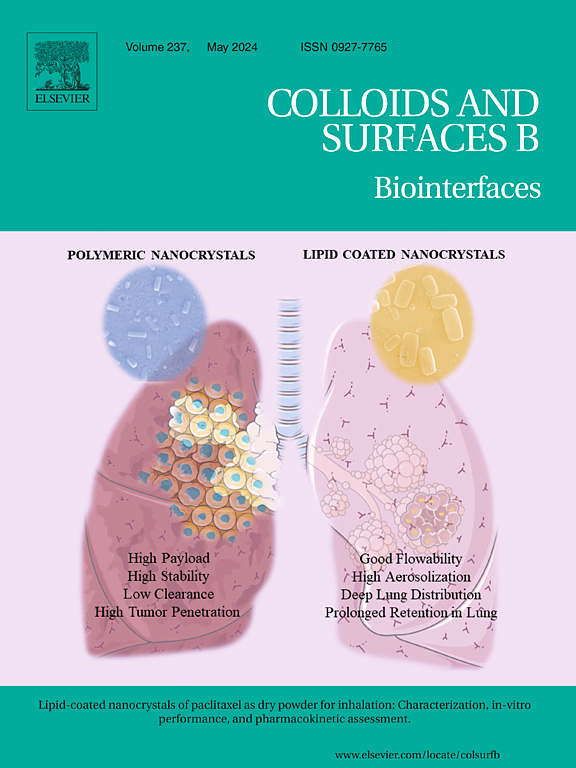
Colloids and Surfaces B: Biointerfaces
生物-材料科学:生物材料
CiteScore
11.10
自引率
3.40%
发文量
730
审稿时长
42 days
期刊介绍:
Colloids and Surfaces B: Biointerfaces is an international journal devoted to fundamental and applied research on colloid and interfacial phenomena in relation to systems of biological origin, having particular relevance to the medical, pharmaceutical, biotechnological, food and cosmetic fields.
Submissions that: (1) deal solely with biological phenomena and do not describe the physico-chemical or colloid-chemical background and/or mechanism of the phenomena, and (2) deal solely with colloid/interfacial phenomena and do not have appropriate biological content or relevance, are outside the scope of the journal and will not be considered for publication.
The journal publishes regular research papers, reviews, short communications and invited perspective articles, called BioInterface Perspectives. The BioInterface Perspective provide researchers the opportunity to review their own work, as well as provide insight into the work of others that inspired and influenced the author. Regular articles should have a maximum total length of 6,000 words. In addition, a (combined) maximum of 8 normal-sized figures and/or tables is allowed (so for instance 3 tables and 5 figures). For multiple-panel figures each set of two panels equates to one figure. Short communications should not exceed half of the above. It is required to give on the article cover page a short statistical summary of the article listing the total number of words and tables/figures.
 求助内容:
 应助结果提醒方式:


 京公网安备 11010802042870号


