
Cascade ROS-modulating Au/Cu nanozyme hydrogel with nitric oxide release ability for accelerated diabetic foot ulcer healing
IF 5.6
2区 医学
Q1 BIOPHYSICS
Colloids and Surfaces B: Biointerfaces
Pub Date : 2026-04-01
Epub Date: 2025-12-28
DOI:10.1016/j.colsurfb.2025.115403
引用次数: 0
Abstract
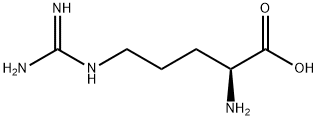
Diabetic foot ulcers (DFUs) persist due to excessive reactive oxygen species (ROS), infection, and poor angiogenesis. We engineered an injectable guar gum hydrogel (AuCu-Arg/Gel) embedding gold/copper nanozymes (Au@Cu₂(OH)₃Cl–L-Arg) to address these barriers synergistically. The nanozymes display cascade-mimicking peroxidase, superoxide dismutase, and catalase activities to rebalance ROS. In the acidic, bacteria-laden niche, peroxidase-like activity is switched on, generating hydroxyl radicals (•OH) and driving bacterial viability to < 1 %. Concurrently, the ROS-rich milieu triggers nitric oxide (NO) release from L-arginine (2.93 μM in 10 min), upregulating VEGF and neovascularization. Mild near-infrared (NIR) photothermal heating (1.5 W cm⁻², 5 min) increased the apparent POD-like initial rate 1.94-fold vs no-NIR (see Fig. 2 A). without tissue injury. In diabetic rats, AuCu-Arg/Gel plus NIR accelerated wound closure, dampened inflammation, and increased collagen deposition and vascular density. The results confirmed day-12 residual wound areas to 2.1 % (AuCu-Arg/Gel + NIR). This spatiotemporally programmable platform integrates ROS modulation, on-demand antibacterial action, NO gas therapy, and photothermal enhancement for chronic wound management.
具有一氧化氮释放能力的级联ros调节金/铜纳米酶水凝胶加速糖尿病足溃疡愈合。
糖尿病足溃疡(DFUs)由于活性氧(ROS)过多、感染和血管生成不良而持续存在。我们设计了一种可注射瓜尔胶水凝胶(AuCu-Arg/Gel),嵌入金/铜纳米酶(Au@Cu₂(OH)₃Cl-L-Arg),以协同解决这些障碍。纳米酶显示级联模拟过氧化物酶、超氧化物歧化酶和过氧化氢酶活性,以重新平衡活性氧。在充满细菌的酸性生态位中,类似过氧化物酶的活性被激活,产生羟基自由基(•OH)并驱动细菌的生存能力
本文章由计算机程序翻译,如有差异,请以英文原文为准。
求助全文
约1分钟内获得全文
求助全文
来源期刊
Colloids and Surfaces B: Biointerfaces
生物-材料科学:生物材料
CiteScore
11.10
自引率
3.40%
发文量
730
审稿时长
42 days
期刊介绍:
Colloids and Surfaces B: Biointerfaces is an international journal devoted to fundamental and applied research on colloid and interfacial phenomena in relation to systems of biological origin, having particular relevance to the medical, pharmaceutical, biotechnological, food and cosmetic fields.
Submissions that: (1) deal solely with biological phenomena and do not describe the physico-chemical or colloid-chemical background and/or mechanism of the phenomena, and (2) deal solely with colloid/interfacial phenomena and do not have appropriate biological content or relevance, are outside the scope of the journal and will not be considered for publication.
The journal publishes regular research papers, reviews, short communications and invited perspective articles, called BioInterface Perspectives. The BioInterface Perspective provide researchers the opportunity to review their own work, as well as provide insight into the work of others that inspired and influenced the author. Regular articles should have a maximum total length of 6,000 words. In addition, a (combined) maximum of 8 normal-sized figures and/or tables is allowed (so for instance 3 tables and 5 figures). For multiple-panel figures each set of two panels equates to one figure. Short communications should not exceed half of the above. It is required to give on the article cover page a short statistical summary of the article listing the total number of words and tables/figures.



 求助内容:
求助内容: 应助结果提醒方式:

 京公网安备 11010802042870号


