
Advancing schistosomiasis monitoring through optimised environmental DNA detection
IF 3.1
Q2 PARASITOLOGY
Food and Waterborne Parasitology
Pub Date : 2026-03-01
Epub Date: 2025-12-20
DOI:10.1016/j.fawpar.2025.e00313
引用次数: 0
Abstract
Schistosomiasis, caused by parasites of the genus Schistosoma, remains a major public health burden in sub-Saharan Africa, particularly where access to clean water, sanitation, and hygiene is limited. Effective control requires large-scale surveillance, but traditional methods such as malacological surveys, and stool or urine microscopy often lack sensitivity and scalability. This study evaluated environmental DNA-based detection of Schistosoma mansoni in water samples from Lake Albert and Lake Victoria, Uganda. Three filtration techniques (open membrane, Waterra eDNA capsule, and Sylphium eDNA Dual filter capsule), were compared for eDNA yield and detection sensitivity. Quantitative PCR (qPCR) targeting the cytochrome c oxidase subunit 1 (COI) mitochondrial gene was used to quantify S. mansoni eDNA, following in silico and in vitro primer optimisation. Conventional malacological surveys were conducted in parallel for validation. Statistical analyses further examined associations between eDNA yield, detectability, and environmental factors. The qPCR assay had a practical limit of detection (LOD) of 100 DNA copies per reaction and a theoretical LOD/limit of quantification of 83 copies. Schistosoma mansoni eDNA was detected in 26 % (15/58) of samples from Lake Albert and 24 % (27/113) from Lake Victoria. Waterra filters yielded the most eDNA, and Sylphium purification produced significantly greater yields than column-based extraction kits. Both filter type and eDNA yield significantly influenced S. mansoni detection: Waterra and Sylphium-single filters had the highest amplification probabilities (∼40 %), while open membrane filters performed poorly (∼3 %). eDNA yield was a strong predictor of detection, with the odds of positivity increasing by ∼0.8 % per additional nanogram of eDNA. Among positive samples, Waterra filters produced the lowest mean Ct values, indicating greater recovery of amplifiable parasite DNA. Conversely, open membrane filters were the most affect by field contamination. Our findings highlight eDNA as a sensitive and scalable tool for surveillance of schistosomiasis and other water-borne parasitic diseases. While higher-capacity filters and two-phase extraction methods maximised eDNA yield, lower-yield methods still enabled detection in high-transmission settings. A comparative analysis of sampling effort, costs and contamination and infection risks is presented. Overall, our results support the adaptability of eDNA approaches across resource contexts and underscore the need for protocol standardisation, ecological validation, and field-deployable diagnostics such as LAMP.
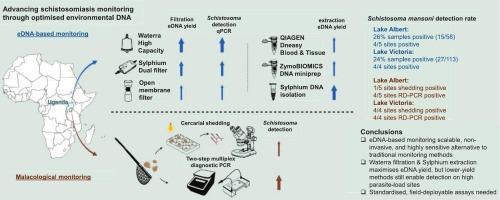
通过优化环境DNA检测推进血吸虫病监测
由血吸虫属寄生虫引起的血吸虫病仍然是撒哈拉以南非洲的一个主要公共卫生负担,特别是在获得清洁水、环境卫生和个人卫生有限的地方。有效的控制需要大规模的监测,但传统的方法,如malacology调查,粪便或尿液显微镜往往缺乏灵敏度和可扩展性。本研究对乌干达艾伯特湖和维多利亚湖水样中的曼氏血吸虫环境dna检测方法进行了评价。比较了三种过滤技术(开放膜、Waterra eDNA胶囊和sylum eDNA双重过滤胶囊)的eDNA产率和检测灵敏度。采用针对细胞色素c氧化酶亚基1 (COI)线粒体基因的定量PCR (qPCR)方法,对mansoni S. mansoni的eDNA进行了定量分析,并进行了体外引物优化。为了验证,平行进行了常规的线虫学调查。统计分析进一步检验了eDNA产率、可检测性和环境因素之间的关系。qPCR检测的实际检测限(LOD)为每个反应100个DNA拷贝,理论定量限为83个拷贝。艾伯特湖和维多利亚湖样品中分别检出26%(15/58)和24%(27/113)的曼氏血吸虫eDNA。Waterra过滤器产生最多的eDNA,而sylium纯化产生的产量明显高于柱式提取试剂盒。滤器类型和eDNA产率都显著影响mansoni的检测:Waterra和sylm -single滤器的扩增概率最高(~ 40%),而开放式膜滤器的扩增概率较低(~ 3%)。eDNA产率是检测的一个强有力的预测指标,每增加一纳克eDNA,阳性几率增加约0.8%。在阳性样本中,Waterra过滤器产生的平均Ct值最低,表明可扩增寄生虫DNA的回收率更高。相反,开放式膜过滤器受现场污染的影响最大。我们的发现强调了eDNA作为血吸虫病和其他水传播寄生虫病监测的敏感和可扩展的工具。虽然高容量过滤器和两相提取方法可以最大限度地提高eDNA产量,但低产量方法仍然可以在高传输环境下进行检测。提出了取样努力、成本、污染和感染风险的比较分析。总的来说,我们的研究结果支持了eDNA方法在资源环境中的适应性,并强调了协议标准化、生态验证和现场可部署诊断(如LAMP)的必要性。
本文章由计算机程序翻译,如有差异,请以英文原文为准。
求助全文
约1分钟内获得全文
求助全文
来源期刊

Food and Waterborne Parasitology
Immunology and Microbiology-Parasitology
CiteScore
5.10
自引率
4.00%
发文量
38
审稿时长
13 weeks
期刊介绍:
Food and Waterborne Parasitology publishes high quality papers containing original research findings, investigative reports, and scientific proceedings on parasites which are transmitted to humans via the consumption of food or water. The relevant parasites include protozoa, nematodes, cestodes and trematodes which are transmitted by food or water and capable of infecting humans. Pertinent food includes products of animal or plant origin which are domestic or wild, and consumed by humans. Animals and plants from both terrestrial and aquatic sources are included, as well as studies related to potable and other types of water which serve to harbor, perpetuate or disseminate food and waterborne parasites. Studies dealing with prevalence, transmission, epidemiology, risk assessment and mitigation, including control measures and test methodologies for parasites in food and water are of particular interest. Evidence of the emergence of such parasites and interactions among domestic animals, wildlife and humans are of interest. The impact of parasites on the health and welfare of humans is viewed as very important and within scope of the journal. Manuscripts with scientifically generated information on associations between food and waterborne parasitic diseases and lifestyle, culture and economies are also welcome. Studies involving animal experiments must meet the International Guiding Principles for Biomedical Research Involving Animals as issued by the Council for International Organizations of Medical Sciences.
 求助内容:
求助内容: 应助结果提醒方式:

 京公网安备 11010802042870号


