
Investigating the capability of CO2 absorption via arginine and histidine amino acid salt solutions at high pressures
IF 5.5
0 ENERGY & FUELS
Gas Science and Engineering
Pub Date : 2026-02-01
Epub Date: 2025-12-16
DOI:10.1016/j.jgsce.2025.205824
引用次数: 0
Abstract
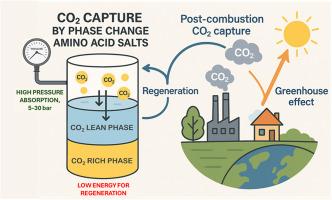
As global energy consumption rises, CO2 emissions have become a critical concern, prompting extensive research into capture technologies. Conventional aqueous amine solvents face challenges due to the high energy required for regeneration, limiting large-scale applications. To overcome this, novel phase-change solvents, particularly water–amino acid systems, have been proposed to reduce regeneration energy. This study investigated the CO2 absorption performance of amino acid salts synthesized from arginine and histidine with potassium hydroxide in aqueous N,N-dimethylformamide (DMF). CO2 absorption capacity was measured under pressures between 5 and 30 bar, reflecting operational conditions of gas sweetening units, and at varying DMF concentrations. Results showed that higher pressure and DMF content enhanced absorption capacity, attributed to simultaneous increases in physical and chemical absorption. Phase analysis using 13C NMR revealed CO2-related carbon bonds in the solid phase but not in the upper liquid phase, indicating that the liquid phase can be directly recovered without regeneration. Since most CO2 resides in the solid phase, regenerating only this fraction significantly reduces energy demand. Among the tested solvents, arginine-based solutions displayed the highest absorption capacity, while histidine-based solutions showed the lowest, a trend linked to differences in amine group numbers. Absorption stability was assessed over three absorption–regeneration cycles. Across all amino acid salts, capacity declined only 6–8 % after three cycles, confirming their potential for efficient and energy-saving CO2 capture.
研究了精氨酸和组氨酸氨基酸盐溶液在高压下吸收CO2的能力
随着全球能源消耗的增加,二氧化碳排放已成为一个关键问题,促使对捕集技术的广泛研究。传统的水胺溶剂由于再生所需的高能量而面临挑战,限制了大规模应用。为了克服这个问题,人们提出了新的相变溶剂,特别是水-氨基酸体系,以减少再生能量。研究了精氨酸和组氨酸与氢氧化钾合成的氨基酸盐在N,N-二甲基甲酰胺(DMF)水溶液中的CO2吸收性能。在5到30 bar的压力下测量二氧化碳吸收能力,反映了气体脱硫装置的操作条件,以及不同的DMF浓度。结果表明,较高的压力和DMF含量增加了吸收能力,这是由于物理和化学吸收同时增加。13C NMR物相分析显示co2相关的碳键存在于固相而不在液相上部,表明液相可以直接回收而不需要再生。由于大多数二氧化碳存在于固相中,因此仅再生这一部分即可显著降低能源需求。在测试的溶剂中,精氨酸溶液的吸收能力最高,而组氨酸溶液的吸收能力最低,这一趋势与胺基数的差异有关。通过三个吸收-再生循环评估吸收稳定性。在所有氨基酸盐中,经过三个循环后,容量仅下降了6 - 8%,证实了它们有效和节能CO2捕获的潜力。
本文章由计算机程序翻译,如有差异,请以英文原文为准。
求助全文
约1分钟内获得全文
求助全文

 求助内容:
求助内容: 应助结果提醒方式:

 京公网安备 11010802042870号


