
Is the expansion of oxygen minimum zones impacting the health of modern ocean basins? A review
Geosystems and Geoenvironment
Pub Date : 2026-05-01
Epub Date: 2025-11-28
DOI:10.1016/j.geogeo.2025.100483
引用次数: 0
Abstract
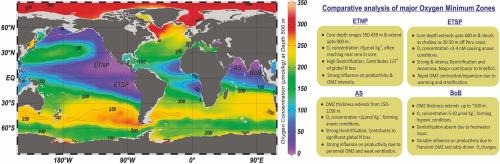
Oxygen minimum zones (OMZ) are represented by sharply depleted oxygen concentrations in the modern ocean basins. The expansion of these zones is documented since 1960. They have been expanding globally in the world's oceans with profound implications for marine ecosystems and biogeochemical cycles. Under this review, we synthesize and integrate the current knowledge on the factors, dynamics and consequences of OMZ expansion in the modern ocean basins. We have explored the interplay of physical, chemical and biological factors conducive to OMZ formation and intensification, highlighting the role of ocean circulation patterns, nutrient enrichment from anthropogenic activities and augmenting influence of climate change. The impact of OMZs on marine ecology are explored with the focus on physiological stress on marine organisms, habitat compression, shifts in community structure and potential loss of biodiversity. We have also investigated their contribution to greenhouse gas emissions and the biogeochemical significance of OMZs, particularly in the context of nitrogen and other nutrient cycles. Further, this work emphasizes on the complex feedback loops between OMZ expansion and climate change underscoring the urgent need for mitigation and adaptation strategies. At the outset, the study discusses the future research scopes and management approaches crucial for addressing the challenges posed by expanding OMZs thereby ensuring the health and sustainability of modern ocean basins.
氧最低带的扩大是否影响了现代海洋盆地的健康?回顾
氧最低带(OMZ)是指现代海洋盆地中氧浓度急剧下降。自1960年以来,这些区域的扩张被记录在案。它们在全球海洋中不断扩大,对海洋生态系统和生物地球化学循环产生深远影响。在此综述下,我们综合和整合了目前关于现代大洋盆地OMZ扩张的因素、动力和后果的知识。我们探索了有利于OMZ形成和强化的物理、化学和生物因素的相互作用,强调了海洋环流模式、人为活动引起的营养物质富集和气候变化的增强影响的作用。从海洋生物生理应激、生境压缩、群落结构变化和生物多样性潜在损失等方面探讨了海洋生物多样性对海洋生态的影响。我们还研究了它们对温室气体排放的贡献以及omz的生物地球化学意义,特别是在氮和其他营养循环的背景下。此外,这项工作强调了OMZ扩展与气候变化之间复杂的反馈循环,强调了迫切需要制定缓解和适应战略。首先,该研究讨论了未来的研究范围和管理方法,这些方法对于应对扩大海洋保护区从而确保现代海洋盆地的健康和可持续性所带来的挑战至关重要。
本文章由计算机程序翻译,如有差异,请以英文原文为准。
求助全文
约1分钟内获得全文
求助全文

 求助内容:
求助内容: 应助结果提醒方式:

 京公网安备 11010802042870号


