
Charge compensation boosts luminous efficiency to achieve ultra-low doped optical thermometer CaWO4: Tb3+ phosphors
IF 3.6
3区 物理与天体物理
Q2 OPTICS
Journal of Luminescence
Pub Date : 2026-03-01
Epub Date: 2025-12-24
DOI:10.1016/j.jlumin.2025.121725
引用次数: 0
Abstract
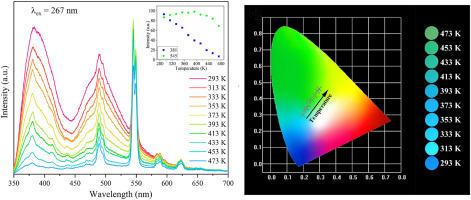
Optical temperature measurement is crucial in various fields, driving the development of fluorescent thermometer materials that are highly sensitive, environmentally friendly, and cost-effective. This paper investigates a temperature sensitive phosphor material based on CaWO4: Tb3+, which achieves ultra-low doping concentration temperature measurement by co-doping Li+ as a charge compensator. A series of CaWO4: Tb3+ phosphors were synthesized using the high-temperature solid-phase method, and their structures and luminescent properties were studied. XRD Rietveld refinement shows that the introduction of Li+ leads to a slight reduction in lattice volume, effectively alleviating the lattice distortion caused by Tb3+ doping. The photoluminescence spectra show that the introduction of Li+ significantly enhances the luminescence intensity of Tb3+, as Li+ reduces lattice defects and improves luminous efficiency. More importantly, by optimizing the doping concentration, CaWO4: 0.0005Tb3+, 0.0005Li+ phosphor was successfully prepared, and high-sensitivity temperature measurement was achieved. The phosphors exhibits excellent fluorescence intensity ratio and chromaticity variation in the temperature range of 293–473 K, with absolute and relative sensitivity reaching 0.21 K−1 at 473 K and 2.2 % K−1 at 473 K, respectively, making it an ideal material for ultra-low doping concentration optical temperature measurement.
电荷补偿提高了发光效率,实现了超低掺杂光学温度计CaWO4: Tb3+荧光粉
光学温度测量在各个领域都是至关重要的,推动了高灵敏度、环保和成本效益的荧光温度计材料的发展。本文研究了一种基于CaWO4: Tb3+的温度敏感荧光粉材料,该材料通过共掺杂Li+作为电荷补偿器实现了超低掺杂浓度温度的测量。采用高温固相法合成了一系列CaWO4: Tb3+荧光粉,并对其结构和发光性能进行了研究。XRD Rietveld细化表明,Li+的引入使晶格体积略有减小,有效缓解了Tb3+掺杂引起的晶格畸变。光致发光光谱表明,Li+的引入显著增强了Tb3+的发光强度,减少了晶格缺陷,提高了发光效率。更重要的是,通过优化掺杂浓度,成功制备了CaWO4: 0.0005Tb3+, 0.0005Li+荧光粉,并实现了高灵敏度的测温。在293 ~ 473 K温度范围内,荧光强度比和色度变化良好,绝对灵敏度和相对灵敏度分别达到0.21 K−1和2.2% K−1,是超低掺杂浓度光学测温的理想材料。
本文章由计算机程序翻译,如有差异,请以英文原文为准。
求助全文
约1分钟内获得全文
求助全文
来源期刊
Journal of Luminescence
物理-光学
CiteScore
6.70
自引率
13.90%
发文量
850
审稿时长
3.8 months
期刊介绍:
The purpose of the Journal of Luminescence is to provide a means of communication between scientists in different disciplines who share a common interest in the electronic excited states of molecular, ionic and covalent systems, whether crystalline, amorphous, or liquid.
We invite original papers and reviews on such subjects as: exciton and polariton dynamics, dynamics of localized excited states, energy and charge transport in ordered and disordered systems, radiative and non-radiative recombination, relaxation processes, vibronic interactions in electronic excited states, photochemistry in condensed systems, excited state resonance, double resonance, spin dynamics, selective excitation spectroscopy, hole burning, coherent processes in excited states, (e.g. coherent optical transients, photon echoes, transient gratings), multiphoton processes, optical bistability, photochromism, and new techniques for the study of excited states. This list is not intended to be exhaustive. Papers in the traditional areas of optical spectroscopy (absorption, MCD, luminescence, Raman scattering) are welcome. Papers on applications (phosphors, scintillators, electro- and cathodo-luminescence, radiography, bioimaging, solar energy, energy conversion, etc.) are also welcome if they present results of scientific, rather than only technological interest. However, papers containing purely theoretical results, not related to phenomena in the excited states, as well as papers using luminescence spectroscopy to perform routine analytical chemistry or biochemistry procedures, are outside the scope of the journal. Some exceptions will be possible at the discretion of the editors.
 求助内容:
求助内容: 应助结果提醒方式:

 京公网安备 11010802042870号


