
Effectiveness of bio-additive in goatskin preservation and tannery wastewater treatment
Q1 Environmental Science
Bioresource Technology Reports
Pub Date : 2026-02-01
Epub Date: 2025-12-17
DOI:10.1016/j.biteb.2025.102493
引用次数: 0
Abstract
Typical soaking in leather manufacturing discharges salt from preserved raw stock, which increases Total Dissolved Solids (TDS) and chloride (Cl−) levels in tannery wastewater. In this study, bio-additive (bagasse powder) was merged with lower common salt to preserve raw goatskin and monitored for 45 days. Moisture percentage, shrinkage temperature, viable bacteria count, total leachable nitrogen, and collagen content were examined on the 0th, 1st, 3rd, 6th, 10th, 14th, 20th, 25th, 30th, 35th, 40th, and 45th days. GC–MS and FTIR analysis revealed the presence of antibacterial, antifungal, and antioxidant agents. The antimicrobial effect of bagasse revealed its effectiveness as a curing agent. In soaking wastewater, TDS and Cl−, Fe, and Ni content were significantly reduced by 93.91 %, 98.07 %, 64.9 %, and 52.55 %, respectively. The physicomechanical properties of preserved leather met standard requirements. SEM images depict a similar cross-sectional orientation. Hence, a bio-additive, lower-salt curing agent can be more environmentally friendly compared to salt-based preservation.
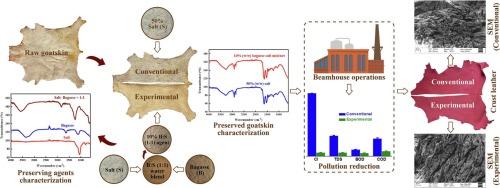
生物添加剂在山羊皮保鲜及制革废水处理中的效果
皮革制造中典型的浸泡会从保存的原料中排放盐,这会增加制革厂废水中的总溶解固体(TDS)和氯化物(Cl−)水平。本研究将生物添加剂(甘蔗渣粉)与低盐混合保存山羊皮,并进行了45天的监测。在第0天、第1天、第3天、第6天、第10天、第14天、第20天、第25天、第30天、第35天、第40天、第45天检测含水率、收缩温度、活菌数、可浸出总氮和胶原蛋白含量。GC-MS和FTIR分析显示含有抗菌、抗真菌和抗氧化剂。甘蔗渣的抗菌作用显示了它作为固化剂的有效性。在浸泡废水中,TDS和Cl−、Fe、Ni含量分别显著降低93.91%、98.07%、64.9%和52.55%。保存皮革的物理力学性能符合标准要求。扫描电镜图像描绘了类似的横截面方向。因此,与盐基保存相比,生物添加剂、低盐固化剂可以更环保。
本文章由计算机程序翻译,如有差异,请以英文原文为准。
求助全文
约1分钟内获得全文
求助全文
来源期刊

Bioresource Technology Reports
Environmental Science-Environmental Engineering
CiteScore
7.20
自引率
0.00%
发文量
390
审稿时长
28 days
 求助内容:
求助内容: 应助结果提醒方式:

 京公网安备 11010802042870号


