
Metagenomic and cytotoxicity insights into the migration behavior and pathogenic potential of multi-medium microorganisms in a wastewater treatment plant
IF 12.4
1区 环境科学与生态学
Q1 ENGINEERING, ENVIRONMENTAL
引用次数: 0
Abstract
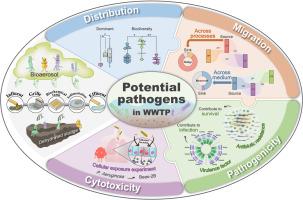
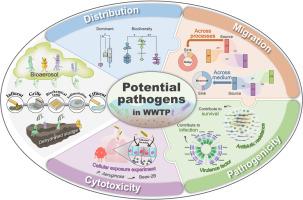
As important interphases between the human society and natural water environments, wastewater treatment plants (WWTPs) accumulate a variety of human activity-related microorganisms. The characteristics of potential pathogenic microorganisms associated with WWTPs have gradually become a research hotspot. In this study, the distribution characteristics and migration patterns of potential pathogenic genera in different processes, media and seasons were investigated via the metagenomic analysis of samples regularly collected at a typical WWTP in North China. The results obtained 112 pathogenic bacteria and 33 pathogenic fungi in the wastewater, sludge, and bioaerosol samples. Resistance mechanisms were dominated by antibiotic efflux with proportion of 62.63–63.53%. Functional genes encoding offensive virulence factors (VFs) including adherence, secretion system, toxin, invasion, and actin-based motility were the most common category in all the WWTP samples. Network analysis revealed the presence of core antibiotic resistance genes (including mtrA, bcrA, oleC, MexB, PmrE) and core VFs (including Type IV pili (VF0082), HIS-I (VF0334), LOS (CFV494), and Alginate (VF0091)) on multiple microbes, which increased the survival rate of microorganisms even under adverse conditions and enhanced the invasion potential to cause diseases. Additionally, cell exposure experiments confirmed the ability of Pseudomonas aeruginosa to induce inflammatory responses in Beas-2B cells. Based on these findings, which offer the insight of a comprehensive understanding of the potential pathogenicity of microorganisms in WWTPs, it is recommended to improve regulation of effluents from WWTPs a nd the implementation of measures to reduce the risk posed by airborne pathogenic microorganisms.
宏基因组和细胞毒性对污水处理厂中多介质微生物迁移行为和致病潜力的见解
污水处理厂作为人类社会与自然水环境的重要界面,积累了多种与人类活动有关的微生物。与污水处理厂相关的潜在病原微生物的特性逐渐成为研究热点。本研究通过对华北某典型污水处理厂定期采集的样本进行宏基因组分析,探讨了潜在病原属在不同工艺、培养基和季节的分布特征和迁移模式。结果在废水、污泥和生物气溶胶样品中检出致病菌112种,致病菌33种。耐药机制以抗生素外排为主,占62.63 ~ 63.53%。编码攻击性毒力因子(VFs)的功能基因,包括粘附性、分泌系统、毒素、侵袭性和基于肌动蛋白的运动性,是所有WWTP样本中最常见的类别。网络分析发现,核心耐药基因(包括mtrA、bcrA、oleC、MexB、PmrE)和核心VFs(包括IV型菌毛(VF0082)、HIS-I (VF0334)、LOS (CFV494)、藻酸盐(VF0091))存在于多种微生物上,即使在不利条件下也提高了微生物的存活率,增强了入侵致病的潜力。此外,细胞暴露实验证实了铜绿假单胞菌在Beas-2B细胞中诱导炎症反应的能力。这些发现为全面了解污水处理厂中微生物的潜在致病性提供了见解,建议加强对污水处理厂出水的监管,并采取措施降低空气传播致病性微生物带来的风险。
本文章由计算机程序翻译,如有差异,请以英文原文为准。
求助全文
约1分钟内获得全文
求助全文
来源期刊
Water Research
环境科学-工程:环境
CiteScore
20.80
自引率
9.40%
发文量
1307
审稿时长
38 days
期刊介绍:
Water Research, along with its open access companion journal Water Research X, serves as a platform for publishing original research papers covering various aspects of the science and technology related to the anthropogenic water cycle, water quality, and its management worldwide. The audience targeted by the journal comprises biologists, chemical engineers, chemists, civil engineers, environmental engineers, limnologists, and microbiologists. The scope of the journal include:
•Treatment processes for water and wastewaters (municipal, agricultural, industrial, and on-site treatment), including resource recovery and residuals management;
•Urban hydrology including sewer systems, stormwater management, and green infrastructure;
•Drinking water treatment and distribution;
•Potable and non-potable water reuse;
•Sanitation, public health, and risk assessment;
•Anaerobic digestion, solid and hazardous waste management, including source characterization and the effects and control of leachates and gaseous emissions;
•Contaminants (chemical, microbial, anthropogenic particles such as nanoparticles or microplastics) and related water quality sensing, monitoring, fate, and assessment;
•Anthropogenic impacts on inland, tidal, coastal and urban waters, focusing on surface and ground waters, and point and non-point sources of pollution;
•Environmental restoration, linked to surface water, groundwater and groundwater remediation;
•Analysis of the interfaces between sediments and water, and between water and atmosphere, focusing specifically on anthropogenic impacts;
•Mathematical modelling, systems analysis, machine learning, and beneficial use of big data related to the anthropogenic water cycle;
•Socio-economic, policy, and regulations studies.
 求助内容:
求助内容: 应助结果提醒方式:

 京公网安备 11010802042870号


