
Molecular docking and GC-MS profiling of seaweed bioactive components: Unraveling antibacterial and antibiofilm activity in carbohydrate-rich extracts
IF 3.6
Bioactive Carbohydrates and Dietary Fibre
Pub Date : 2026-05-01
Epub Date: 2025-12-11
DOI:10.1016/j.bcdf.2025.100516
引用次数: 0
Abstract
In this study, the antibacterial and antibiofilm activities of ethanolic and methanolic extracts of seaweed species, Corallina officinalis, Padina pavonica, and Caulerpa lentillifera, were systematically evaluated. Eleven clinically resistant bacterial strains, representing both Gram-positive and Gram-negative species, were tested to assess the broad-spectrum efficacy of the extracts. Phytochemical characterization using GC–MS and FTIR analyses revealed several bioactive compounds that may be responsible for the observed antimicrobial effects, including significant inhibition of biofilm formation. Among the tested samples, the methanolic extract of P. pavonica exhibited the most potent antibacterial activity, with a minimum inhibitory concentration (MIC) of 70 mg/mL against Streptococcus pyogenes and a minimum bactericidal concentration (MBC) of 160 mg/mL against Bacillus velezensis. These findings suggest that marine algae represent a valuable source of novel antimicrobial agents with potential pharmaceutical and medicinal applications. Furthermore, molecular docking results provide additional insight into the possible mechanisms of action, supporting the development of seaweed-derived compounds as promising candidates for future therapeutic interventions.
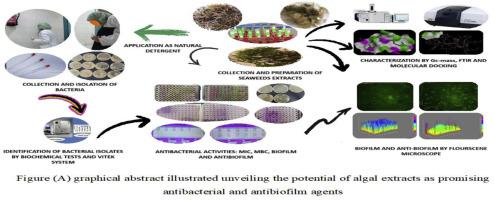
海藻生物活性成分的分子对接和GC-MS分析:揭示富含碳水化合物提取物的抗菌和抗生物膜活性
本研究系统评价了海苔(Corallina officinalis)、帕迪纳(Padina pavonica)和小扁豆(Caulerpa lentillifera)的乙醇和甲醇提取物的抗菌和抗膜活性。11种临床耐药菌株,分别代表革兰氏阳性和革兰氏阴性菌株,进行了测试,以评估提取物的广谱疗效。利用GC-MS和FTIR分析的植物化学特征揭示了几种生物活性化合物可能负责观察到的抗菌作用,包括显著抑制生物膜的形成。其中,金银花甲醇提取物的抑菌活性最强,对化脓性链球菌的最低抑菌浓度为70 mg/mL,对velezensis芽孢杆菌的最低杀菌浓度为160 mg/mL。这些发现表明,海藻是具有潜在制药和医疗应用价值的新型抗菌剂的宝贵来源。此外,分子对接结果为可能的作用机制提供了额外的见解,支持了海藻衍生化合物作为未来治疗干预措施的有希望的候选者的发展。
本文章由计算机程序翻译,如有差异,请以英文原文为准。
求助全文
约1分钟内获得全文
求助全文
来源期刊
Bioactive Carbohydrates and Dietary Fibre
Agricultural and Biological Sciences-Food Science
CiteScore
6.00
自引率
0.00%
发文量
38
期刊介绍:
 求助内容:
求助内容: 应助结果提醒方式:

 京公网安备 11010802042870号


