
Biogenic synthesis of silver nanoparticles using cell-free extracts of thermotolerant bacteria: Antioxidant and antibacterial properties
IF 2.5
4区 生物学
Q3 BIOTECHNOLOGY & APPLIED MICROBIOLOGY
Electronic Journal of Biotechnology
Pub Date : 2026-01-01
Epub Date: 2025-11-23
DOI:10.1016/j.ejbt.2025.100698
引用次数: 0
Abstract
Background
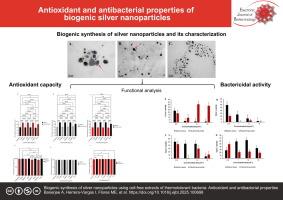
Eco-friendly synthesis of silver nanoparticles (AgNPs) using biological systems offers a sustainable alternative to conventional physicochemical methods. In this study, we employed cell-free extracts from three thermotolerant bacterial strains, Bacillus haynesii CamB6, Pseudomonas alcaligenes Med1, and Staphylococcus sp. BSP3 for the biosynthesis of AgNPs, aiming to explore their antioxidant and antibacterial properties.
Results
The biosynthesized AgNPs were characterized through UV–Vis spectroscopy, FTIR, TEM, and DLS analyses, which revealed distinct physicochemical profiles among the nanoparticles. Notably, AgNP2 and AgNP3 exhibited smaller particle sizes, enhanced colloidal stability, and superior biological activities compared to AgNP1. Antioxidant evaluation demonstrated significant free radical scavenging potential, with AgNP2 showing the highest DPPH activity (65.18% at 5 mg mL−1). Antibacterial activity, assessed via agar well diffusion and cell viability assays against Bacillus cereus and Pseudomonas putida revealed that AgNP2 achieved the lowest bacterial viability (0.74%) for P. putida at 1 mg mL−1 concentration.
Conclusions
The study highlights the potential of biosynthesized AgNPs, particularly AgNP2, as sustainable for biomedical applications. Their antioxidant and antibacterial activities suggest valuable applications in managing oxidative stress and combating antimicrobial resistance.
How to cite: Banerjee A, Herrera-Vargas I, Flores ME, et al. Biogenic synthesis of silver nanoparticles using cell-free extracts of thermotolerant bacteria: Antioxidant and antibacterial properties. Electron J Biotechnol 2026:79. https://doi.org/10.1016/j.ejbt.2025.100698.
利用耐热细菌的无细胞提取物生物合成纳米银:抗氧化和抗菌性能
利用生物系统合成银纳米颗粒(AgNPs)为传统的物理化学方法提供了一种可持续的选择。本研究利用haynesii CamB6、Pseudomonas alcaligenes Med1和Staphylococcus sp. BSP3三种耐热菌株的无细胞提取物进行AgNPs的生物合成,探讨AgNPs的抗氧化和抗菌性能。结果通过紫外可见光谱(UV-Vis)、红外光谱(FTIR)、透射电镜(TEM)和能谱分析(DLS)对合成的AgNPs进行了表征。值得注意的是,与AgNP1相比,AgNP2和AgNP3具有更小的粒径、更强的胶体稳定性和更优越的生物活性。抗氧化评价显示出显著的自由基清除潜力,AgNP2显示出最高的DPPH活性(在5 mg mL−1时为65.18%)。通过琼脂孔扩散和对蜡样芽孢杆菌和恶臭假单胞菌的抑菌活性测定,AgNP2在1 mg mL−1浓度下对恶臭假单胞菌的抑菌活性最低(0.74%)。该研究强调了生物合成AgNPs,特别是AgNP2在生物医学应用方面的可持续潜力。它们的抗氧化和抗菌活性在处理氧化应激和对抗抗菌素耐药性方面具有重要的应用价值。如何引用:Banerjee A, Herrera-Vargas I, Flores ME等。利用耐热细菌的无细胞提取物生物合成纳米银:抗氧化和抗菌性能。电子学报[J] . 2026(6): 779。https://doi.org/10.1016/j.ejbt.2025.100698。
本文章由计算机程序翻译,如有差异,请以英文原文为准。
求助全文
约1分钟内获得全文
求助全文
来源期刊
Electronic Journal of Biotechnology
工程技术-生物工程与应用微生物
CiteScore
5.60
自引率
0.00%
发文量
50
审稿时长
2 months
期刊介绍:
Electronic Journal of Biotechnology is an international scientific electronic journal, which publishes papers from all areas related to Biotechnology. It covers from molecular biology and the chemistry of biological processes to aquatic and earth environmental aspects, computational applications, policy and ethical issues directly related to Biotechnology.
The journal provides an effective way to publish research and review articles and short communications, video material, animation sequences and 3D are also accepted to support and enhance articles. The articles will be examined by a scientific committee and anonymous evaluators and published every two months in HTML and PDF formats (January 15th , March 15th, May 15th, July 15th, September 15th, November 15th).
The following areas are covered in the Journal:
• Animal Biotechnology
• Biofilms
• Bioinformatics
• Biomedicine
• Biopolicies of International Cooperation
• Biosafety
• Biotechnology Industry
• Biotechnology of Human Disorders
• Chemical Engineering
• Environmental Biotechnology
• Food Biotechnology
• Marine Biotechnology
• Microbial Biotechnology
• Molecular Biology and Genetics
•Nanobiotechnology
• Omics
• Plant Biotechnology
• Process Biotechnology
• Process Chemistry and Technology
• Tissue Engineering
 求助内容:
求助内容: 应助结果提醒方式:

 京公网安备 11010802042870号


