
Preliminary characterization of wind turbine blade waste by solvolysis, microwave-assisted extraction, and comprehensive two-dimensional gas chromatography coupled with time-of-flight mass spectrometry

IF 3.2
Journal of chromatography open Pub Date : 2026-05-01 Epub Date: 2025-12-09 DOI:10.1016/j.jcoa.2025.100301
Giulia Giacoppo , Charlotte Mase , Marco Piparo , Pierre Giusti , Caroline Mangote , Callum Branfoot , Luisa Pasti , Flavio Antonio Franchina , Marco Beccaria
{"title":"Preliminary characterization of wind turbine blade waste by solvolysis, microwave-assisted extraction, and comprehensive two-dimensional gas chromatography coupled with time-of-flight mass spectrometry","authors":"Giulia Giacoppo ,&nbsp;Charlotte Mase ,&nbsp;Marco Piparo ,&nbsp;Pierre Giusti ,&nbsp;Caroline Mangote ,&nbsp;Callum Branfoot ,&nbsp;Luisa Pasti ,&nbsp;Flavio Antonio Franchina ,&nbsp;Marco Beccaria","doi":"10.1016/j.jcoa.2025.100301","DOIUrl":null,"url":null,"abstract":"<div><div>The growth of renewable energy infrastructure highlights the urgent need for sustainable solutions to manage its end-of-life materials, including wind turbine blades (WTBs). These composite materials present significant challenges in recycling due to their complex heterogeneous structure and varied chemical composition. To depolymerize WTB composite materials, a solvolysis process was applied. The resulting chemical products underwent microwave-assisted extraction (MAE), using a mixture of <em>n-</em>hexane and methanol (10:3, v:v). The non-polar organic phase was subjected to analysis using comprehensive two-dimensional gas chromatography–time-of-flight mass spectrometry (GC×GC-ToFMS). On the basis of electron impact ionization mass spectral matching at 70 eV, linear retention index data, and molecular distribution on the two-dimensional space, &gt;110 compounds were putatively identified, mainly composed by aromatic and heteroatom-containing species. To the best of our knowledge, this is the first time that the molecular composition of WTBs has been investigated by MAE-GC×GC–MS.</div></div>","PeriodicalId":93576,"journal":{"name":"Journal of chromatography open","volume":"9 ","pages":"Article 100301"},"PeriodicalIF":3.2000,"publicationDate":"2026-05-01","publicationTypes":"Journal Article","fieldsOfStudy":null,"isOpenAccess":false,"openAccessPdf":"","citationCount":"0","resultStr":null,"platform":"Semanticscholar","paperid":null,"PeriodicalName":"Journal of chromatography open","FirstCategoryId":"1085","ListUrlMain":"https://www.sciencedirect.com/science/article/pii/S2772391725001008","RegionNum":0,"RegionCategory":null,"ArticlePicture":[],"TitleCN":null,"AbstractTextCN":null,"PMCID":null,"EPubDate":"2025/12/9 0:00:00","PubModel":"Epub","JCR":"","JCRName":"","Score":null,"Total":0}
引用次数: 0

Abstract

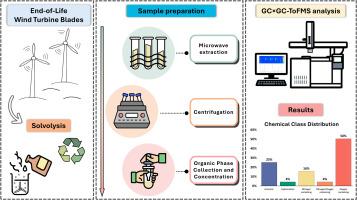
The growth of renewable energy infrastructure highlights the urgent need for sustainable solutions to manage its end-of-life materials, including wind turbine blades (WTBs). These composite materials present significant challenges in recycling due to their complex heterogeneous structure and varied chemical composition. To depolymerize WTB composite materials, a solvolysis process was applied. The resulting chemical products underwent microwave-assisted extraction (MAE), using a mixture of n-hexane and methanol (10:3, v:v). The non-polar organic phase was subjected to analysis using comprehensive two-dimensional gas chromatography–time-of-flight mass spectrometry (GC×GC-ToFMS). On the basis of electron impact ionization mass spectral matching at 70 eV, linear retention index data, and molecular distribution on the two-dimensional space, >110 compounds were putatively identified, mainly composed by aromatic and heteroatom-containing species. To the best of our knowledge, this is the first time that the molecular composition of WTBs has been investigated by MAE-GC×GC–MS.
Abstract Image

通过溶剂溶解、微波辅助萃取和综合二维气相色谱-飞行时间质谱法对风力涡轮机叶片废弃物进行初步表征
可再生能源基础设施的发展凸显了对可持续解决方案的迫切需求,以管理其报废材料,包括风力涡轮机叶片(WTBs)。这些复合材料由于其复杂的非均相结构和多变的化学成分,在回收方面面临着重大挑战。采用溶剂解聚法对WTB复合材料进行解聚。用正己烷和甲醇(10:3,v:v)的混合物进行微波辅助萃取(MAE)。非极性有机相采用综合二维气相色谱-飞行时间质谱法(GC×GC-ToFMS)进行分析。根据70 eV下的电子碰撞电离质谱匹配、线性保留指数数据和二维空间上的分子分布,推定鉴定出110种化合物,主要由芳香族和杂原子组成。据我们所知,这是第一次通过MAE-GC×GC-MS研究wtb的分子组成。
本文章由计算机程序翻译,如有差异,请以英文原文为准。
求助全文
约1分钟内获得全文 求助全文
来源期刊
Journal of chromatography open
Journal of chromatography open Analytical Chemistry
CiteScore
2.50
自引率
0.00%
发文量
0
审稿时长
50 days

×
引用
GB/T 7714-2015
复制
MLA
复制
APA
复制
导出至
BibTeX EndNote RefMan NoteFirst NoteExpress
×
提示
您的信息不完整,为了账户安全,请先补充。
现在去补充
×
提示
您因"违规操作"
具体请查看互助需知
我知道了
×
提示
确定
请完成安全验证×
copy
已复制链接
快去分享给好友吧!
我知道了
右上角分享
点击右上角分享
0
联系我们:info@booksci.cn Book学术提供免费学术资源搜索服务,方便国内外学者检索中英文文献。致力于提供最便捷和优质的服务体验。 Copyright © 2023 布克学术 All rights reserved.
京ICP备2023020795号-1
ghs 京公网安备 11010802042870号
Book学术文献互助
Book学术文献互助群
群 号:604180095
Book学术官方微信
小红书


