
Eco-friendly dyeing of polyester with natural colorants extracted from jackfruit wood shavings: Insights into fabric performance, chromatic parameters, and flame retardancy

Hybrid Advances Pub Date : 2026-03-01 Epub Date: 2025-12-17 DOI:10.1016/j.hybadv.2025.100596
Md. Abdullah Al Mamun, Md Khalilur Rahman, Md. Tareque Rahaman, Arnob Dhar Pranta
{"title":"Eco-friendly dyeing of polyester with natural colorants extracted from jackfruit wood shavings: Insights into fabric performance, chromatic parameters, and flame retardancy","authors":"Md. Abdullah Al Mamun,&nbsp;Md Khalilur Rahman,&nbsp;Md. Tareque Rahaman,&nbsp;Arnob Dhar Pranta","doi":"10.1016/j.hybadv.2025.100596","DOIUrl":null,"url":null,"abstract":"<div><div>Growing environmental concerns associated with petroleum-based synthetic dyes have intensified the demand of sustainable natural colorants for textile applications. This research evaluates jackfruit (<em>Artocarpus heterophyllus</em>) wood shavings, an underutilized agricultural byproduct, as a renewable dye source for polyester dyeing, including its dual significance in waste valorization and environmentally sustainable processing. The colorant was extracted through alkaline extraction at 100 °C for 60 min, and polyester fabrics were subsequently dyed under systematically varied dyeing process parameters, including time (20–120 min), temperature (80–160 °C), and pH (4, 7, 9). FTIR spectroscopy revealed the presence of characteristic polyester bands alongside additional absorption features, indicative of interactions between dye constituents and the fiber surface. Dyeing induced measurable modifications in fabric performance, including reduced air permeability attributable to surface deposition and limited moisture transfer as evidenced by near-zero bottom-surface wetting and a negative one-way transport index. Chromatic assessment demonstrated that dyeing parameters significantly influenced chromatic parameters, with maximum color strength reaching (K/S) 10.39. Samples dyed at 140 °C for 100 min exhibited enhanced flame retardancy (29.1 s) and excellent wash, rubbing, light, and perspiration fastness (ratings 4–5). Acidic pH improved wash fastness, whereas neutral pH yielded superior rubbing, light, and perspiration resistance. The findings establish jackfruit wood shavings as a promising sustainable colorant capable of imparting functional and aesthetic value to polyester textiles.</div></div>","PeriodicalId":100614,"journal":{"name":"Hybrid Advances","volume":"12 ","pages":"Article 100596"},"PeriodicalIF":0.0000,"publicationDate":"2026-03-01","publicationTypes":"Journal Article","fieldsOfStudy":null,"isOpenAccess":false,"openAccessPdf":"","citationCount":"0","resultStr":null,"platform":"Semanticscholar","paperid":null,"PeriodicalName":"Hybrid Advances","FirstCategoryId":"1085","ListUrlMain":"https://www.sciencedirect.com/science/article/pii/S2773207X25002209","RegionNum":0,"RegionCategory":null,"ArticlePicture":[],"TitleCN":null,"AbstractTextCN":null,"PMCID":null,"EPubDate":"2025/12/17 0:00:00","PubModel":"Epub","JCR":"","JCRName":"","Score":null,"Total":0}
引用次数: 0

Abstract

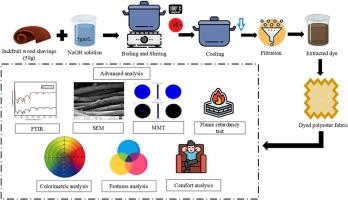
Growing environmental concerns associated with petroleum-based synthetic dyes have intensified the demand of sustainable natural colorants for textile applications. This research evaluates jackfruit (Artocarpus heterophyllus) wood shavings, an underutilized agricultural byproduct, as a renewable dye source for polyester dyeing, including its dual significance in waste valorization and environmentally sustainable processing. The colorant was extracted through alkaline extraction at 100 °C for 60 min, and polyester fabrics were subsequently dyed under systematically varied dyeing process parameters, including time (20–120 min), temperature (80–160 °C), and pH (4, 7, 9). FTIR spectroscopy revealed the presence of characteristic polyester bands alongside additional absorption features, indicative of interactions between dye constituents and the fiber surface. Dyeing induced measurable modifications in fabric performance, including reduced air permeability attributable to surface deposition and limited moisture transfer as evidenced by near-zero bottom-surface wetting and a negative one-way transport index. Chromatic assessment demonstrated that dyeing parameters significantly influenced chromatic parameters, with maximum color strength reaching (K/S) 10.39. Samples dyed at 140 °C for 100 min exhibited enhanced flame retardancy (29.1 s) and excellent wash, rubbing, light, and perspiration fastness (ratings 4–5). Acidic pH improved wash fastness, whereas neutral pH yielded superior rubbing, light, and perspiration resistance. The findings establish jackfruit wood shavings as a promising sustainable colorant capable of imparting functional and aesthetic value to polyester textiles.
Abstract Image

利用从菠萝蜜木屑中提取的天然着色剂对涤纶进行环保染色:洞察织物性能、色彩参数和阻燃性
与石油基合成染料相关的日益增长的环境问题加剧了对可持续天然着色剂用于纺织品的需求。本研究评估了菠萝蜜(Artocarpus heterophyllus)木屑作为一种未充分利用的农业副产品,作为聚酯染色的可再生染料来源,包括其在废物增值和环境可持续处理方面的双重意义。在100°C下碱性萃取60 min提取着色剂,然后在不同的染色工艺参数下对涤纶织物进行染色,包括时间(20-120 min)、温度(80-160°C)和pH(4,7,9)。FTIR光谱揭示了特征聚酯带的存在以及额外的吸收特征,表明染料成分与纤维表面之间的相互作用。染色对织物性能产生了可测量的改变,包括由于表面沉积而导致的透气性降低和有限的水分转移,这可以通过接近零的底面润湿和负的单向传输指数来证明。色度评价表明染色参数对色度参数影响显著,最大色强达到(K/S) 10.39。在140°C下染色100分钟的样品表现出增强的阻燃性(29.1 s)和优异的洗涤,摩擦,光和排汗牢度(等级4-5)。酸性酸碱度提高了洗涤牢度,而中性酸碱度产生了优异的摩擦、耐光性和耐汗性。研究结果表明,菠萝蜜木屑是一种很有前途的可持续着色剂,能够赋予聚酯纺织品功能和美学价值。
本文章由计算机程序翻译,如有差异,请以英文原文为准。
求助全文
约1分钟内获得全文 求助全文
来源期刊
自引率
0.00%
发文量
0
×
引用
GB/T 7714-2015
复制
MLA
复制
APA
复制
导出至
BibTeX EndNote RefMan NoteFirst NoteExpress
×
提示
您的信息不完整,为了账户安全,请先补充。
现在去补充
×
提示
您因"违规操作"
具体请查看互助需知
我知道了
×
提示
确定
请完成安全验证×
copy
已复制链接
快去分享给好友吧!
我知道了
右上角分享
点击右上角分享
0
联系我们:info@booksci.cn Book学术提供免费学术资源搜索服务,方便国内外学者检索中英文文献。致力于提供最便捷和优质的服务体验。 Copyright © 2023 布克学术 All rights reserved.
京ICP备2023020795号-1
ghs 京公网安备 11010802042870号
Book学术文献互助
Book学术文献互助群
群 号:604180095
Book学术官方微信
小红书



