{"title":"The relationship between ovarian and colorectal cancers: a systematic review and meta-analysis.","authors":"Heba Ramadan","doi":"10.14216/kjco.25355","DOIUrl":null,"url":null,"abstract":"<p><strong>Purpose: </strong>This systematic review and meta-analysis aimed to examine the relationship between ovarian and colorectal cancer, with a particular focus on the standardized incidence ratio (SIR).</p><p><strong>Methods: </strong>A comprehensive search was conducted across multiple databases, including Scopus, Web of Science, PubMed, and Google Scholar. A total of 20 studies were included in the final analysis.</p><p><strong>Results: </strong>The results indicated that women with ovarian cancer had a significantly higher incidence of colorectal cancer (SIR, 1.69; 95% confidence interval [CI], 1.39-1.98), with an increased risk for both colon (SIR, 1.57; 95% CI, 1.14-1.99) and rectal cancers (SIR, 1.58; 95% CI, 1.38-1.78). Subgroup analysis of borderline ovarian tumor revealed an SIR for colorectal cancer of 1.27 (95% CI, 0.99-1.55), with a significant risk in the serous subtype (SIR, 1.38; 95% CI, 1.09-1.67). Conversely, studies examining ovarian cancer in women diagnosed with colorectal cancer showed an SIR of 1.48 (95% CI, 1.17-1.79). Specifically, women with colon cancer had a higher incidence of ovarian cancer (SIR, 1.64; 95% CI, 1.25-2.03), while women with rectal cancer showed a decreased risk (SIR, 0.88; 95% CI, 0.77-0.99). The results underscore the potential bidirectional relationship between ovarian and colorectal cancers, which may be influenced by genetic predispositions.</p><p><strong>Conclusion: </strong>Future advanced genetic studies are needed to better understand the underlying molecular mechanisms. Additionally, the results emphasize the importance of careful cancer surveillance and early detection strategies for women with a history of either ovarian cancer or colorectal cancer.</p>","PeriodicalId":74045,"journal":{"name":"Korean journal of clinical oncology","volume":" ","pages":"150-158"},"PeriodicalIF":0.0000,"publicationDate":"2025-12-01","publicationTypes":"Journal Article","fieldsOfStudy":null,"isOpenAccess":false,"openAccessPdf":"https://www.ncbi.nlm.nih.gov/pmc/articles/PMC12784147/pdf/","citationCount":"0","resultStr":null,"platform":"Semanticscholar","paperid":null,"PeriodicalName":"Korean journal of clinical oncology","FirstCategoryId":"1085","ListUrlMain":"https://doi.org/10.14216/kjco.25355","RegionNum":0,"RegionCategory":null,"ArticlePicture":[],"TitleCN":null,"AbstractTextCN":null,"PMCID":null,"EPubDate":"2025/12/19 0:00:00","PubModel":"Epub","JCR":"","JCRName":"","Score":null,"Total":0}
引用次数: 0
Abstract
Purpose: This systematic review and meta-analysis aimed to examine the relationship between ovarian and colorectal cancer, with a particular focus on the standardized incidence ratio (SIR).
Methods: A comprehensive search was conducted across multiple databases, including Scopus, Web of Science, PubMed, and Google Scholar. A total of 20 studies were included in the final analysis.
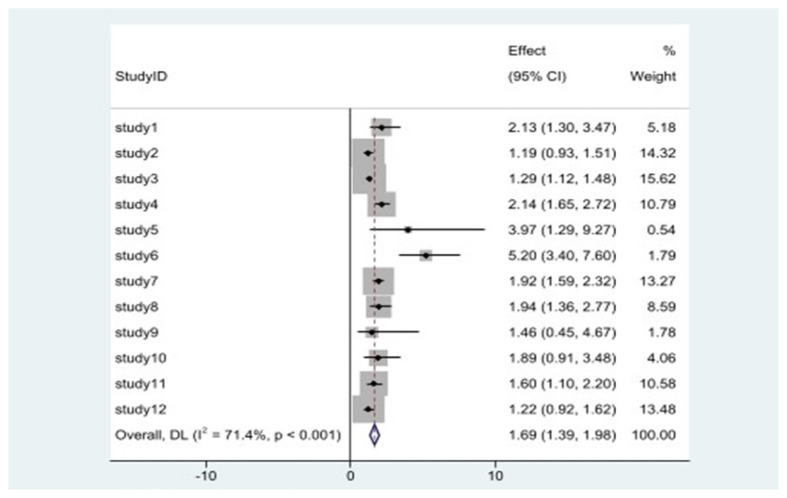
Results: The results indicated that women with ovarian cancer had a significantly higher incidence of colorectal cancer (SIR, 1.69; 95% confidence interval [CI], 1.39-1.98), with an increased risk for both colon (SIR, 1.57; 95% CI, 1.14-1.99) and rectal cancers (SIR, 1.58; 95% CI, 1.38-1.78). Subgroup analysis of borderline ovarian tumor revealed an SIR for colorectal cancer of 1.27 (95% CI, 0.99-1.55), with a significant risk in the serous subtype (SIR, 1.38; 95% CI, 1.09-1.67). Conversely, studies examining ovarian cancer in women diagnosed with colorectal cancer showed an SIR of 1.48 (95% CI, 1.17-1.79). Specifically, women with colon cancer had a higher incidence of ovarian cancer (SIR, 1.64; 95% CI, 1.25-2.03), while women with rectal cancer showed a decreased risk (SIR, 0.88; 95% CI, 0.77-0.99). The results underscore the potential bidirectional relationship between ovarian and colorectal cancers, which may be influenced by genetic predispositions.
Conclusion: Future advanced genetic studies are needed to better understand the underlying molecular mechanisms. Additionally, the results emphasize the importance of careful cancer surveillance and early detection strategies for women with a history of either ovarian cancer or colorectal cancer.




 求助内容:
求助内容: 应助结果提醒方式:

 京公网安备 11010802042870号


