
Emerging Noninvasive Approaches for the Suppression of Pathological Tremor
IF 16
1区 工程技术
Q1 ENGINEERING, BIOMEDICAL
引用次数: 0
Abstract
Pathological tremor affects over 40 million people worldwide, significantly impairing daily activities and quality of life. Pharmacological treatments show limited efficacy, with up to 30% discontinuation rates, while surgical interventions like deep brain stimulation achieve significant tremor reduction but are often unsuitable due to age, comorbidities, or personal preference. Recently, the need for safe and effective alternatives has led to the development of innovative, noninvasive, and patient-friendly technologies for tremor management. This clinical application review analyzed 134 studies (1969-2025), categorizing them into three major modalities, focusing on their underlying neurophysiological mechanisms, with a special emphasis on the clinical perspective. The three considered modalities were force-controlling (orthoses and functional electrical stimulation), central neuromodulation (transcranial magnetic stimulation, transcranial electrical stimulation, low-intensity focused ultrasound, and transcutaneous spinal cord stimulation), and peripheral neuromodulation (afferent stimulation and vibration). Force-controlling strategies showed promising acute effects, though clinical translation remains limited by poor wearability and the development of muscle fatigue. Central neuromodulation produced moderate effects, while peripheral neuromodulation has gained clinical traction, with several devices now being commercially available. However, heterogeneity in study design, patient populations, and technology maturity remain the main obstacles for the direct comparison of techniques. Future research should prioritize larger multicenter trials, standardized outcome measures, and accessibility considerations to enable personalized, evidence-based treatment selection for diverse tremor populations.新兴的无创方法抑制病理性震颤。
病理性震颤影响全球超过4000万人,严重影响日常活动和生活质量。药物治疗效果有限,停药率高达30%,而手术干预,如深部脑刺激,可以显著减少震颤,但由于年龄、合并症或个人偏好,往往不适合。最近,对安全有效的替代方案的需求导致了创新、无创和对患者友好的震颤管理技术的发展。本临床应用综述分析了134项研究(1969-2025),将其分为三种主要模式,重点关注其潜在的神经生理机制,并特别强调临床观点。考虑的三种方式是力控制(矫形器和功能性电刺激),中枢神经调节(经颅磁刺激,经颅电刺激,低强度聚焦超声和经皮脊髓刺激)和周围神经调节(传入刺激和振动)。力控制策略显示出有希望的急性效果,尽管临床翻译仍然受到耐磨性差和肌肉疲劳发展的限制。中枢神经调节产生中等效果,而周围神经调节已获得临床牵引力,现在有几种设备已商品化。然而,研究设计、患者群体和技术成熟度的异质性仍然是直接比较技术的主要障碍。未来的研究应优先考虑更大的多中心试验、标准化的结果测量和可及性,以便为不同的震颤人群提供个性化的、基于证据的治疗选择。
本文章由计算机程序翻译,如有差异,请以英文原文为准。
求助全文
约1分钟内获得全文
求助全文
来源期刊
IEEE Reviews in Biomedical Engineering
Engineering-Biomedical Engineering
CiteScore
31.70
自引率
0.60%
发文量
93
期刊介绍:
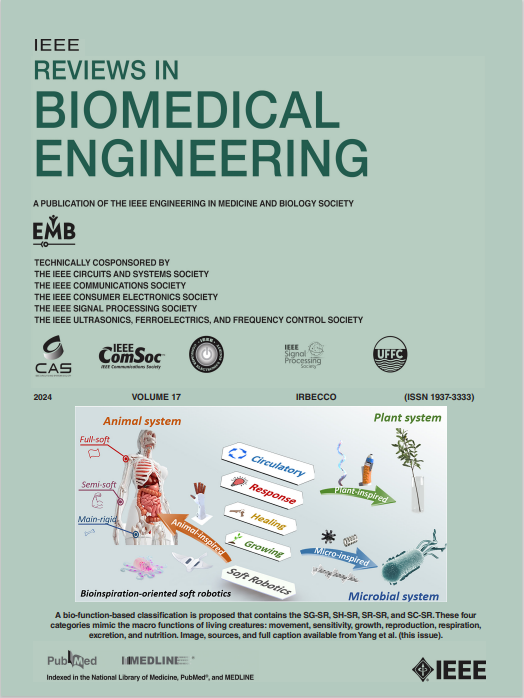
IEEE Reviews in Biomedical Engineering (RBME) serves as a platform to review the state-of-the-art and trends in the interdisciplinary field of biomedical engineering, which encompasses engineering, life sciences, and medicine. The journal aims to consolidate research and reviews for members of all IEEE societies interested in biomedical engineering. Recognizing the demand for comprehensive reviews among authors of various IEEE journals, RBME addresses this need by receiving, reviewing, and publishing scholarly works under one umbrella. It covers a broad spectrum, from historical to modern developments in biomedical engineering and the integration of technologies from various IEEE societies into the life sciences and medicine.
 求助内容:
 应助结果提醒方式:


 京公网安备 11010802042870号


