
Enhanced ion transport in CNT-doped PVA/HCl/TEOS electrolyte membranes for aluminium-air batteries
Q1 Materials Science
Materials Science for Energy Technologies
Pub Date : 2026-01-01
Epub Date: 2025-12-08
DOI:10.1016/j.mset.2025.12.001
引用次数: 0
Abstract
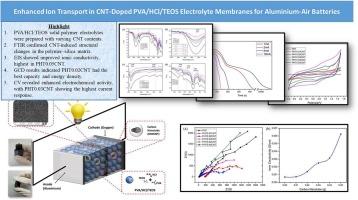
This study investigates the impact of carbon nanotube (CNT) incorporation on the electrochemical performance of polyvinyl alcohol (PVA)/HCl/TEOS-based solid polymer electrolytes for rechargeable aluminium-air batteries. CNTs were introduced in varying quantities (0–0.05 g), while a polylactic acid (PLA) nanofiber layer containing carbon quantum dots (CQDs) was integrated as a separator to enhance ion transport. The inclusion of CNTs improved the amorphous structure, as evidenced by X-ray diffraction (XRD), and optimized ionic pathways within the polymer-silica network. The PHT0.05CNT membrane exhibited the highest ionic conductivity of 6.25 × 10⁻³ S cm−1, while transference number analysis confirmed predominant ionic conduction (Tion = 0.923). Among the tested compositions, PHT0.02CNT achieved the best battery performance, delivering a capacity of 0.4168 mAh g−1 and an energy density of 0.145 mWh g−1. Cyclic voltammetry further demonstrated enhanced redox reversibility with the addition of CNTs. These findings underscore that controlled CNT incorporation significantly enhances ion transport and electrochemical performance, suggesting strong potential for developing high-efficiency aluminium-air batteries.
碳纳米管掺杂PVA/HCl/TEOS铝-空气电池电解质膜中离子输运的增强
本文研究了碳纳米管(CNT)掺入对聚乙烯醇(PVA)/HCl/ teos基固体聚合物电解质用于可充电铝空气电池的电化学性能的影响。加入不同数量的碳纳米管(0-0.05 g),同时集成含有碳量子点(CQDs)的聚乳酸(PLA)纳米纤维层作为分离器以增强离子传输。x射线衍射(XRD)结果表明,CNTs的加入改善了聚合物-二氧化硅网络的非晶结构,并优化了聚合物-二氧化硅网络内的离子路径。PHT0.05CNT膜的离子电导率最高,为6.25 × 10⁻³ S cm−1,迁移数分析证实其离子电导率最高(Tion = 0.923)。在测试的组合物中,pht0.02碳纳米管的电池性能最好,容量为0.4168 mAh g−1,能量密度为0.145 mWh g−1。循环伏安法进一步证明了CNTs的加入增强了氧化还原可逆性。这些发现强调,可控碳纳米管掺入显著提高离子传输和电化学性能,表明开发高效铝-空气电池的巨大潜力。
本文章由计算机程序翻译,如有差异,请以英文原文为准。
求助全文
约1分钟内获得全文
求助全文
来源期刊

Materials Science for Energy Technologies
Materials Science-Materials Science (miscellaneous)
CiteScore
16.50
自引率
0.00%
发文量
41
审稿时长
39 days
 求助内容:
求助内容: 应助结果提醒方式:

 京公网安备 11010802042870号


