
Peak glacier extinction in the mid-twenty-first century
IF 27.1
1区 地球科学
Q1 ENVIRONMENTAL SCIENCES
引用次数: 0
Abstract
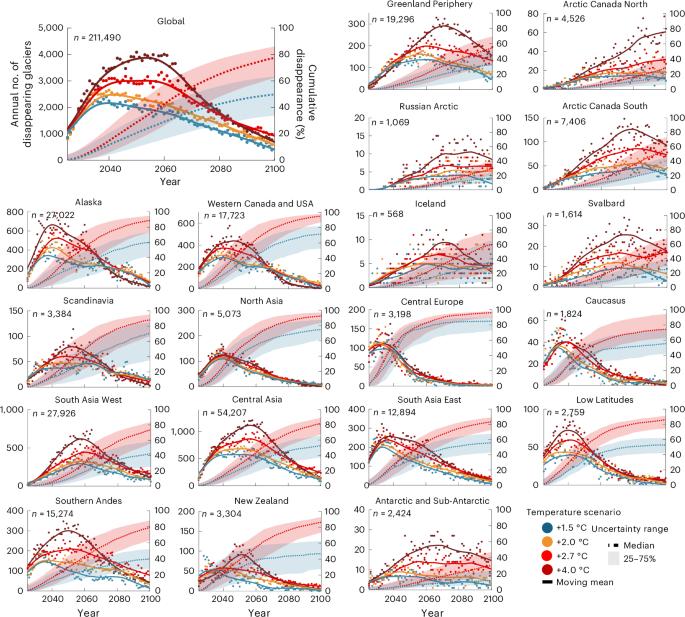
Projections of glacier change typically focus on mass and area loss, yet the disappearance of individual glaciers directly threatens culturally, spiritually and touristically significant landscapes. Here, using three global glacier models, we project a sharp rise in the number of glaciers disappearing worldwide, peaking between 2041 and 2055 with up to ~4,000 glaciers vanishing annually. Regional variability reflects differences in average glacier size, local climate, the magnitude of warming and inventory completeness. Many mountain glaciers will disappear with warming. Here the authors assess how many glaciers will disappear per year under different warming scenarios, finding that a peak in glacier loss will happen during the mid-twenty-first century.

冰川在21世纪中期消失
冰川变化的预测通常侧重于质量和面积的损失,然而单个冰川的消失直接威胁到具有文化、精神和旅游意义的景观。在这里,我们使用三个全球冰川模型,预测全球冰川消失的数量急剧增加,在2041年至2055年之间达到峰值,每年多达4,000个冰川消失。区域变率反映了平均冰川大小、局地气候、变暖幅度和库存量完整性的差异。
本文章由计算机程序翻译,如有差异,请以英文原文为准。
求助全文
约1分钟内获得全文
求助全文
来源期刊
Nature Climate Change
ENVIRONMENTAL SCIENCES-METEOROLOGY & ATMOSPHERIC SCIENCES
CiteScore
40.30
自引率
1.60%
发文量
267
审稿时长
4-8 weeks
期刊介绍:
Nature Climate Change is dedicated to addressing the scientific challenge of understanding Earth's changing climate and its societal implications. As a monthly journal, it publishes significant and cutting-edge research on the nature, causes, and impacts of global climate change, as well as its implications for the economy, policy, and the world at large.
The journal publishes original research spanning the natural and social sciences, synthesizing interdisciplinary research to provide a comprehensive understanding of climate change. It upholds the high standards set by all Nature-branded journals, ensuring top-tier original research through a fair and rigorous review process, broad readership access, high standards of copy editing and production, rapid publication, and independence from academic societies and other vested interests.
Nature Climate Change serves as a platform for discussion among experts, publishing opinion, analysis, and review articles. It also features Research Highlights to highlight important developments in the field and original reporting from renowned science journalists in the form of feature articles.
Topics covered in the journal include adaptation, atmospheric science, ecology, economics, energy, impacts and vulnerability, mitigation, oceanography, policy, sociology, and sustainability, among others.
 求助内容:
求助内容: 应助结果提醒方式:

 京公网安备 11010802042870号


