
New bi-functional catalysts for a novel continuous production of propylene oxide with in-situ generated hydrogen peroxide
IF 6.5
1区 化学
Q2 CHEMISTRY, PHYSICAL
引用次数: 0
Abstract
Combined direct synthesis of hydrogen peroxide (DSHP) and epoxidation of propene to propylene oxide with hydrogen peroxide (HPPO) was carried out first time in a continuous laboratory-scale trickle bed reactor operating under mild conditions of 8 bar and 10°C. The reaction was performed with bimetallic gold–palladium catalysts supported on titanium silicalite 1 (TS-1). Three series of catalysts were synthesized from two different lots of TS-1 and different calcination heating rates. The catalysts were extensively examined using XRD, SEM-EDS, TEM-SAED, STEM-EDS, ICP-OES, XPS, UV–vis DRS, nitrogen-physisorption and ammonia-TPD. The metal-modification of TS-1 containing anatase impurities was shown first time, where the preferential deposition site for the bimetallic nanoparticles was on the minor anatase phase, found in different amounts in commercial TS-1 materials. In the first catalyst series, a higher anatase content was found, which led to a decrease of the AuPd nanoparticle size compared to the second and third series. Increasing the heating rate in calcination resulted in an additional reduction of the AuPd nanoparticle size. The propylene oxide selectivity was 55.7 % using catalysts of the third series, while the propylene oxide production rate was 0.17 mol·kgcat-1·h−1 with 19.2 % propene conversion. The use of a palladium-poor alloy was found to be crucial for this reaction system to limit the hydrogenation of hydrogen peroxide and propene. The catalyst activity was investigated in the separate processes of DSHP and epoxidation to get a deeper insight into the reaction mechanism. In the switch experiments, DSHP followed by the combined reaction of DSHP and HPPO, the competing side reactions, hydrogenation of propene and hydrogen peroxide were confirmed. In another experiment, the dismutation of hydrogen peroxide was disproved.

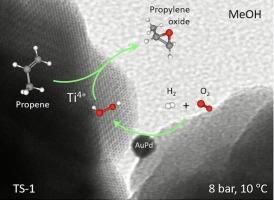
原位生成过氧化氢连续生产环氧丙烷的新型双功能催化剂
在实验室规模的连续滴流床反应器上,在8 bar和10℃的温和条件下,首次进行了双氧水直接合成(DSHP)和丙烯环氧化制环氧丙烷(HPPO)的联合反应。采用钛硅石1 (TS-1)为载体的双金属金钯催化剂进行反应。以两种不同批次的TS-1和不同的煅烧升温速率合成了三个系列的催化剂。采用XRD、SEM-EDS、TEM-SAED、STEM-EDS、ICP-OES、XPS、UV-vis DRS、氮物理吸附和氨- tpd对催化剂进行了广泛的表征。首次发现了含有锐钛矿杂质的TS-1的金属修饰,其中双金属纳米颗粒的优先沉积位置在少量锐钛矿相上,在商业TS-1材料中发现了不同数量的锐钛矿。在第一个催化剂系列中,发现了较高的锐钛矿含量,这导致与第二和第三个系列相比,AuPd纳米颗粒尺寸减小。在煅烧中增加加热速率导致了AuPd纳米颗粒尺寸的进一步减小。第三系列催化剂的环氧丙烷选择性为55.7% %,环氧丙烷产率为0.17 mol·kgcat-1·h−1,丙烯转化率为19.2% %。贫钯合金的使用对该反应体系至关重要,以限制过氧化氢和丙烯的加氢。在DSHP和环氧化分离过程中考察了催化剂的活性,以深入了解反应机理。在开关实验中,确定了DSHP后DSHP与HPPO的联合反应、丙烯加氢和过氧化氢的竞争副反应。在另一个实验中,过氧化氢的异变被证明是错误的。
本文章由计算机程序翻译,如有差异,请以英文原文为准。
求助全文
约1分钟内获得全文
求助全文
来源期刊
Journal of Catalysis
工程技术-工程:化工
CiteScore
12.30
自引率
5.50%
发文量
447
审稿时长
31 days
期刊介绍:
The Journal of Catalysis publishes scholarly articles on both heterogeneous and homogeneous catalysis, covering a wide range of chemical transformations. These include various types of catalysis, such as those mediated by photons, plasmons, and electrons. The focus of the studies is to understand the relationship between catalytic function and the underlying chemical properties of surfaces and metal complexes.
The articles in the journal offer innovative concepts and explore the synthesis and kinetics of inorganic solids and homogeneous complexes. Furthermore, they discuss spectroscopic techniques for characterizing catalysts, investigate the interaction of probes and reacting species with catalysts, and employ theoretical methods.
The research presented in the journal should have direct relevance to the field of catalytic processes, addressing either fundamental aspects or applications of catalysis.
 求助内容:
求助内容: 应助结果提醒方式:

 京公网安备 11010802042870号


