
Knowledge-based data-driven prediction of shield tail clearance under karst geological condition

IF 12.7 1区 地球科学 Q1 GEOSCIENCES, MULTIDISCIPLINARY
Geoscience frontiers Pub Date : 2026-03-01 Epub Date: 2025-12-01 DOI:10.1016/j.gsf.2025.102221
Wengang Zhang , Han Han , Weixin Sun , Yunhao Wang , Zhihao Wu , Peng Xiao , Yumiao Yan
{"title":"Knowledge-based data-driven prediction of shield tail clearance under karst geological condition","authors":"Wengang Zhang ,&nbsp;Han Han ,&nbsp;Weixin Sun ,&nbsp;Yunhao Wang ,&nbsp;Zhihao Wu ,&nbsp;Peng Xiao ,&nbsp;Yumiao Yan","doi":"10.1016/j.gsf.2025.102221","DOIUrl":null,"url":null,"abstract":"<div><div>Precise control of shield tail clearance is a critical factor influencing the safety and quality of shield tunneling construction. Although various methods exist for accurately measuring shield tail clearance, predictive capabilities remain insufficient. This study is based on a shield tunnel project in the karst region of Longgang, Shenzhen, China. By integrating geological parameters obtained from advanced geological prediction with shield construction monitoring data, a predictive calculation method for shield tail clearance is developed, grounded in the spatial relationship between the shield machine and the pipe segments. A knowledge-based data-driven prediction approach is proposed using a Transformer-LSTM deep learning model. Case analysis demonstrates that the proposed Transformer–LSTM model consistently outperformed baseline models such as GRU, LSTM, and pure Transformer. The predicted <em>R</em><sup>2</sup> values for the four positions of the shield tail—top, bottom, left, and right—reached 0.990, 0.901, 0.976, and 0.908, respectively, while error indicators (MAE, RMSE, and MAPE) were also minimized. These results confirm that the proposed hybrid approach effectively captures both global dependencies and temporal dynamics, enabling accurate prediction of shield tail clearance and offering practical engineering significance for guiding shield tunneling construction.</div></div>","PeriodicalId":12711,"journal":{"name":"Geoscience frontiers","volume":"17 2","pages":"Article 102221"},"PeriodicalIF":12.7000,"publicationDate":"2026-03-01","publicationTypes":"Journal Article","fieldsOfStudy":null,"isOpenAccess":false,"openAccessPdf":"","citationCount":"0","resultStr":null,"platform":"Semanticscholar","paperid":null,"PeriodicalName":"Geoscience frontiers","FirstCategoryId":"89","ListUrlMain":"https://www.sciencedirect.com/science/article/pii/S1674987125002269","RegionNum":1,"RegionCategory":"地球科学","ArticlePicture":[],"TitleCN":null,"AbstractTextCN":null,"PMCID":null,"EPubDate":"2025/12/1 0:00:00","PubModel":"Epub","JCR":"Q1","JCRName":"GEOSCIENCES, MULTIDISCIPLINARY","Score":null,"Total":0}
引用次数: 0

Abstract

Precise control of shield tail clearance is a critical factor influencing the safety and quality of shield tunneling construction. Although various methods exist for accurately measuring shield tail clearance, predictive capabilities remain insufficient. This study is based on a shield tunnel project in the karst region of Longgang, Shenzhen, China. By integrating geological parameters obtained from advanced geological prediction with shield construction monitoring data, a predictive calculation method for shield tail clearance is developed, grounded in the spatial relationship between the shield machine and the pipe segments. A knowledge-based data-driven prediction approach is proposed using a Transformer-LSTM deep learning model. Case analysis demonstrates that the proposed Transformer–LSTM model consistently outperformed baseline models such as GRU, LSTM, and pure Transformer. The predicted R2 values for the four positions of the shield tail—top, bottom, left, and right—reached 0.990, 0.901, 0.976, and 0.908, respectively, while error indicators (MAE, RMSE, and MAPE) were also minimized. These results confirm that the proposed hybrid approach effectively captures both global dependencies and temporal dynamics, enabling accurate prediction of shield tail clearance and offering practical engineering significance for guiding shield tunneling construction.
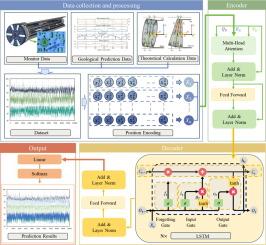
Abstract Image

岩溶地质条件下盾构尾间隙数据驱动的知识预测
盾构尾隙的精确控制是影响盾构隧道施工安全和质量的关键因素。虽然有各种方法可以精确测量盾尾间隙,但预测能力仍然不足。本文以深圳龙岗岩溶地区的盾构隧道工程为研究对象。基于盾构机与管段的空间关系,将超前地质预测得到的地质参数与盾构施工监测数据相结合,提出了盾构尾间隙的预测计算方法。利用Transformer-LSTM深度学习模型,提出了一种基于知识的数据驱动预测方法。案例分析表明,所提出的Transformer - LSTM模型始终优于基准模型,如GRU、LSTM和纯Transformer。盾尾上、下、左、右4个位置的预测R2分别达到0.990、0.901、0.976、0.908,误差指标MAE、RMSE、MAPE均达到最小。这些结果证实了所提出的混合方法有效地捕获了全局依赖关系和时间动态,能够准确预测盾构尾间隙,对指导盾构隧道施工具有实际的工程意义。
本文章由计算机程序翻译,如有差异,请以英文原文为准。
求助全文
约1分钟内获得全文 求助全文
来源期刊
Geoscience frontiers
Geoscience frontiers Earth and Planetary Sciences-General Earth and Planetary Sciences
CiteScore
17.80
自引率
3.40%
发文量
147
审稿时长
35 days
期刊介绍: Geoscience Frontiers (GSF) is the Journal of China University of Geosciences (Beijing) and Peking University. It publishes peer-reviewed research articles and reviews in interdisciplinary fields of Earth and Planetary Sciences. GSF covers various research areas including petrology and geochemistry, lithospheric architecture and mantle dynamics, global tectonics, economic geology and fuel exploration, geophysics, stratigraphy and paleontology, environmental and engineering geology, astrogeology, and the nexus of resources-energy-emissions-climate under Sustainable Development Goals. The journal aims to bridge innovative, provocative, and challenging concepts and models in these fields, providing insights on correlations and evolution.

×
引用
GB/T 7714-2015
复制
MLA
复制
APA
复制
导出至
BibTeX EndNote RefMan NoteFirst NoteExpress
×
提示
您的信息不完整,为了账户安全,请先补充。
现在去补充
×
提示
您因"违规操作"
具体请查看互助需知
我知道了
×
提示
确定
请完成安全验证×
copy
已复制链接
快去分享给好友吧!
我知道了
右上角分享
点击右上角分享
0
联系我们:info@booksci.cn Book学术提供免费学术资源搜索服务,方便国内外学者检索中英文文献。致力于提供最便捷和优质的服务体验。 Copyright © 2023 布克学术 All rights reserved.
京ICP备2023020795号-1
ghs 京公网安备 11010802042870号
Book学术文献互助
Book学术文献互助群
群 号:604180095
Book学术官方微信
小红书


