
Petrogenetic evolution of I-type granitoids in the Gouna region, Northern Cameroon: Geochemical evidence for subduction-related to post-collisional magmatism during the Pan-African orogeny
Geosystems and Geoenvironment
Pub Date : 2026-05-01
Epub Date: 2025-11-28
DOI:10.1016/j.geogeo.2025.100485
引用次数: 0
Abstract
The Gouna region, located in the northern part of the Pan-African belt in Cameroon, comprises a diverse suite of granitoids, including amphibole granites, amphibole–biotite granites, biotite granites, biotite–muscovite granites, and muscovite-bearing leucogranites. Deciphering their magmatic sources and tectonic evolution is key to understanding the geodynamic framework of the Pan-African Belt, which records the transition from subduction-related to post-collisional regimes during the Neoproterozoic.
This study integrates petrographic investigations of 25 thin sections, whole-rock geochemical analyses of 13 representative samples (11 granites and 2 quartz diorites), and new Sr–Nd isotopic data to constrain the petrogenetic evolution of the Gouna granitoids. The rocks are metaluminous, calc-alkaline, and magnesian (SiO₂ = 67.55–73.15 wt%; K₂O/Na₂O < 1), characteristic of I-type granites emplaced under hydrous, oxidizing conditions. Isotopic compositions (⁸⁷Sr/⁸⁶Srᵢ = 0.7068–0.7072; εNd (540 Ma) = −4.8 to −6.2) suggest hybrid magma sources derived from a metasomatized enriched mantle with variable crustal assimilation.
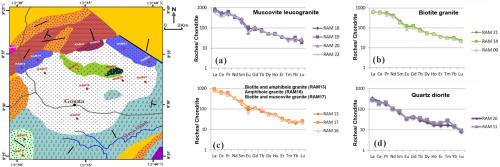
Amphibole granites display weak REE fractionation ((La/Yb)n = 0.64–1.68) and pronounced negative Eu anomalies (Eu/Eu* = 0.29–0.45), whereas muscovite-bearing leucogranites are highly fractionated ((La/Yb)n = 17.30–33.71). Primitive mantle–normalized patterns show consistent negative anomalies in Nb, Ta, Ti, Pb, Sr, Y, and Hf, and enrichment in LILEs relative to HFSEs, reflecting a subduction-modified source.
The geochemical and isotopic data collectively record a polyphase magmatic evolution, marking the transition from arc-related mantle magmatism to syn- and post-collisional anatexis (600–540 Ma), and highlight progressive mantle–crust interaction during the Pan-African orogeny.
喀麦隆北部Gouna地区i型花岗岩的成岩演化:泛非造山期碰撞后岩浆作用俯冲的地球化学证据
Gouna地区位于喀麦隆泛非带北部,花岗岩种类繁多,包括角闪孔花岗岩、角闪-黑云母花岗岩、黑云母花岗岩、黑云母-白云母花岗岩和含白云母的浅花岗岩。破译它们的岩浆来源和构造演化是理解泛非带地球动力学框架的关键,泛非带记录了新元古代从俯冲到后碰撞的过渡过程。结合25个薄片岩石学调查、13个代表性样品(11个花岗岩和2个石英闪长岩)的全岩地球化学分析和新的Sr-Nd同位素数据,对郭那花岗岩类的成岩演化进行了研究。岩石为铝质、钙碱性、镁质(sio2 = 67.55 ~ 73.15 wt%; K₂O/Na₂O < 1),具有含水氧化条件下的i型花岗岩特征。同位素组成(⁸⁷Sr/⁸⁶Sr′= 0.7068 ~ 0.7072;εNd (540 Ma) = - 4.8 ~ - 6.2)表明岩浆源来源于变质富集地幔,并具有不同的地壳同化作用。角闪花岗岩表现出弱REE分异((La/Yb)n = 0.64 ~ 1.68)和明显的负Eu异常(Eu/Eu* = 0.29 ~ 0.45),而含白云母的浅长花岗岩表现出高REE分异((La/Yb)n = 17.30 ~ 33.71)。原始地幔归一化模式显示Nb、Ta、Ti、Pb、Sr、Y和Hf的负异常,LILEs相对于hfse富集,反映了俯冲修正的来源。地球化学和同位素资料共同记录了一个多阶段的岩浆演化,标志着从弧相关的地幔岩浆作用到碰撞前后的熔融作用(600-540 Ma)的过渡,突出了泛非造山运动期间的渐进式幔壳相互作用。
本文章由计算机程序翻译,如有差异,请以英文原文为准。
求助全文
约1分钟内获得全文
求助全文

 求助内容:
求助内容: 应助结果提醒方式:

 京公网安备 11010802042870号


