
Trait-based analysis of meiobenthic foraminifera in a glacier-influenced fjord: Krossfjord, Svalbard
IF 2.8
3区 地球科学
Q1 MARINE & FRESHWATER BIOLOGY
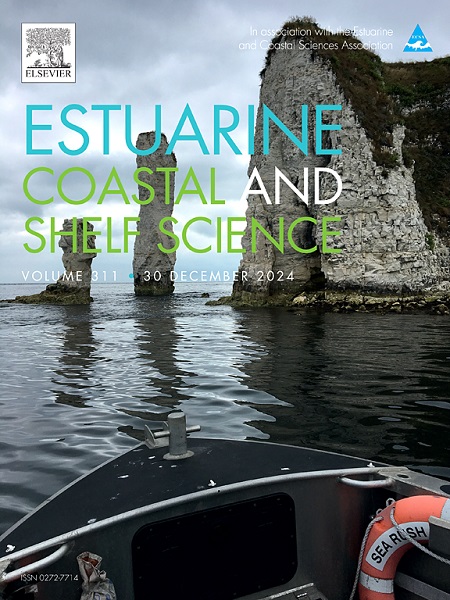
Estuarine Coastal and Shelf Science
Pub Date : 2026-02-01
Epub Date: 2025-12-06
DOI:10.1016/j.ecss.2025.109654
引用次数: 0
Abstract
Habitat heterogeneity can influence functional diversity in Arctic benthic ecosystems, but its effects on meiobenthic Foraminifera remain poorly understood. This study hypothesised that the fjord gradient selects distinct trait profiles, with agglutinated tests in the inner fjord and calcareous tests in the outer fjord (H1), that functional richness peaks in the outer fjord (H2), and that trait–environment links are strongest for test material (H3). The study quantified key foraminiferan traits, tested trait–environment relationships, and compared functional diversity (FRic, FDis, RaoQ), redundancy, and vulnerability across the inner, middle, and outer zones of Krossfjord using RLQ and fourth-corner analyses. Trait analysis of 43 species showed that communities were dominated by infaunal strategies, calcareous tests, muddy-sand substrates, suboxic affinities, and fresh food preferences, with only weak shifts among zones. Functional diversity was broadly similar across the fjord gradient, with a tendency for slightly higher functional richness in the outer fjord and slightly higher functional dispersion and Rao's quadratic entropy in the inner fjord. Test material was the only trait significantly associated with environmental gradients, with agglutinated forms more common in the inner fjord and calcareous forms prevailing in the outer fjord. The study identified 35 functional entities, of which 37 % were represented by a single species, indicating potential functional vulnerability. Overall, these findings suggest weak environmental filtering of foraminiferan traits along the fjord gradient, while possible effects of climate-driven change require further investigation.
冰川影响峡湾中新世有孔虫的特征分析:斯瓦尔巴群岛克罗斯峡湾
生境异质性可以影响北极底栖生态系统的功能多样性,但其对中底栖有孔虫的影响尚不清楚。本研究假设峡湾梯度选择了不同的性状谱,内峡湾有黏结试验,外峡湾有钙化试验(H1),功能丰富度在外峡湾达到峰值(H2),性状-环境联系在测试材料上最强(H3)。该研究量化了有孔虫的关键特征,测试了性状与环境的关系,并使用RLQ和第四角分析比较了克罗斯峡湾内部、中部和外部区域的功能多样性(FRic、FDis、RaoQ)、冗余和脆弱性。43个物种的性状分析表明,群落主要受生境策略、钙质试验、泥沙基质、缺氧亲和性和新鲜食物偏好等因素的影响,各带间变化不大。功能多样性在整个峡湾梯度上大致相似,外峡湾的功能丰富度略高,内峡湾的功能分散度和Rao二次熵略高。测试材料是唯一与环境梯度显著相关的性状,胶结形式在内峡湾更常见,钙质形式在外峡湾普遍存在。研究确定了35种功能实体,其中单一物种占37%,表明潜在的功能脆弱性。总的来说,这些发现表明峡湾梯度对有孔虫特征的环境过滤作用较弱,而气候驱动变化的可能影响需要进一步研究。
本文章由计算机程序翻译,如有差异,请以英文原文为准。
求助全文
约1分钟内获得全文
求助全文
来源期刊
CiteScore
5.60
自引率
7.10%
发文量
374
审稿时长
9 months
期刊介绍:
Estuarine, Coastal and Shelf Science is an international multidisciplinary journal devoted to the analysis of saline water phenomena ranging from the outer edge of the continental shelf to the upper limits of the tidal zone. The journal provides a unique forum, unifying the multidisciplinary approaches to the study of the oceanography of estuaries, coastal zones, and continental shelf seas. It features original research papers, review papers and short communications treating such disciplines as zoology, botany, geology, sedimentology, physical oceanography.
 求助内容:
 应助结果提醒方式:


 京公网安备 11010802042870号


