
Entanglement of a nuclear spin qubit register in silicon photonics
IF 34.9
1区 材料科学
Q1 MATERIALS SCIENCE, MULTIDISCIPLINARY
引用次数: 0
Abstract
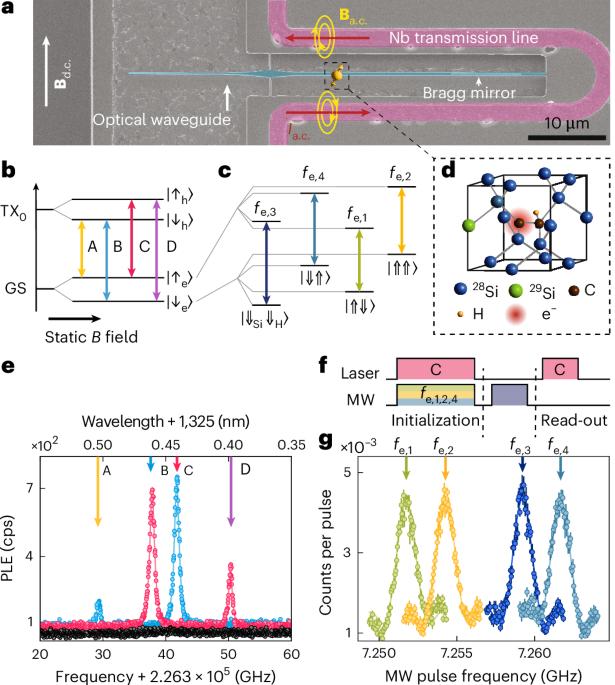
Colour centres provide an optical interface to quantum registers based on electron and nuclear spin qubits in solids. The T centre in silicon is an emerging spin–photon interface that combines telecom O-band optical transitions and an electron spin in a scalable photonics platform. Here we integrate T centres into single-mode photonic waveguides in a silicon-on-insulator platform. We demonstrate the initialization, coherent control and state read-out of a three-qubit register based on the electron spin of a T centre coupled to a hydrogen and a silicon nuclear spin. The spin register exhibits spin echo coherence times of 0.41(2) ms for the electron spin, 112(12) ms for the hydrogen nuclear spin and 67(7) ms for the silicon nuclear spin. We use nuclear–nuclear two-qubit gates to generate entanglement between the two nuclear spins with a fidelity of F = 0.77(3) and a coherence time of $${T}_{2}^{* }=2.60(8)$$ ms. Our results show that a T centre in silicon photonics can realize a multi-qubit register with an optical interface for quantum communication. A T colour centre in silicon, hyperfine-coupled to two nuclear spins, enables entanglement between the two nuclear spins with a fidelity of 0.77.

硅光子学中核自旋量子位寄存器的纠缠
色彩中心为固体中基于电子和核自旋量子位的量子寄存器提供了一个光学接口。硅中的T中心是一种新兴的自旋光子界面,它结合了电信o波段光学跃迁和可扩展光子平台中的电子自旋。在这里,我们将T中心集成到单模光子波导在绝缘体上的硅平台。我们展示了一个基于T中心的电子自旋耦合到氢和硅核自旋的三量子位寄存器的初始化、相干控制和状态读出。电子自旋的自旋回波相干时间为0.41(2)ms,氢核自旋为112(12)ms,硅核自旋为67(7)ms。我们使用核-核双量子比特门来产生两个核自旋之间的纠缠,保真度为F = 0.77(3),相干时间为\({T}_{2}^{* }=2.60(8)\) ms。结果表明,硅光子学中的T中心可以实现具有量子通信光接口的多量子位寄存器。
本文章由计算机程序翻译,如有差异,请以英文原文为准。
求助全文
约1分钟内获得全文
求助全文
来源期刊
Nature nanotechnology
工程技术-材料科学:综合
CiteScore
59.70
自引率
0.80%
发文量
196
审稿时长
4-8 weeks
期刊介绍:
Nature Nanotechnology is a prestigious journal that publishes high-quality papers in various areas of nanoscience and nanotechnology. The journal focuses on the design, characterization, and production of structures, devices, and systems that manipulate and control materials at atomic, molecular, and macromolecular scales. It encompasses both bottom-up and top-down approaches, as well as their combinations.
Furthermore, Nature Nanotechnology fosters the exchange of ideas among researchers from diverse disciplines such as chemistry, physics, material science, biomedical research, engineering, and more. It promotes collaboration at the forefront of this multidisciplinary field. The journal covers a wide range of topics, from fundamental research in physics, chemistry, and biology, including computational work and simulations, to the development of innovative devices and technologies for various industrial sectors such as information technology, medicine, manufacturing, high-performance materials, energy, and environmental technologies. It includes coverage of organic, inorganic, and hybrid materials.
 求助内容:
求助内容: 应助结果提醒方式:

 京公网安备 11010802042870号


