
Breaking the yield–selectivity trade-off in polystyrene waste valorization via tandem depolymerization and hydrogenolysis
IF 34.9
1区 材料科学
Q1 MATERIALS SCIENCE, MULTIDISCIPLINARY
引用次数: 0
Abstract
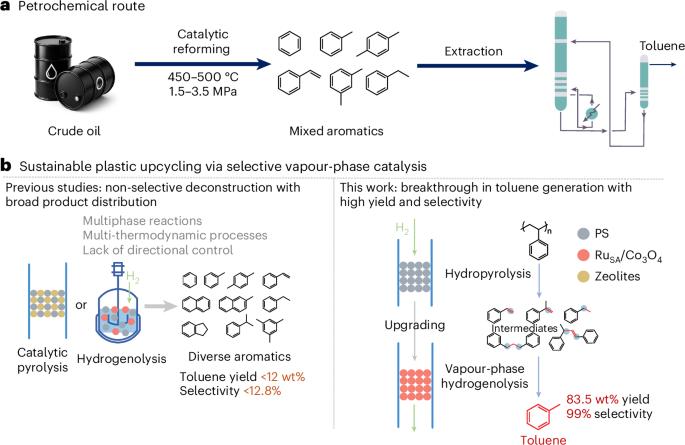
Converting plastic waste into valuable products mitigates plastic pollution and lowers the carbon footprint of naphtha-derived aromatics. However, the difficulties of precisely controlling complex multiphase systems and the catalyst inefficiencies hinder process viability. Here we report a vapour-phase hydrogenolysis strategy catalysed by Ru single atoms on Co3O4 (RuSA/Co3O4), decoupling depolymerization from hydrogenolysis to overcome the toluene yield–selectivity trade-off. In a pressurized dual-stage fixed-bed reactor, polystyrene undergoes hydropyrolysis at 475 °C, followed by vapour-phase hydrogenolysis at 275 °C (0.4 MPa H2, 2.4 s), yielding toluene with 99% selectivity, 83.5 wt% yield and 1,320 mmol gcat.−1 h−1 rate. The RuSA/Co3O4 catalyst demonstrates excellent stability, maintaining >99% conversion and selectivity during 100 h continuous operation (turnover number 24,747), and effectively processes diverse real-world polystyrene wastes. Life-cycle assessment shows a 53% carbon footprint reduction over fossil-based methods, while techno-economic analysis estimates a competitive minimum selling price of US$0.61 kg−1, below the US$1 kg−1 industry benchmark. A tandem catalytic strategy is developed to convert polystyrene waste into a spectrum of aromatic intermediates and subsequently into a single dominant product, toluene. This tandem design enhances product selectivity to 99% and minimizes downstream separation costs.
通过串联解聚和氢解打破聚苯乙烯废物增值的产率-选择性权衡。
将塑料废物转化为有价值的产品可以减轻塑料污染,降低石脑油衍生芳烃的碳足迹。然而,精确控制复杂多相体系的困难和催化剂效率低下阻碍了工艺的可行性。本文报道了Ru单原子在Co3O4上催化气相氢解的策略(RuSA/Co3O4),从氢解解解耦,以克服甲苯产率和选择性的权衡。在加压双级固定床反应器中,聚苯乙烯在475℃下进行加氢热解,然后在275℃(0.4 MPa H2, 2.4 s)气相氢解,以99%的选择性,83.5 wt%的收率和1320 mmol gcat得到甲苯。-1 h-1速率。RuSA/Co3O4催化剂表现出优异的稳定性,在连续运行100 h(周转率24,747)时保持>99%的转化率和选择性,并有效地处理各种实际的聚苯乙烯废物。生命周期评估显示,与基于化石燃料的方法相比,碳足迹减少了53%,而技术经济分析估计,具有竞争力的最低售价为0.61美元/公斤,低于1美元/公斤的行业基准。
本文章由计算机程序翻译,如有差异,请以英文原文为准。
求助全文
约1分钟内获得全文
求助全文
来源期刊
Nature nanotechnology
工程技术-材料科学:综合
CiteScore
59.70
自引率
0.80%
发文量
196
审稿时长
4-8 weeks
期刊介绍:
Nature Nanotechnology is a prestigious journal that publishes high-quality papers in various areas of nanoscience and nanotechnology. The journal focuses on the design, characterization, and production of structures, devices, and systems that manipulate and control materials at atomic, molecular, and macromolecular scales. It encompasses both bottom-up and top-down approaches, as well as their combinations.
Furthermore, Nature Nanotechnology fosters the exchange of ideas among researchers from diverse disciplines such as chemistry, physics, material science, biomedical research, engineering, and more. It promotes collaboration at the forefront of this multidisciplinary field. The journal covers a wide range of topics, from fundamental research in physics, chemistry, and biology, including computational work and simulations, to the development of innovative devices and technologies for various industrial sectors such as information technology, medicine, manufacturing, high-performance materials, energy, and environmental technologies. It includes coverage of organic, inorganic, and hybrid materials.
 求助内容:
求助内容: 应助结果提醒方式:

 京公网安备 11010802042870号


