Abdulkareem AlGarni, Nawaf Alanazi, Sarah AlMukhaylid, Sultan Alqahtani, Hassan Almasoudi, Yaqob Samir Taleb, Nada Alkhamis, Sameerah Shaheen, Abdulaziz Haji Siyal, Aamer Aleem, Rizwan Naeem, Masood A Shammas, Giuseppe Saglio, Deema Alroweilly, Asraf Hussain, Zafar Iqbal
{"title":"Omics and artificial intelligence integration for stratifying blast crisis CML using COSMIC signatures and pan-cancer precision drug repurposing.","authors":"Abdulkareem AlGarni, Nawaf Alanazi, Sarah AlMukhaylid, Sultan Alqahtani, Hassan Almasoudi, Yaqob Samir Taleb, Nada Alkhamis, Sameerah Shaheen, Abdulaziz Haji Siyal, Aamer Aleem, Rizwan Naeem, Masood A Shammas, Giuseppe Saglio, Deema Alroweilly, Asraf Hussain, Zafar Iqbal","doi":"10.5306/wjco.v16.i11.111983","DOIUrl":null,"url":null,"abstract":"<p><strong>Background: </strong>Although chronic-phase chronic myeloid leukemia (CP-CML) is treatable and nearly curable in about 50% of patients, accelerated-phase chronic myeloid leukemia (AP-CML) shows concerning drug resistance, while blast crisis chronic myeloid leukemia (BC-CML) is highly lethal. Advances in whole exome sequencing (WES) reveal pan-cancer mutations in BC-CML, supporting mutation-guided therapies beyond Breakpoint cluster region-Abelson. Artificial intelligence (AI) and machine learning (ML) enable genomic stratification and drug repurposing, addressing overlooked actionable mutations.</p><p><strong>Aim: </strong>To stratify BC-CML into molecular subtypes using WES, ML, and AI for precision drug repurposing.</p><p><strong>Methods: </strong>Included 123 CML patients (111 CP-CML, 5 AP-CML, 7 BC-CML). WES identified pan-cancer mutations. Variants annotated <i>via</i> Ensembl Variant Effect Predictor and Catalogue of Somatic Mutations in Cancer (COSMIC). ML (principal component analysis, K-means) stratified BC-CML. COSMIC signatures and PanDrugs prioritized drugs. Analysis of variance/Kruskal-Wallis validated differences (<i>P</i> < 0.05).</p><p><strong>Results: </strong>In this exploratory, hypothesis-generating study of BC-CML patients (<i>n</i> = 7), we detected over 2500 somatic mutations. ML identified three BC-CML clusters: (1) Cluster 1 [breast cancer susceptibility gene 2 (BRCA2), TP53]; (2) Cluster 2 [isocitrate dehydrogenase (IDH) 1/2, ten-eleven translocation 2]; and (3) Cluster 3 [Janus kinase (JAK) 2, colony-stimulating factor 3 receptor], with distinct COSMIC signatures. Therapies: (1) Polyadenosine-diphosphate-ribose polymerase inhibitors (olaparib); (2) IDH inhibitors (ivosidenib); and (3) JAK inhibitors (ruxolitinib). Mutational burden, signatures, and targets varied significantly across clusters, supporting precision stratification.</p><p><strong>Conclusion: </strong>This WES-AI-ML framework provides mutation-guided therapies for BC-CML, enabling real-time stratification and Food and Drug Administration-approved drug repurposing. While this exploratory study is limited by its small sample size (<i>n</i> = 7), it establishes a methodological framework for precision oncology stratification that warrants validation in larger, multi-center cohorts.</p>","PeriodicalId":23802,"journal":{"name":"World journal of clinical oncology","volume":"16 11","pages":"111983"},"PeriodicalIF":3.2000,"publicationDate":"2025-11-24","publicationTypes":"Journal Article","fieldsOfStudy":null,"isOpenAccess":false,"openAccessPdf":"https://www.ncbi.nlm.nih.gov/pmc/articles/PMC12678951/pdf/","citationCount":"0","resultStr":null,"platform":"Semanticscholar","paperid":null,"PeriodicalName":"World journal of clinical oncology","FirstCategoryId":"1085","ListUrlMain":"https://doi.org/10.5306/wjco.v16.i11.111983","RegionNum":0,"RegionCategory":null,"ArticlePicture":[],"TitleCN":null,"AbstractTextCN":null,"PMCID":null,"EPubDate":"","PubModel":"","JCR":"Q3","JCRName":"ONCOLOGY","Score":null,"Total":0}
引用次数: 0
Abstract
Background: Although chronic-phase chronic myeloid leukemia (CP-CML) is treatable and nearly curable in about 50% of patients, accelerated-phase chronic myeloid leukemia (AP-CML) shows concerning drug resistance, while blast crisis chronic myeloid leukemia (BC-CML) is highly lethal. Advances in whole exome sequencing (WES) reveal pan-cancer mutations in BC-CML, supporting mutation-guided therapies beyond Breakpoint cluster region-Abelson. Artificial intelligence (AI) and machine learning (ML) enable genomic stratification and drug repurposing, addressing overlooked actionable mutations.
Aim: To stratify BC-CML into molecular subtypes using WES, ML, and AI for precision drug repurposing.
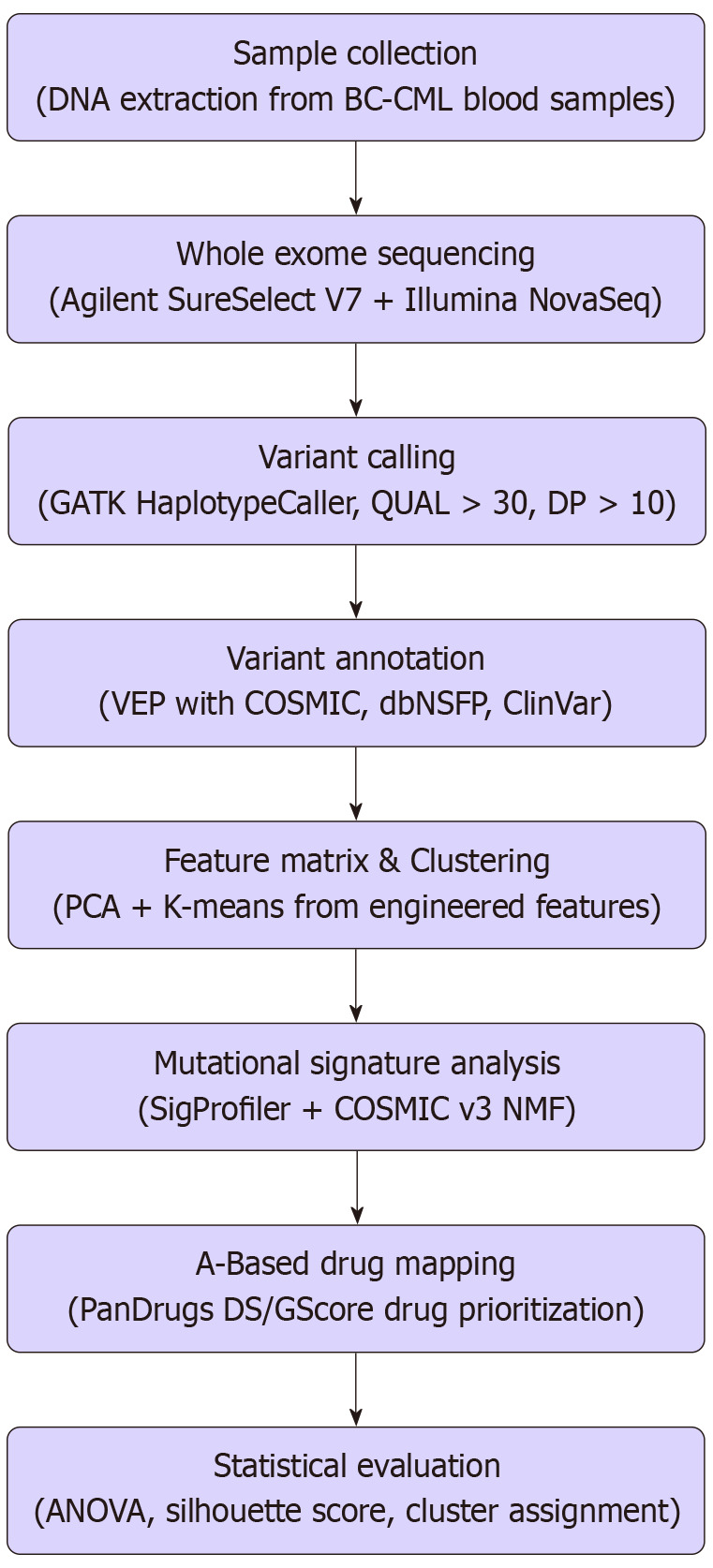
Methods: Included 123 CML patients (111 CP-CML, 5 AP-CML, 7 BC-CML). WES identified pan-cancer mutations. Variants annotated via Ensembl Variant Effect Predictor and Catalogue of Somatic Mutations in Cancer (COSMIC). ML (principal component analysis, K-means) stratified BC-CML. COSMIC signatures and PanDrugs prioritized drugs. Analysis of variance/Kruskal-Wallis validated differences (P < 0.05).
Results: In this exploratory, hypothesis-generating study of BC-CML patients (n = 7), we detected over 2500 somatic mutations. ML identified three BC-CML clusters: (1) Cluster 1 [breast cancer susceptibility gene 2 (BRCA2), TP53]; (2) Cluster 2 [isocitrate dehydrogenase (IDH) 1/2, ten-eleven translocation 2]; and (3) Cluster 3 [Janus kinase (JAK) 2, colony-stimulating factor 3 receptor], with distinct COSMIC signatures. Therapies: (1) Polyadenosine-diphosphate-ribose polymerase inhibitors (olaparib); (2) IDH inhibitors (ivosidenib); and (3) JAK inhibitors (ruxolitinib). Mutational burden, signatures, and targets varied significantly across clusters, supporting precision stratification.
Conclusion: This WES-AI-ML framework provides mutation-guided therapies for BC-CML, enabling real-time stratification and Food and Drug Administration-approved drug repurposing. While this exploratory study is limited by its small sample size (n = 7), it establishes a methodological framework for precision oncology stratification that warrants validation in larger, multi-center cohorts.
期刊介绍:
The WJCO is a high-quality, peer reviewed, open-access journal. The primary task of WJCO is to rapidly publish high-quality original articles, reviews, editorials, and case reports in the field of oncology. In order to promote productive academic communication, the peer review process for the WJCO is transparent; to this end, all published manuscripts are accompanied by the anonymized reviewers’ comments as well as the authors’ responses. The primary aims of the WJCO are to improve diagnostic, therapeutic and preventive modalities and the skills of clinicians and to guide clinical practice in oncology. Scope: Art of Oncology, Biology of Neoplasia, Breast Cancer, Cancer Prevention and Control, Cancer-Related Complications, Diagnosis in Oncology, Gastrointestinal Cancer, Genetic Testing For Cancer, Gynecologic Cancer, Head and Neck Cancer, Hematologic Malignancy, Lung Cancer, Melanoma, Molecular Oncology, Neurooncology, Palliative and Supportive Care, Pediatric Oncology, Surgical Oncology, Translational Oncology, and Urologic Oncology.




 求助内容:
求助内容: 应助结果提醒方式:

 京公网安备 11010802042870号


