Yehya Tlaiss, Alaa Tarchichi, Katherine Atallah, Ehab Al Mashtoub, Issa Zalzali, Zeinab Chokor, Issam Fassih, Najah Harb, Jane Kassas, Hussein Hamze
{"title":"Point-of-care ultrasonography for detecting raised intracranial pressure through optic nerve sheath diameter in non-traumatic headache patients.","authors":"Yehya Tlaiss, Alaa Tarchichi, Katherine Atallah, Ehab Al Mashtoub, Issa Zalzali, Zeinab Chokor, Issam Fassih, Najah Harb, Jane Kassas, Hussein Hamze","doi":"10.4329/wjr.v17.i11.113012","DOIUrl":null,"url":null,"abstract":"<p><p>Non-traumatic headache is a common presentation in both emergency and outpatient settings, where timely identification of raised intracranial pressure (ICP) is crucial to prevent severe neurological complications. Conventional diagnostic methods such as computed tomography and lumbar puncture have important limitations, including invasiveness, delayed availability, and limited sensitivity in certain contexts. Point-of-care ultrasound measurement of the optic nerve sheath diameter (ONSD) has emerged as a rapid, non-invasive tool for detecting elevated ICP at the bedside. The technique is based on the anatomical continuity between the intracranial subarachnoid space and the optic nerve sheath, which expands in response to increased ICP. Evidence from multiple studies and meta-analyses indicates that ONSD measurements above 5.0-5.7 mm in adults strongly correlate with elevated ICP, showing pooled sensitivities and specificities approaching 90%. This modality enables immediate triage, guides urgency of neuroimaging, reduces unnecessary radiation exposure, and can be applied in outpatient and low-resource settings. Despite these advantages, ONSD assessment is subject to operator dependency, variability in threshold values, and reduced accuracy in patients with certain ocular or systemic conditions. Advances in artificial intelligence-assisted measurement, coupled with standardized training protocols, have the potential to improve reproducibility and broaden adoption. Overall, point-of-care ultrasound-based ONSD measurement represents a valuable adjunct in the early evaluation of patients with non-traumatic headache, facilitating faster diagnosis, better resource utilization, and improved patient outcomes.</p>","PeriodicalId":23819,"journal":{"name":"World journal of radiology","volume":"17 11","pages":"113012"},"PeriodicalIF":1.2000,"publicationDate":"2025-11-28","publicationTypes":"Journal Article","fieldsOfStudy":null,"isOpenAccess":false,"openAccessPdf":"https://www.ncbi.nlm.nih.gov/pmc/articles/PMC12679187/pdf/","citationCount":"0","resultStr":null,"platform":"Semanticscholar","paperid":null,"PeriodicalName":"World journal of radiology","FirstCategoryId":"1085","ListUrlMain":"https://doi.org/10.4329/wjr.v17.i11.113012","RegionNum":0,"RegionCategory":null,"ArticlePicture":[],"TitleCN":null,"AbstractTextCN":null,"PMCID":null,"EPubDate":"","PubModel":"","JCR":"Q3","JCRName":"RADIOLOGY, NUCLEAR MEDICINE & MEDICAL IMAGING","Score":null,"Total":0}
引用次数: 0
Abstract
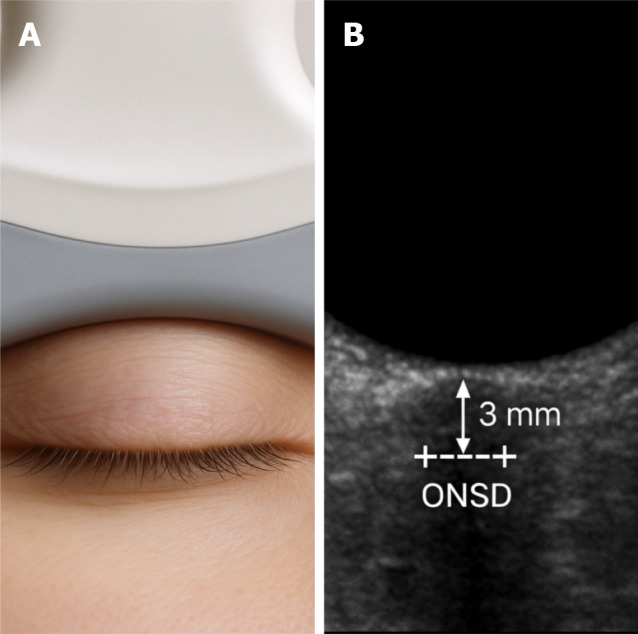
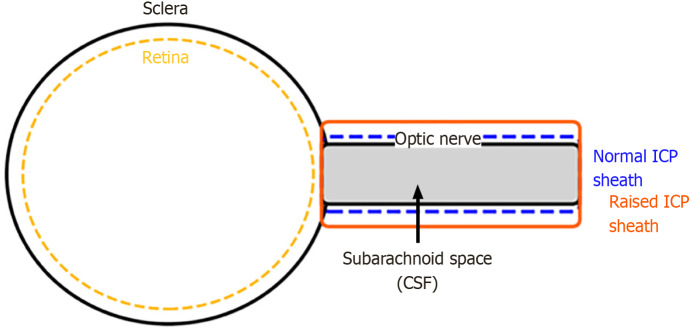
Non-traumatic headache is a common presentation in both emergency and outpatient settings, where timely identification of raised intracranial pressure (ICP) is crucial to prevent severe neurological complications. Conventional diagnostic methods such as computed tomography and lumbar puncture have important limitations, including invasiveness, delayed availability, and limited sensitivity in certain contexts. Point-of-care ultrasound measurement of the optic nerve sheath diameter (ONSD) has emerged as a rapid, non-invasive tool for detecting elevated ICP at the bedside. The technique is based on the anatomical continuity between the intracranial subarachnoid space and the optic nerve sheath, which expands in response to increased ICP. Evidence from multiple studies and meta-analyses indicates that ONSD measurements above 5.0-5.7 mm in adults strongly correlate with elevated ICP, showing pooled sensitivities and specificities approaching 90%. This modality enables immediate triage, guides urgency of neuroimaging, reduces unnecessary radiation exposure, and can be applied in outpatient and low-resource settings. Despite these advantages, ONSD assessment is subject to operator dependency, variability in threshold values, and reduced accuracy in patients with certain ocular or systemic conditions. Advances in artificial intelligence-assisted measurement, coupled with standardized training protocols, have the potential to improve reproducibility and broaden adoption. Overall, point-of-care ultrasound-based ONSD measurement represents a valuable adjunct in the early evaluation of patients with non-traumatic headache, facilitating faster diagnosis, better resource utilization, and improved patient outcomes.



 求助内容:
求助内容: 应助结果提醒方式:

 京公网安备 11010802042870号


