E. A. Popova, A. A. Shestakova, D. E. Surkova, A. A. Osmolovskiy
{"title":"Analysis of the Profile of Secreted Proteolytic Enzymes of the Micromycete Aspergillus ochraceus VKM F-4104D","authors":"E. A. Popova, A. A. Shestakova, D. E. Surkova, A. A. Osmolovskiy","doi":"10.1134/S000368382570005X","DOIUrl":null,"url":null,"abstract":"<p>The enzymes that are least represented but most in demand in biotechnology are highly specific proteases that can hydrolyze difficult-to-degrade substrates. Micromycetes from the genus <i>Aspergillus</i> have been identified as producers of these proteases, which have diverse biochemical properties. For <i>Aspergillus ochraceus</i> VKM F-4104D, which has been previously studied as a producer of a protease that activates protein C and human factor X, its ability to secrete proteolytic enzymes that act on globular and fibrillar proteins has been investigated when cultured in nine different nutrient media with varying nitrogen sources. Maximum collagenolytic and fibrinolytic activity was observed when using a medium containing bovine collagen as an inducer. During preparative isoelectric focusing and subsequent zymography, two proteases with isoelectric points of 5.6 and 6.2 and molecular weights of 74 and 33 kilodaltons, respectively, were identified. As a result of genomic analysis of <i>A. ochraceus</i> VKM F-4104D, 121 potential secreted proteases have been predicted. Transcriptomic analysis revealed that when grown on a medium containing bovine collagen with high proteolytic activity, the microorganism expresses 117 extracellular proteases. Of these, only two were identified using traditional enzymological methods. Thus, the use of more advanced techniques allows for the detection of previously unidentified proteases with different activities among organisms for which information on physiology has been gathered or individual enzymes have been described previously, whereas traditional methods for identifying new enzymes often yield sparse or unrepresentative results.</p>","PeriodicalId":466,"journal":{"name":"Applied Biochemistry and Microbiology","volume":"61 7","pages":"1287 - 1295"},"PeriodicalIF":1.1000,"publicationDate":"2025-12-09","publicationTypes":"Journal Article","fieldsOfStudy":null,"isOpenAccess":false,"openAccessPdf":"","citationCount":"0","resultStr":null,"platform":"Semanticscholar","paperid":null,"PeriodicalName":"Applied Biochemistry and Microbiology","FirstCategoryId":"99","ListUrlMain":"https://link.springer.com/article/10.1134/S000368382570005X","RegionNum":4,"RegionCategory":"生物学","ArticlePicture":[],"TitleCN":null,"AbstractTextCN":null,"PMCID":null,"EPubDate":"","PubModel":"","JCR":"Q4","JCRName":"BIOTECHNOLOGY & APPLIED MICROBIOLOGY","Score":null,"Total":0}
引用次数: 0
Abstract
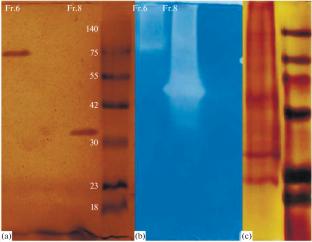
The enzymes that are least represented but most in demand in biotechnology are highly specific proteases that can hydrolyze difficult-to-degrade substrates. Micromycetes from the genus Aspergillus have been identified as producers of these proteases, which have diverse biochemical properties. For Aspergillus ochraceus VKM F-4104D, which has been previously studied as a producer of a protease that activates protein C and human factor X, its ability to secrete proteolytic enzymes that act on globular and fibrillar proteins has been investigated when cultured in nine different nutrient media with varying nitrogen sources. Maximum collagenolytic and fibrinolytic activity was observed when using a medium containing bovine collagen as an inducer. During preparative isoelectric focusing and subsequent zymography, two proteases with isoelectric points of 5.6 and 6.2 and molecular weights of 74 and 33 kilodaltons, respectively, were identified. As a result of genomic analysis of A. ochraceus VKM F-4104D, 121 potential secreted proteases have been predicted. Transcriptomic analysis revealed that when grown on a medium containing bovine collagen with high proteolytic activity, the microorganism expresses 117 extracellular proteases. Of these, only two were identified using traditional enzymological methods. Thus, the use of more advanced techniques allows for the detection of previously unidentified proteases with different activities among organisms for which information on physiology has been gathered or individual enzymes have been described previously, whereas traditional methods for identifying new enzymes often yield sparse or unrepresentative results.
期刊介绍:
Applied Biochemistry and Microbiology is an international peer reviewed journal that publishes original articles on biochemistry and microbiology that have or may have practical applications. The studies include: enzymes and mechanisms of enzymatic reactions, biosynthesis of low and high molecular physiologically active compounds; the studies of their structure and properties; biogenesis and pathways of their regulation; metabolism of producers of biologically active compounds, biocatalysis in organic synthesis, applied genetics of microorganisms, applied enzymology; protein and metabolic engineering, biochemical bases of phytoimmunity, applied aspects of biochemical and immunochemical analysis; biodegradation of xenobiotics; biosensors; biomedical research (without clinical studies). Along with experimental works, the journal publishes descriptions of novel research techniques and reviews on selected topics.

 求助内容:
求助内容: 应助结果提醒方式:

 京公网安备 11010802042870号


