
Frost depth increase under a nuclear winter scenario projected to sever piped-water access in the Northern Hemisphere
IF 4.3
Q1 Earth and Planetary Sciences
引用次数: 0
Abstract
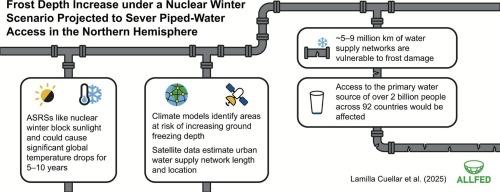
The continuous functioning of the underground water supply networks is essential for many aspects of modern civilization. Therefore, it is essential to keep such critical infrastructure safe from disasters. However, existing risk assessment studies often assume relatively stable climate conditions. Abrupt sunlight reduction scenarios, such as those caused by a nuclear war, a large volcanic eruption, or an asteroid impact, could cool the planet by up to 10 °C and thus frost-damage water pipes. This study investigates such vulnerability of the global underground water supply network in urban areas, in a nuclear winter – one such abrupt climate shift resulting from a nuclear war. We use climate modeling data simulating a nuclear exchange between Russia and the United States of America, in combination with predictions of the network location and density derived from nighttime light and artificial impervious surface data. By considering an increase in maximum frost depth under nuclear winter conditions, we identify areas where such networks are most vulnerable to disruption, and predict the length of the potentially affected pipelines using population-size-based and street-network-length-based models. As estimated, a total of ∼ 5–9 million kilometers of this critical infrastructure in 92 countries is at risk of freezing, potentially impacting the primary water source of over 2 billion individuals. Our findings highlight the need to expand the scope of climate resilience assessments in water risk research to include a broader range of climate scenarios, including sudden cold shifts.
在核冬天的情景下,霜冻深度的增加预计将切断北半球的管道供水
地下供水网络的持续运作对现代文明的许多方面都是必不可少的。因此,确保这些关键基础设施不受灾害影响至关重要。然而,现有的风险评估研究往往假设相对稳定的气候条件。由于核战争、大型火山爆发或小行星撞击造成的突然日照减少,可能会使地球温度降低10摄氏度,从而使水管受到霜冻。这项研究调查了在核冬天(由核战争引起的气候突变)下,城市地区全球地下水供应网络的脆弱性。我们使用模拟俄罗斯和美国之间核交换的气候建模数据,结合从夜间灯光和人工不透水表面数据得出的网络位置和密度预测。通过考虑核冬季条件下最大霜深的增加,我们确定了此类网络最容易受到破坏的区域,并使用基于人口规模和基于街道网络长度的模型预测可能受影响的管道的长度。据估计,92个国家共有约500万至900万公里的这一关键基础设施面临冻结的风险,可能影响超过20亿人的主要水源。我们的研究结果强调,有必要扩大水风险研究中气候适应能力评估的范围,以包括更广泛的气候情景,包括突然的冷移。
本文章由计算机程序翻译,如有差异,请以英文原文为准。
求助全文
约1分钟内获得全文
求助全文
来源期刊
Water Security
Earth and Planetary Sciences-Oceanography
CiteScore
8.50
自引率
0.00%
发文量
17
期刊介绍:
Water Security aims to publish papers that contribute to a better understanding of the economic, social, biophysical, technological, and institutional influencers of current and future global water security. At the same time the journal intends to stimulate debate, backed by science, with strong interdisciplinary connections. The goal is to publish concise and timely reviews and synthesis articles about research covering the following elements of water security: -Shortage- Flooding- Governance- Health and Sanitation
 求助内容:
求助内容: 应助结果提醒方式:

 京公网安备 11010802042870号


