Acer VanWallendael, Xingxing Li, Dan Xie, Kallysa Taylor, Evan Handowski, Jose Serate, Lillian M. Barten, Yaoping Zhang, Kurt Thelen, Robert L. Last, Trey K. Sato, David B. Lowry
{"title":"Switchgrass Steroidal Saponins Reduce Fungal Disease but Decrease Yeast Fermentation Yield","authors":"Acer VanWallendael, Xingxing Li, Dan Xie, Kallysa Taylor, Evan Handowski, Jose Serate, Lillian M. Barten, Yaoping Zhang, Kurt Thelen, Robert L. Last, Trey K. Sato, David B. Lowry","doi":"10.1111/gcbb.70097","DOIUrl":null,"url":null,"abstract":"<p>Increasing the production of bioproducts from lignocellulosic feedstocks requires improvement in both field production and biorefinery efficiency. When plant traits arise that improve field production but decrease biofuel yield, these trade-offs can represent challenges in the entire production process. To examine trade-offs between field and production traits, we examined factors underlying switchgrass resistance to fungal rust pathogens in field conditions and factors that impede yeast fermentation in the lab using repeated measurements on a switchgrass genetic diversity panel. We found that the same switchgrass genotypes that showed high fungal pathogen resistance also showed recalcitrance to yeast fermentation. These switchgrass genotypes were mostly from the Atlantic genetic group, which had high levels of specialized metabolites of the saponin class. Among 1589 metabolites identified through metabolomics, we found that saponins were among the most likely to explain variation in both rust infection and fermentation yield using random forest feature selection, and that only four of these were sufficient to explain 57.9% of the variation in rust susceptibility. Through follow-up testing in recalcitrant biomass, we found that the bacterium <i>Zymomonas mobilis</i> does not suffer the same inhibition as the yeast <i>Saccharomyces cerevisiae</i>, and that the addition of ergosterol (thought to be the fungal cellular target of saponin inhibition) rescues yeast fermentation. Several lines of evidence point to a central role for saponins as key metabolites protecting switchgrass from fungal pathogens and interfering with yeast fermentation, underscoring an ongoing need for collaboration between plant breeders and biofuel production scientists.</p>","PeriodicalId":55126,"journal":{"name":"Global Change Biology Bioenergy","volume":"18 1","pages":""},"PeriodicalIF":4.9000,"publicationDate":"2025-12-04","publicationTypes":"Journal Article","fieldsOfStudy":null,"isOpenAccess":false,"openAccessPdf":"https://onlinelibrary.wiley.com/doi/epdf/10.1111/gcbb.70097","citationCount":"0","resultStr":null,"platform":"Semanticscholar","paperid":null,"PeriodicalName":"Global Change Biology Bioenergy","FirstCategoryId":"5","ListUrlMain":"https://onlinelibrary.wiley.com/doi/10.1111/gcbb.70097","RegionNum":3,"RegionCategory":"工程技术","ArticlePicture":[],"TitleCN":null,"AbstractTextCN":null,"PMCID":null,"EPubDate":"","PubModel":"","JCR":"Q1","JCRName":"AGRONOMY","Score":null,"Total":0}
引用次数: 0
Abstract
Increasing the production of bioproducts from lignocellulosic feedstocks requires improvement in both field production and biorefinery efficiency. When plant traits arise that improve field production but decrease biofuel yield, these trade-offs can represent challenges in the entire production process. To examine trade-offs between field and production traits, we examined factors underlying switchgrass resistance to fungal rust pathogens in field conditions and factors that impede yeast fermentation in the lab using repeated measurements on a switchgrass genetic diversity panel. We found that the same switchgrass genotypes that showed high fungal pathogen resistance also showed recalcitrance to yeast fermentation. These switchgrass genotypes were mostly from the Atlantic genetic group, which had high levels of specialized metabolites of the saponin class. Among 1589 metabolites identified through metabolomics, we found that saponins were among the most likely to explain variation in both rust infection and fermentation yield using random forest feature selection, and that only four of these were sufficient to explain 57.9% of the variation in rust susceptibility. Through follow-up testing in recalcitrant biomass, we found that the bacterium Zymomonas mobilis does not suffer the same inhibition as the yeast Saccharomyces cerevisiae, and that the addition of ergosterol (thought to be the fungal cellular target of saponin inhibition) rescues yeast fermentation. Several lines of evidence point to a central role for saponins as key metabolites protecting switchgrass from fungal pathogens and interfering with yeast fermentation, underscoring an ongoing need for collaboration between plant breeders and biofuel production scientists.
期刊介绍:
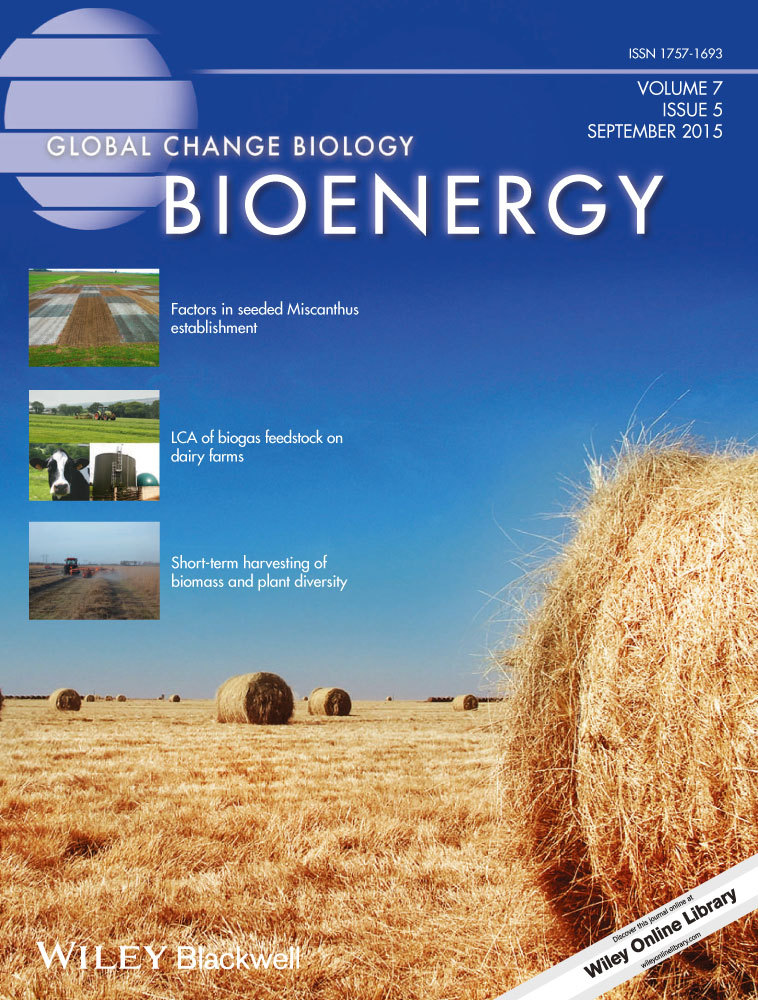
GCB Bioenergy is an international journal publishing original research papers, review articles and commentaries that promote understanding of the interface between biological and environmental sciences and the production of fuels directly from plants, algae and waste. The scope of the journal extends to areas outside of biology to policy forum, socioeconomic analyses, technoeconomic analyses and systems analysis. Papers do not need a global change component for consideration for publication, it is viewed as implicit that most bioenergy will be beneficial in avoiding at least a part of the fossil fuel energy that would otherwise be used.
Key areas covered by the journal:
Bioenergy feedstock and bio-oil production: energy crops and algae their management,, genomics, genetic improvements, planting, harvesting, storage, transportation, integrated logistics, production modeling, composition and its modification, pests, diseases and weeds of feedstocks. Manuscripts concerning alternative energy based on biological mimicry are also encouraged (e.g. artificial photosynthesis).
Biological Residues/Co-products: from agricultural production, forestry and plantations (stover, sugar, bio-plastics, etc.), algae processing industries, and municipal sources (MSW).
Bioenergy and the Environment: ecosystem services, carbon mitigation, land use change, life cycle assessment, energy and greenhouse gas balances, water use, water quality, assessment of sustainability, and biodiversity issues.
Bioenergy Socioeconomics: examining the economic viability or social acceptability of crops, crops systems and their processing, including genetically modified organisms [GMOs], health impacts of bioenergy systems.
Bioenergy Policy: legislative developments affecting biofuels and bioenergy.
Bioenergy Systems Analysis: examining biological developments in a whole systems context.


 求助内容:
 应助结果提醒方式:


 京公网安备 11010802042870号


