
Kinematic handwriting impairments in olfactory dysfunction-related post-acute covid syndrome: short and long-term neurophysiological considerations
IF 1.4
3区 心理学
Q3 NEUROSCIENCES
引用次数: 0
Abstract
Background
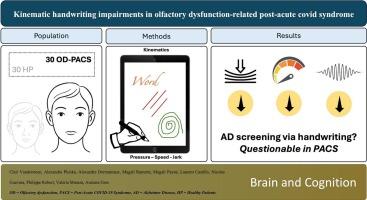
Post-Acute COVID-19 Syndrome (PACS) frequently includes persistent olfactory dysfunction (OD) and may share neurocognitive features with Alzheimer’s disease (AD). While fine motor impairments in handwriting are established in AD, they have not been systematically investigated in PACS.
Methods
In this prospective-retrospective study, handwriting kinematics from 30 patients with OD-related PACS were compared with those of 30 healthy participants (HP) matched for age, sex, and education. Tasks were performed on a digital tablet which automatically extracted kinematic parameters including average pressure (AVP), maximum pressure (MXP), average speed (AVS), and average jerk (AVJ) across linguistic, cognitive non-linguistic, and non-cognitive non-linguistic tasks. A separate cohort comprising 16 patients with AD or mild cognitive impairment (MCI) and 16 matched controls was also evaluated.
Results
Patients with OD-PACS showed significantly lower AVP, MXP, AVS, and AVJ values than HP (all p < 0.01), with deficits evident across all task categories. No significant correlations were found between olfactory test scores and kinematic parameters. In contrast, AD/MCI patients exhibited higher AVP and MXP in specific tasks.
Conclusions
This first kinematic handwriting analysis in OD-PACS reveals fine motor slowing, reduced pressure, and decreased movement variability. These alterations, independent of olfactory performance, may affect the reliability of handwriting-based AD screening in this population. Longitudinal studies are warranted to clarify causality and potential reversibility.
嗅觉功能障碍相关急性后冠状病毒综合征的动态书写障碍:短期和长期神经生理学考虑
急性后COVID-19综合征(PACS)通常包括持续性嗅觉功能障碍(OD),并可能与阿尔茨海默病(AD)具有相同的神经认知特征。虽然在AD中已经建立了书写方面的精细运动障碍,但在PACS中还没有系统的研究。方法在本前瞻性-回顾性研究中,对30例od相关PACS患者的笔迹运动学进行了比较,并与30名年龄、性别和教育程度相匹配的健康参与者(HP)进行了比较。在一个数字平板电脑上完成任务,自动提取语言、认知非语言和非认知非语言任务的运动学参数,包括平均压力(AVP)、最大压力(MXP)、平均速度(AVS)和平均加速度(AVJ)。另一个单独的队列包括16名AD或轻度认知障碍(MCI)患者和16名匹配的对照组。结果OD-PACS患者的AVP、MXP、AVS和AVJ值显著低于HP (p < 0.01),且在所有任务类别中均存在明显缺陷。嗅觉测试成绩与运动参数之间无显著相关性。相比之下,AD/MCI患者在特定任务中表现出更高的AVP和MXP。这是OD-PACS患者的首次运动学笔迹分析,揭示了精细运动减慢、压力降低和运动变异性降低。这些独立于嗅觉表现的改变可能会影响该人群中基于笔迹的阿尔茨海默病筛查的可靠性。有必要进行纵向研究,以澄清因果关系和潜在的可逆性。
本文章由计算机程序翻译,如有差异,请以英文原文为准。
求助全文
约1分钟内获得全文
求助全文
来源期刊
Brain and Cognition
医学-神经科学
CiteScore
4.60
自引率
0.00%
发文量
46
审稿时长
6 months
期刊介绍:
Brain and Cognition is a forum for the integration of the neurosciences and cognitive sciences. B&C publishes peer-reviewed research articles, theoretical papers, case histories that address important theoretical issues, and historical articles into the interaction between cognitive function and brain processes. The focus is on rigorous studies of an empirical or theoretical nature and which make an original contribution to our knowledge about the involvement of the nervous system in cognition. Coverage includes, but is not limited to memory, learning, emotion, perception, movement, music or praxis in relationship to brain structure or function. Published articles will typically address issues relating some aspect of cognitive function to its neurological substrates with clear theoretical import, formulating new hypotheses or refuting previously established hypotheses. Clinical papers are welcome if they raise issues of theoretical importance or concern and shed light on the interaction between brain function and cognitive function. We welcome review articles that clearly contribute a new perspective or integration, beyond summarizing the literature in the field; authors of review articles should make explicit where the contribution lies. We also welcome proposals for special issues on aspects of the relation between cognition and the structure and function of the nervous system. Such proposals can be made directly to the Editor-in-Chief from individuals interested in being guest editors for such collections.
 求助内容:
求助内容: 应助结果提醒方式:

 京公网安备 11010802042870号


