
Assessing the impact of hydrological extremes on food security from post-disaster reporting
IF 9.6
1区 经济学
Q1 FOOD SCIENCE & TECHNOLOGY
Global Food Security-Agriculture Policy Economics and Environment
Pub Date : 2025-12-01
Epub Date: 2025-10-07
DOI:10.1016/j.gfs.2025.100889
引用次数: 0
Abstract
Climate change can potentially drive variations in the frequency and magnitude of hydrological extremes, and in turn, the impact these events have on agriculture. Agricultural damage resulting from extreme events can significantly affect food security at multiple scales, especially in contexts where pre-existing unfavorable social and economic conditions already hinder the stability and the effectiveness of the food supply chain. In these contexts, formulating approaches to directly quantify food security impacts of extreme events in a way that is compatible with local data availability, but at the same time reliable and transparent, becomes a crucial and urgent matter. Moreover, while the importance of the multifaceted repercussions of agricultural damage on food security has been highlighted in the current literature, investigations on impacts other than reduced crop availability remain understudied. Here, we propose a methodology to derive metrics of food availability, access, and utilization impacts from post-disaster assessments, by putting the affected communities at the core of the analysis, providing perspectives on food stability impacts. We apply the methodology to the severe floods that affected Malawi in the early months of 2015. We find that agricultural losses correspond to food sufficient for feeding more than 300,000 people and for balancing the diet of almost 2.3 million. Food security impacts also appear to disproportionately hit poorer and less food-secure districts. Despite necessary simplifications and associated limitations, the proposed methodology is easily replicable in other post-disaster contexts, allowing to provide more insightful information to policy and practice aimed at post-disaster food security management and restoration.
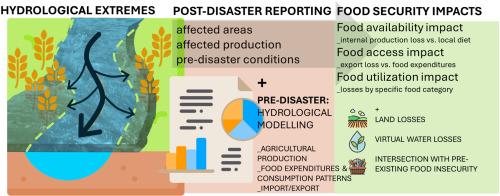
通过灾后报告评估水文极端事件对粮食安全的影响
气候变化可能会导致极端水文事件发生的频率和程度发生变化,进而影响这些事件对农业的影响。极端事件造成的农业破坏可以在多个层面上严重影响粮食安全,特别是在先前不利的社会和经济条件已经阻碍粮食供应链的稳定性和有效性的情况下。在这种情况下,制定方法,直接量化极端事件对粮食安全的影响,既要与当地可用数据兼容,又要可靠和透明,这是一项至关重要和紧迫的任务。此外,虽然目前的文献强调了农业破坏对粮食安全的多方面影响的重要性,但对作物产量减少以外的影响的调查仍未得到充分研究。在这里,我们提出了一种方法,通过将受影响社区置于分析的核心,从粮食稳定性影响的角度出发,从灾后评估中得出粮食供应、获取和利用影响的指标。我们将该方法应用于2015年初影响马拉维的严重洪水。我们发现,农业损失相当于足以养活30多万人和平衡近230万人饮食的粮食。粮食安全的影响似乎也不成比例地打击了较贫穷和粮食不安全的地区。尽管有必要的简化和相关的限制,所提出的方法很容易在其他灾后情况下复制,从而为旨在灾后粮食安全管理和恢复的政策和实践提供更有见地的信息。
本文章由计算机程序翻译,如有差异,请以英文原文为准。
求助全文
约1分钟内获得全文
求助全文
来源期刊
Global Food Security-Agriculture Policy Economics and Environment
FOOD SCIENCE & TECHNOLOGY-
CiteScore
20.90
自引率
3.40%
发文量
69
期刊介绍:
Global Food Security plays a vital role in addressing food security challenges from local to global levels. To secure food systems, it emphasizes multifaceted actions considering technological, biophysical, institutional, economic, social, and political factors. The goal is to foster food systems that meet nutritional needs, preserve the environment, support livelihoods, tackle climate change, and diminish inequalities. This journal serves as a platform for researchers, policymakers, and practitioners to access and engage with recent, diverse research and perspectives on achieving sustainable food security globally. It aspires to be an internationally recognized resource presenting cutting-edge insights in an accessible manner to a broad audience.
 求助内容:
求助内容: 应助结果提醒方式:

 京公网安备 11010802042870号


