
Experimental investigation on the multi-failure coupling strength mechanism of the hybrid Steel/GFRP adhesive joint
IF 3.5
3区 材料科学
Q2 ENGINEERING, CHEMICAL
International Journal of Adhesion and Adhesives
Pub Date : 2026-03-01
Epub Date: 2025-12-03
DOI:10.1016/j.ijadhadh.2025.104243
引用次数: 0
Abstract
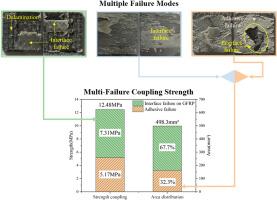
The damage of a bi-material adhesive joint generally involves multiple failure modes, such as the fracture in the adhesive layer and the delamination on the different interfaces. The different combinations of these multiple failure modes generate various macro strengths of the adhesive joint, so the common strength criterion with an assumed single mode is normally limited to predict the damage. Therefore, it's necessary to present test and fracture strength identification methods for all possible failure modes in the adhesive joint. In this work, two kinds of materials – uniform thickness steel plates (UT) and orthogonal woven glass fibre reinforced plastics (GFRP) were used to prepare three types of single-lap shear specimens – UT/UT, GFRP/GFRP and UT/GFRP. With these specimens, firstly, the double-side gluing was found to have higher strength than that of the single-side gluing in both UT/UT and GFRP/GFRP specimens. Secondly, with different pre-crack positions, in total three kinds of failure modes in these adhesive joints have been activated and identified, which are the interface failure on the steel (strength: 21.0 MPa), the adhesive failure (strength: 16.0 MPa) and the interface failure on the GFRP (strength: 10.7 MPa). Finally, it is found that the macro shear strength of the hybrid UT/GFRP adhesive joint could be estimated by the sum of the independent shear strengths of each happened failure multiplied by their corresponding area percentages, which is the quantitative multi-failure coupling strength mechanism of the hybrid Steel/GFRP adhesive joint. This coupling mechanism would be applied for precisely predicting the strength of the bi-material adhesive joint.
钢/玻璃钢复合粘结接头多次破坏耦合强度机理试验研究
双材料粘接接头的损伤通常包含多种破坏模式,如粘接层断裂和不同界面上的分层。多种破坏模式的不同组合会产生不同的粘接宏观强度,因此通常采用假定单一模式的常用强度准则来预测损伤是有限的。因此,有必要针对粘接中各种可能的破坏模式提出试验和断裂强度识别方法。本文采用均厚钢板(UT)和正交编织玻璃纤维增强塑料(GFRP)两种材料,分别制备了UT/UT、GFRP/GFRP和UT/GFRP三种单搭剪试件。通过这些试件,首先发现在UT/UT和GFRP/GFRP试件中,双面粘接强度均高于单面粘接强度;其次,在不同的预裂纹位置,激活并识别了粘结接头的三种破坏模式,即钢的界面破坏(强度:21.0 MPa)、粘结破坏(强度:16.0 MPa)和GFRP的界面破坏(强度:10.7 MPa)。最后,发现UT/GFRP粘接接头的宏观抗剪强度可由每次发生破坏的独立抗剪强度之和乘以其对应的面积百分比来估计,这是钢/GFRP粘接接头的定量多破坏耦合强度机制。该耦合机制可用于双材料粘接接头强度的精确预测。
本文章由计算机程序翻译,如有差异,请以英文原文为准。
求助全文
约1分钟内获得全文
求助全文
来源期刊
International Journal of Adhesion and Adhesives
工程技术-材料科学:综合
CiteScore
6.90
自引率
8.80%
发文量
200
审稿时长
8.3 months
期刊介绍:
The International Journal of Adhesion and Adhesives draws together the many aspects of the science and technology of adhesive materials, from fundamental research and development work to industrial applications. Subject areas covered include: interfacial interactions, surface chemistry, methods of testing, accumulation of test data on physical and mechanical properties, environmental effects, new adhesive materials, sealants, design of bonded joints, and manufacturing technology.
 求助内容:
求助内容: 应助结果提醒方式:

 京公网安备 11010802042870号


