
Evaluation of the anticorrosive effectiveness of an epoxy coating applied to galvanized steel treated with a silane hybrid film incorporating a natural corrosion inhibitor
IF 3.5
3区 材料科学
Q2 ENGINEERING, CHEMICAL
International Journal of Adhesion and Adhesives
Pub Date : 2026-03-01
Epub Date: 2025-11-29
DOI:10.1016/j.ijadhadh.2025.104231
引用次数: 0
Abstract
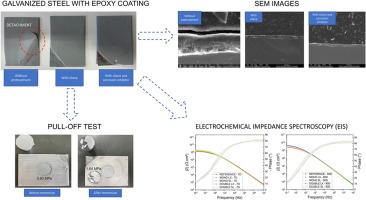
The aim of this study is to evaluate the performance of an organic coating based on epoxy resin applied to the surface of galvanized steel that was pre-treated with the hybrid silane film (TEOS + GPTMS) incorporated with garlic peel powder (Allium sativum L.). Corrosion resistance was evaluated using electrochemical impedance spectroscopy (EIS) and potentiodynamic polarization in NaCl 3.5 wt %. The cross-section SEM images revealed the adhesion of the substrate/coating and silane/epoxy interfaces. Test results indicated that the film modified with the natural inhibitor improved anticorrosive properties compared to the film without silane or natural green inhibitors. It can be concluded in EIS measurements that the complete pretrearment applied to grinded exhibits after 90 days of immersion the highest impedance modulus in the low-frequency region (|Z|0.01Hz = 4.18 × 10⁹ Ω cm2). Similarly, the results after the immersion of pull-off adhesion tests was impaired when complete pretreatment was not used (0.15 MPa), which is a positive result for the future application of coatings with complete pretreatment based on this silane + natural corrosion inhibitor approach (0.60 MPa).
用含天然缓蚀剂的硅烷杂化膜处理镀锌钢,评价环氧涂层的防腐效果
本研究的目的是评估一种基于环氧树脂的有机涂层在镀锌钢表面的性能,该涂层是用混合硅烷膜(TEOS + GPTMS)和大蒜皮粉(Allium sativum L.)预处理的。采用电化学阻抗谱(EIS)和动电位极化法对其在3.5 wt % NaCl中的耐蚀性进行了评价。SEM的横截面图像显示了衬底/涂层和硅烷/环氧界面的粘附性。试验结果表明,与不含硅烷或天然绿色缓蚀剂的膜相比,经天然缓蚀剂改性后的膜的防腐性能有所提高。在EIS测量中可以得出结论,对研磨物进行完全预处理后,浸泡90天后,低频区阻抗模量最高(|Z|0.01Hz = 4.18 × 10⁹ Ω cm2)。同样,当不使用完全预处理(0.15 MPa)时,浸渍后的拉脱附着力测试结果也会受到影响,这对未来基于硅烷+天然缓蚀剂方法(0.60 MPa)的完全预处理涂层的应用是一个积极的结果。
本文章由计算机程序翻译,如有差异,请以英文原文为准。
求助全文
约1分钟内获得全文
求助全文
来源期刊
International Journal of Adhesion and Adhesives
工程技术-材料科学:综合
CiteScore
6.90
自引率
8.80%
发文量
200
审稿时长
8.3 months
期刊介绍:
The International Journal of Adhesion and Adhesives draws together the many aspects of the science and technology of adhesive materials, from fundamental research and development work to industrial applications. Subject areas covered include: interfacial interactions, surface chemistry, methods of testing, accumulation of test data on physical and mechanical properties, environmental effects, new adhesive materials, sealants, design of bonded joints, and manufacturing technology.
 求助内容:
求助内容: 应助结果提醒方式:

 京公网安备 11010802042870号


