
Cationic iridium complexes with a pyridyl-carbene ancillary ligand: strategic color tuning and application in live cell imaging
IF 3.6
3区 物理与天体物理
Q2 OPTICS
Journal of Luminescence
Pub Date : 2026-02-01
Epub Date: 2025-12-01
DOI:10.1016/j.jlumin.2025.121689
引用次数: 0
Abstract
Three novel cationic iridium(III) complexes, [Ir(btp)2(pymi)]PF6 (Ir1), [Ir(tfbtp)2(pymi)]PF6 (Ir2), and [Ir(btq)2(pymi)]PF6 (Ir3), featuring benzothiophene-based cyclometalating ligands and a pyridyl-carbene ancillary ligand, were designed and synthesized. By systematically varying the π-conjugation length and electron-withdrawing substituents on the cyclometalating ligands, we achieved precise tuning of the luminescence properties. In acetonitrile solution, Ir1–Ir3 exhibit intense phosphorescence spanning from yellow to deep-red, with emission maxima at 580, 608, and 639 nm, respectively. Combined photophysical studies and quantum chemical calculations reveal that the emissions predominantly originate from ligand-centered triplet states (3LC π–π*) on the cyclometalating ligands. Furthermore, these complexes serve as excellent luminescent probes for live cell imaging, demonstrating efficient cellular uptake and distinct subcellular localization patterns—from cytoplasmic distribution (Ir1) to lysosomal (Ir2) and membrane-associated (Ir3) targeting. This work underscores the significant potential of pyridyl-carbene based Ir(III) complexes as tunable luminophores for both fundamental photophysical studies and advanced bioimaging applications.
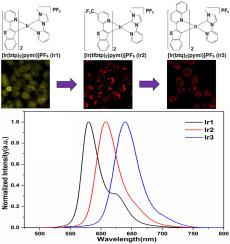
阳离子铱配合物与吡啶羰基辅助配体:策略颜色调整和在活细胞成像中的应用
设计并合成了以苯并噻吩基环金属化配体和吡啶基碳烯为辅助配体的新型阳离子铱(III)配合物[Ir(btp)2(pymi)]PF6 (Ir1)、[Ir(tfbtp)2(pymi)]PF6 (Ir2)和[Ir(btq)2(pymi)]PF6 (Ir3)。通过系统地改变环金属化配体上的π共轭长度和吸电子取代基,我们实现了发光性质的精确调谐。在乙腈溶液中,Ir1-Ir3表现出从黄色到深红色的强烈磷光,发射最大值分别在580、608和639 nm处。结合光物理研究和量子化学计算表明,辐射主要来源于环金属化配体上的配体中心三重态(3LC π -π *)。此外,这些复合物作为活细胞成像的优秀发光探针,展示了有效的细胞摄取和独特的亚细胞定位模式-从细胞质分布(Ir1)到溶酶体(Ir2)和膜相关(Ir3)靶向。这项工作强调了吡啶基羰基Ir(III)配合物作为可调光团在基础光物理研究和高级生物成像应用中的巨大潜力。
本文章由计算机程序翻译,如有差异,请以英文原文为准。
求助全文
约1分钟内获得全文
求助全文
来源期刊
Journal of Luminescence
物理-光学
CiteScore
6.70
自引率
13.90%
发文量
850
审稿时长
3.8 months
期刊介绍:
The purpose of the Journal of Luminescence is to provide a means of communication between scientists in different disciplines who share a common interest in the electronic excited states of molecular, ionic and covalent systems, whether crystalline, amorphous, or liquid.
We invite original papers and reviews on such subjects as: exciton and polariton dynamics, dynamics of localized excited states, energy and charge transport in ordered and disordered systems, radiative and non-radiative recombination, relaxation processes, vibronic interactions in electronic excited states, photochemistry in condensed systems, excited state resonance, double resonance, spin dynamics, selective excitation spectroscopy, hole burning, coherent processes in excited states, (e.g. coherent optical transients, photon echoes, transient gratings), multiphoton processes, optical bistability, photochromism, and new techniques for the study of excited states. This list is not intended to be exhaustive. Papers in the traditional areas of optical spectroscopy (absorption, MCD, luminescence, Raman scattering) are welcome. Papers on applications (phosphors, scintillators, electro- and cathodo-luminescence, radiography, bioimaging, solar energy, energy conversion, etc.) are also welcome if they present results of scientific, rather than only technological interest. However, papers containing purely theoretical results, not related to phenomena in the excited states, as well as papers using luminescence spectroscopy to perform routine analytical chemistry or biochemistry procedures, are outside the scope of the journal. Some exceptions will be possible at the discretion of the editors.
 求助内容:
求助内容: 应助结果提醒方式:

 京公网安备 11010802042870号


