
Smart nanomaterial-crosslinked hydrogels for biomedical applications
Q1 Engineering
Smart Materials in Medicine
Pub Date : 2025-12-01
Epub Date: 2025-11-07
DOI:10.1016/j.smaim.2025.11.001
引用次数: 0
Abstract
Hydrogels have advanced significantly in biomedical applications, yet their inherent hydrophilic matrices often hinder the efficient encapsulation and controlled release of hydrophobic drugs. Nanomaterial-crosslinked (NMC) hydrogels, in which nanomaterials (NMs) serve as crosslinkers rather than mere fillers, represent an innovative platform. NMC hydrogels synergistically integrate the tissue-mimetic and injectable properties of hydrogels with the versatile functionalities of NMs. This review systematically categorizes and discusses the diverse NM-polymer interactions, including irreversible covalent bonds, dynamic covalent bonds, and non-covalent interactions. These interactions that govern the formation and performance of NMC hydrogels and endow them with unique smart behaviors, such as stimuli-responsive phase transitions, programmable cargo release, self-healing capability, and suitability for 3D/4D bioprinting. Particular emphasis is placed on the design principles of NM-polymer interactions and their role in enhancing mechanical robustness, dynamic adaptability, and biomedical functionality. This review aims to inspire the development of more sophisticated and adaptable NMC hydrogel systems, thereby accelerating their translation into clinical practice.
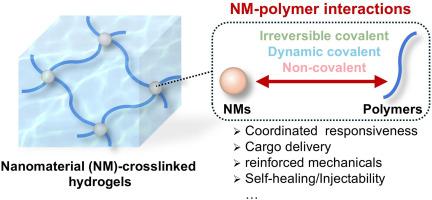
用于生物医学应用的智能纳米材料交联水凝胶
水凝胶在生物医学领域的应用取得了显著进展,但其固有的亲水基质往往阻碍了疏水药物的有效包封和控释。纳米材料-交联(NMC)水凝胶,其中纳米材料(NMs)作为交联剂而不仅仅是填料,代表了一个创新的平台。NMC水凝胶将水凝胶的模拟组织和可注射特性与NMs的多功能功能协同集成。本文系统地对纳米聚合物相互作用进行了分类和讨论,包括不可逆共价键、动态共价键和非共价键相互作用。这些相互作用控制着NMC水凝胶的形成和性能,并赋予它们独特的智能行为,如刺激响应相变、可编程的货物释放、自修复能力以及对3D/4D生物打印的适用性。特别强调纳米聚合物相互作用的设计原则及其在增强机械稳健性,动态适应性和生物医学功能方面的作用。这篇综述旨在激发更复杂和适应性更强的NMC水凝胶系统的发展,从而加速其转化为临床实践。
本文章由计算机程序翻译,如有差异,请以英文原文为准。
求助全文
约1分钟内获得全文
求助全文
来源期刊

Smart Materials in Medicine
Engineering-Biomedical Engineering
CiteScore
14.00
自引率
0.00%
发文量
41
审稿时长
48 days
 求助内容:
求助内容: 应助结果提醒方式:

 京公网安备 11010802042870号


