
Cenozoic extension mechanism of the Weihe Graben, central China: constraints from analog modeling
IF 2.4
3区 地球科学
Q2 GEOSCIENCES, MULTIDISCIPLINARY
Journal of Asian Earth Sciences
Pub Date : 2026-01-01
Epub Date: 2025-11-22
DOI:10.1016/j.jseaes.2025.106875
引用次数: 0
Abstract
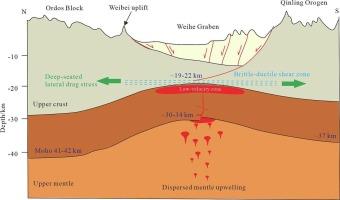
The Weihe Graben, a Cenozoic rift system at the Ordos-Qinling tectonic boundary in East Asia, provides critical insights into intracontinental extension mechanisms, with debate continuing among three models: simple shear via detachment faulting, pure shear through distributed crustal thinning, and a hybrid early pure/late simple shear transition. To resolve this, we conducted 11 scaled analog experiments simulating end-member pure shear (basal stretching) and simple shear (detachment-driven) regimes, testing variables such as extension rate, extension direction, basement heterogeneity, and synkinematic sedimentation. Pure shear systems develop basins bounded by pre-existing basement structures (unaffected by listric faults), with homogeneous basements generating domino/conjugate faults and heterogeneous basements forming graben-horst-graben systems. Oblique extension induces en echelon depressions, and a slower extension rate corresponds to reduced subsidence thickness. In contrast, simple shear systems exhibit three kinematic domains: (i) rolling anticlines, (ii) secondary grabens, and (iii) horizontal translation zones, with basin architecture insensitive to basement variations or extension direction. Synkinematic sedimentation and the sand-to-mud ratio moderately enhanced basin evolution. Comparing natural structures indicates that the half-graben structures in the Weihe Graben were controlled by listric faults, and the en echelon distribution of the Xi’an and Gushi depressions resulted from oblique extension under a pure shear mechanism. Controlled by oblique extension, en echelon faults developed along its northern margin, accompanied by two en echelon depressions. Influenced by the relatively cold and rigid basement, these depressions are distributed around the Lishan area, where listric faults are well-developed. A decreased extension rate further enhanced the localization.
渭河地堑新生代伸展机制:模拟模拟的约束
渭河地堑是东亚鄂尔多斯—秦岭构造边界上的一个新生代裂谷系统,它对陆内伸展机制提供了重要的见解,目前仍有三种模式的争论:滑脱断裂作用下的简单剪切、分布地壳减薄作用下的纯剪切和早期纯/晚期混合简单剪切过渡。为了解决这个问题,我们进行了11个按比例的模拟实验,模拟端部纯剪切(基底拉伸)和简单剪切(分离驱动)机制,测试了拉伸速率、拉伸方向、基底非均质性和同动沉降等变量。纯剪切体系发育的盆地以已有的基底构造为界(不受盘状断层的影响),均质基底形成多米诺/共轭断层,非均质基底形成地堑-地垒-地堑体系。斜向伸展形成雁梯状凹陷,伸展速度越慢,沉降厚度越小。相比之下,简单剪切系统表现出三个运动域:(i)滚动背斜,(ii)次级地堑和(iii)水平平移带,盆地结构对基底变化或伸展方向不敏感。同动沉积作用和砂泥比适度促进了盆地演化。对比自然构造表明,渭河地堑的半地堑构造受盘状断裂控制,西安坳陷和固始坳陷呈雁列状分布,是纯剪切作用下斜向伸展的结果。受斜伸控制,其北缘发育雁列断裂,并伴有两个雁列凹陷。受较冷、刚性基底的影响,这些凹陷主要分布在梨山地区周围,梨山断裂发育。扩展率的降低进一步增强了定位。
本文章由计算机程序翻译,如有差异,请以英文原文为准。
求助全文
约1分钟内获得全文
求助全文
来源期刊
Journal of Asian Earth Sciences
地学-地球科学综合
CiteScore
5.90
自引率
10.00%
发文量
324
审稿时长
71 days
期刊介绍:
Journal of Asian Earth Sciences has an open access mirror journal Journal of Asian Earth Sciences: X, sharing the same aims and scope, editorial team, submission system and rigorous peer review.
The Journal of Asian Earth Sciences is an international interdisciplinary journal devoted to all aspects of research related to the solid Earth Sciences of Asia. The Journal publishes high quality, peer-reviewed scientific papers on the regional geology, tectonics, geochemistry and geophysics of Asia. It will be devoted primarily to research papers but short communications relating to new developments of broad interest, reviews and book reviews will also be included. Papers must have international appeal and should present work of more than local significance.
The scope includes deep processes of the Asian continent and its adjacent oceans; seismology and earthquakes; orogeny, magmatism, metamorphism and volcanism; growth, deformation and destruction of the Asian crust; crust-mantle interaction; evolution of life (early life, biostratigraphy, biogeography and mass-extinction); fluids, fluxes and reservoirs of mineral and energy resources; surface processes (weathering, erosion, transport and deposition of sediments) and resulting geomorphology; and the response of the Earth to global climate change as viewed within the Asian continent and surrounding oceans.
 求助内容:
求助内容: 应助结果提醒方式:

 京公网安备 11010802042870号


