
Modeling Aedes albopictus (Diptera: Culicidae) abundance in Nu‘uanu Valley, Hawai‘i: The role of building footprint size

IF 1.5 3区 农林科学 Q3 ENTOMOLOGY
Journal of Asia-pacific Entomology Pub Date : 2025-12-01 Epub Date: 2025-11-25 DOI:10.1016/j.aspen.2025.102509
John M. Kirsch, Jia-Wei Tay
{"title":"Modeling Aedes albopictus (Diptera: Culicidae) abundance in Nu‘uanu Valley, Hawai‘i: The role of building footprint size","authors":"John M. Kirsch,&nbsp;Jia-Wei Tay","doi":"10.1016/j.aspen.2025.102509","DOIUrl":null,"url":null,"abstract":"<div><div>Since their introduction in Hawai‘i, mosquitoes have contributed to declines in native bird populations and to multiple dengue outbreaks across the islands. The most prevalent mosquito throughout Oahu, in both urban and rural environments, is <em>Aedes albopictus</em> (Skuse). Ovipositional trapping and larval habitat sampling were conducted to create generalized linear models to evaluate how urbanization affects <em>Ae. albopictus</em> abundance and to assess its environmental plasticity across three sites in Nu‘uanu Valley, Oahu, Hawai‘i. Four consecutive weeks of ovitrapping resulted in 31 eggs at the low site, 410 eggs at the middle site, and 85 eggs at the high site. Due to differences in mosquito abundance among sites, we evaluated population drivers including potential larval habitats, abiotic environmental factors, and four measurements of urbanization (total building area, percentage of building area, average building size, and number of buildings). The negative binomial model results indicated that <em>Ae. albopictus</em> was more prevalent in areas containing high densities of small buildings with the average building footprint size being a significant predictor. The elevation and density of potential natural breeding sites were not significant factors contributing to abundance of <em>Ae. albopictus</em>. Because most of these buildings were homes, we posit that residents of these areas located in the Nu‘uanu Valley have a higher risk of mosquito encounters than in other sites evaluated. These single-family residential neighborhoods offer a starting point for mosquito control operations during the next dengue outbreak in Hawai‘i.</div></div>","PeriodicalId":15094,"journal":{"name":"Journal of Asia-pacific Entomology","volume":"28 4","pages":"Article 102509"},"PeriodicalIF":1.5000,"publicationDate":"2025-12-01","publicationTypes":"Journal Article","fieldsOfStudy":null,"isOpenAccess":false,"openAccessPdf":"","citationCount":"0","resultStr":null,"platform":"Semanticscholar","paperid":null,"PeriodicalName":"Journal of Asia-pacific Entomology","FirstCategoryId":"97","ListUrlMain":"https://www.sciencedirect.com/science/article/pii/S1226861525001402","RegionNum":3,"RegionCategory":"农林科学","ArticlePicture":[],"TitleCN":null,"AbstractTextCN":null,"PMCID":null,"EPubDate":"2025/11/25 0:00:00","PubModel":"Epub","JCR":"Q3","JCRName":"ENTOMOLOGY","Score":null,"Total":0}
引用次数: 0

Abstract

Since their introduction in Hawai‘i, mosquitoes have contributed to declines in native bird populations and to multiple dengue outbreaks across the islands. The most prevalent mosquito throughout Oahu, in both urban and rural environments, is Aedes albopictus (Skuse). Ovipositional trapping and larval habitat sampling were conducted to create generalized linear models to evaluate how urbanization affects Ae. albopictus abundance and to assess its environmental plasticity across three sites in Nu‘uanu Valley, Oahu, Hawai‘i. Four consecutive weeks of ovitrapping resulted in 31 eggs at the low site, 410 eggs at the middle site, and 85 eggs at the high site. Due to differences in mosquito abundance among sites, we evaluated population drivers including potential larval habitats, abiotic environmental factors, and four measurements of urbanization (total building area, percentage of building area, average building size, and number of buildings). The negative binomial model results indicated that Ae. albopictus was more prevalent in areas containing high densities of small buildings with the average building footprint size being a significant predictor. The elevation and density of potential natural breeding sites were not significant factors contributing to abundance of Ae. albopictus. Because most of these buildings were homes, we posit that residents of these areas located in the Nu‘uanu Valley have a higher risk of mosquito encounters than in other sites evaluated. These single-family residential neighborhoods offer a starting point for mosquito control operations during the next dengue outbreak in Hawai‘i.

Abstract Image

夏威夷努瓦努山谷白纹伊蚊(双翅目:库蚊科)数量建模:建筑足迹大小的作用
自从蚊子被引入夏威夷以来,它们已经导致了本地鸟类数量的减少,并在岛屿上引发了多次登革热疫情。在瓦胡岛的城市和农村环境中,最常见的蚊子是白纹伊蚊(Skuse)。采用诱卵法和幼虫生境抽样建立广义线性模型,评价城市化对伊蚊的影响。在夏威夷瓦胡岛努瓦努山谷的三个地点评估白纹伊蚊的丰度和环境可塑性。连续4周诱卵,低点31枚,中点410枚,高点85枚。由于不同地点蚊虫丰度的差异,我们评估了种群驱动因素,包括潜在的幼虫栖息地、非生物环境因素和城市化的四项测量(总建筑面积、建筑面积百分比、平均建筑面积和建筑数量)。负二项模型结果表明,Ae。白纹伊蚊在小型建筑密度较高的地区更为普遍,平均建筑占地面积是一个重要的预测因子。潜在自然繁殖地的海拔和密度对伊蚊的丰度影响不显著。蚊。由于这些建筑物大多是住宅,我们假设Nu 'uanu山谷这些地区的居民比其他评估地点的居民遭遇蚊子的风险更高。在夏威夷下一次登革热爆发期间,这些单户住宅社区为蚊虫控制行动提供了一个起点。
本文章由计算机程序翻译,如有差异,请以英文原文为准。
求助全文
约1分钟内获得全文 求助全文
来源期刊
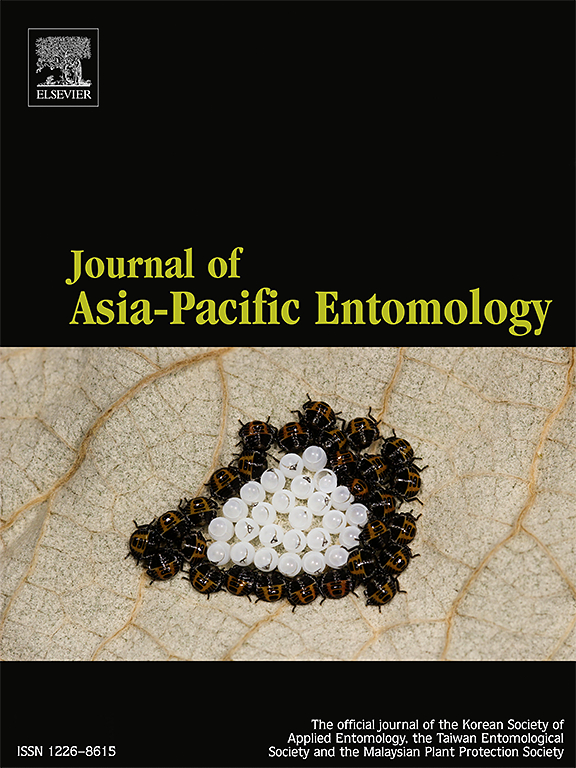
Journal of Asia-pacific Entomology
Journal of Asia-pacific Entomology Agricultural and Biological Sciences-Insect Science
CiteScore
2.70
自引率
6.70%
发文量
152
审稿时长
69 days
期刊介绍: The journal publishes original research papers, review articles and short communications in the basic and applied area concerning insects, mites or other arthropods and nematodes of economic importance in agriculture, forestry, industry, human and animal health, and natural resource and environment management, and is the official journal of the Korean Society of Applied Entomology and the Taiwan Entomological Society.

×
引用
GB/T 7714-2015
复制
MLA
复制
APA
复制
导出至
BibTeX EndNote RefMan NoteFirst NoteExpress
×
提示
您的信息不完整,为了账户安全,请先补充。
现在去补充
×
提示
您因"违规操作"
具体请查看互助需知
我知道了
×
提示
确定
请完成安全验证×
copy
已复制链接
快去分享给好友吧!
我知道了
右上角分享
点击右上角分享
0
联系我们:info@booksci.cn Book学术提供免费学术资源搜索服务,方便国内外学者检索中英文文献。致力于提供最便捷和优质的服务体验。 Copyright © 2023 布克学术 All rights reserved.
京ICP备2023020795号-1
ghs 京公网安备 11010802042870号
Book学术文献互助
Book学术文献互助群
群 号:604180095
Book学术官方微信
小红书


