
Changes in crater lake chemistry after the 2021 eruption at Aso Volcano, Japan: insights from UAV-based hot water sampling
IF 2.3
Q3 GEOSCIENCES, MULTIDISCIPLINARY
Journal of Asian Earth Sciences: X
Pub Date : 2025-12-01
Epub Date: 2025-11-23
DOI:10.1016/j.jaesx.2025.100211
引用次数: 0
Abstract
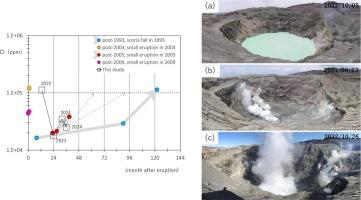
Several volcanoes in Japan have summit craters filled with water, including Zao, Kusatsu-Shirane, Kirishima, and Aso volcanoes. Aso Volcano, located in central Kyushu, is an active caldera volcano with a crater lake whose water volume varies from nearly zero to full capacity depending on volcanic activity. Following the latest eruption of Aso Volcano in October 2021, we conducted UAV-based hot water sampling at the Nakadake First Crater (NFC) in 2022, 2023, and 2024. These efforts enabled the development of sampling method using a weight, rope, and sterilized sampling bottle with a long fluorinated ethylene propylene (FEP) sleeve, allowing hot water collection at temperatures higher than previously possible. We found that crater lake chemistry changed drastically within one year, with sulfate concentrations decreasing rapidly from 211,900 ppm in 2022 to 19,940 ppm in 2023 (approximately one-tenth), while temperature changes were smaller (about 5 °C). Compared with intermittent records from 1993 to 2009, these sulfate values were up to twice as high as previously reported maxima. Such deviations suggest increased inputs of magma-derived fluids, possibly associated with the 2021 eruption. Based on compiled data, we propose that extremely high chlorine concentrations in lake water can serve as significant indicators for predicting forthcoming eruptions, regardless of temperature changes. Our findings indicate that short-interval monitoring of the NFC is necessary to understand the transition between open and closed hydrothermal systems, especially after eruptions. Combined with UAV-based methods capable of sampling during eruptions, this approach will enhance understanding of crater lake hydrothermal dynamics and eruption forecasting.
2021年日本麻生火山喷发后火山口湖化学的变化:来自无人机热水采样的见解
日本的几座火山的山顶都有充满水的火山口,包括早灶火山、草津shirane火山、雾岛火山和麻生火山。阿索火山位于九州中部,是一座活火山,火山口湖的水量根据火山活动从几乎为零到满负荷变化。在2021年10月麻生火山最近一次喷发之后,我们于2022年、2023年和2024年在中泷第一火山口(NFC)进行了无人机热水取样。这些努力使取样方法得以发展,该方法使用砝码、绳子和带有长氟化乙丙烯(FEP)套管的灭菌取样瓶,可以在比以前更高的温度下收集热水。我们发现火山口湖的化学成分在一年内发生了巨大变化,硫酸盐浓度从2022年的211,900 ppm迅速下降到2023年的19,940 ppm(约十分之一),而温度变化较小(约5°C)。与1993年至2009年的间歇性记录相比,这些硫酸盐值高达先前报道的最大值的两倍。这种偏差表明岩浆衍生流体的输入增加,可能与2021年的喷发有关。根据汇编的数据,我们提出,无论温度如何变化,湖水中极高的氯浓度都可以作为预测即将爆发的重要指标。我们的研究结果表明,短间隔监测NFC是必要的,以了解开放和封闭的热液系统之间的过渡,特别是在喷发之后。结合能够在喷发期间进行采样的基于无人机的方法,该方法将增强对火山口湖热液动力学和喷发预测的理解。
本文章由计算机程序翻译,如有差异,请以英文原文为准。
求助全文
约1分钟内获得全文
求助全文
来源期刊
Journal of Asian Earth Sciences: X
Earth and Planetary Sciences-Earth-Surface Processes
CiteScore
3.40
自引率
0.00%
发文量
53
审稿时长
28 weeks
 求助内容:
求助内容: 应助结果提醒方式:

 京公网安备 11010802042870号


