
Integrating life cycle and techno-economic assessment for bio-based lactic acid production from industrial residues
IF 11.2
1区 社会学
Q1 ENVIRONMENTAL STUDIES
Environmental Impact Assessment Review
Pub Date : 2026-04-01
Epub Date: 2025-11-30
DOI:10.1016/j.eiar.2025.108291
引用次数: 0
Abstract
Evaluating the economic viability and environmental impact of emerging technologies is crucial for the transition to a bio-based economy. This study proposes a methodology to assess the environmental and economic performance of bio-based lactic acid (LA) production by scaling up from pilot to industrial levels using fiber sludge, a residue from the pulp and paper industry, as a feedstock. Process design, Techno-Economic Analysis (TEA) and Life Cycle Assessment (LCA) were conducted at pilot scale to identify key environmental and economic hotspots. External costs were estimated following the environmental Life Cycle Costing (eLCC) approach using the Environmental Prices (EP) method. At the pilot scale, the LCA indicated a Global Warming Potential (GWP) of 3.87 kg CO₂-eq, which aligns with the values reported in previous studies. Scaling up to different plant capacities revealed the potential economies of scale. At a production rate of 50 kt per year, the Minimum Selling Price (MSP) was estimated at 1.71€/kg, which is comparable to that of other bio-based LA production routes. Assuming proportional environmental impacts from pilot to industrial scale, external costs were integrated into the MSP, resulting in adjusted values of 2.04€/kg (lower value), 2.21€/kg (central value), and 2.46 €/kg (upper value). Sensitivity and uncertainty analyses using Monte Carlo simulations indicated an 87.5 % probability of achieving a positive Net Present Value (NPV). This study highlights the need for standardised methodologies to evaluate the environmental and economic impacts of emerging bio-based technologies, particularly when accounting for external costs.
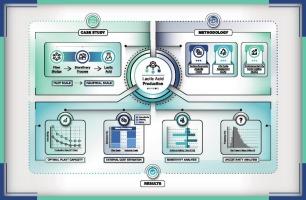
工业废渣生物制乳酸的生命周期与技术经济综合评价
评估新兴技术的经济可行性和环境影响对于向生物经济过渡至关重要。本研究提出了一种方法,通过使用纤维污泥(纸浆和造纸工业的残留物)作为原料,从试验规模扩大到工业水平,来评估生物基乳酸(LA)生产的环境和经济性能。在中试规模下进行了工艺设计、技术经济分析(TEA)和生命周期评估(LCA),以确定关键的环境和经济热点。外部成本是根据使用环境价格(EP)方法的环境生命周期成本(eLCC)方法估算的。在试点规模上,LCA表明全球变暖潜能值(GWP)为3.87 kg CO₂-eq,这与先前研究报告的值一致。扩大到不同的工厂产能揭示了潜在的规模经济。以每年5万吨的生产速度,最低销售价格(MSP)估计为1.71欧元/公斤,与其他生物基LA生产路线相当。假设从试点到工业规模的环境影响是成比例的,外部成本被整合到MSP中,得到调整值为2.04欧元/公斤(低值)、2.21欧元/公斤(中央值)和2.46欧元/公斤(最高值)。使用蒙特卡罗模拟的敏感性和不确定性分析表明,实现正净现值(NPV)的概率为87.5%。这项研究强调需要标准化的方法来评估新兴生物基技术的环境和经济影响,特别是在考虑外部成本时。
本文章由计算机程序翻译,如有差异,请以英文原文为准。
求助全文
约1分钟内获得全文
求助全文
来源期刊
Environmental Impact Assessment Review
ENVIRONMENTAL STUDIES-
CiteScore
12.60
自引率
10.10%
发文量
200
审稿时长
33 days
期刊介绍:
Environmental Impact Assessment Review is an interdisciplinary journal that serves a global audience of practitioners, policymakers, and academics involved in assessing the environmental impact of policies, projects, processes, and products. The journal focuses on innovative theory and practice in environmental impact assessment (EIA). Papers are expected to present innovative ideas, be topical, and coherent. The journal emphasizes concepts, methods, techniques, approaches, and systems related to EIA theory and practice.
 求助内容:
求助内容: 应助结果提醒方式:

 京公网安备 11010802042870号


