
Multivariate environmental and social life cycle assessment of circular recycled-plastic voided slabs for data-driven sustainable construction
IF 12.2
1区 社会学
Q1 ENVIRONMENTAL STUDIES
Environmental Impact Assessment Review
Pub Date : 2026-04-01
Epub Date: 2025-12-05
DOI:10.1016/j.eiar.2025.108297
引用次数: 0
Abstract
The construction sector is a major contributor to climate change and resource depletion, responsible for over 36 % of global final energy use and nearly half of all raw material consumption. Addressing structural systems' environmental and social sustainability is a critical challenge for the transition toward a circular and low-carbon built environment. Among structural elements, floor slabs are particularly critical due to their intensive use of concrete and steel. This study develops an integrated, data-driven framework that combines multivariate structural modeling with environmental and social life cycle assessment (E-LCA and S-LCA), explicitly describing the methodological approach before results are introduced. Leveraging empirical data from 67 real buildings, the framework generates robust pre-dimensioning guidelines that support early-stage decision-making in sustainable construction. Results demonstrate substantial material and impact reductions: concrete and steel use decrease by 23–33 % and up to 29 %, respectively, leading to average endpoint environmental impact reductions of 25 % and global warming potential decreases of 24 %, reaching 30 % for six-meter spans. S-LCA highlights social risk reductions up to 20 % in the Workers and Local Community categories, reflecting safer and more socially responsible construction practices. By integrating advanced multivariate modeling with comprehensive life cycle assessment, this research delivers a decision-oriented tool that accelerates the adoption of circular, low-carbon construction systems. The revised abstract also highlights the policy and management implications: the findings provide actionable insights for engineers, regulators, and policymakers, supporting the development of building codes, resource-efficient design guidelines, and climate-aligned strategies for the construction sector. Ultimately, this work promotes a resilient and sustainable built environment, advancing circular economy principles and the United Nations Sustainable Development Goals (SDGs).
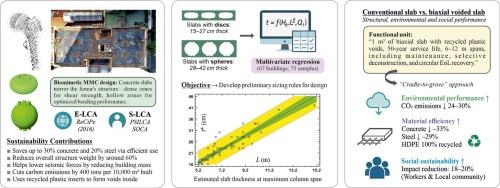
数据驱动的可持续建筑循环再生塑料中空板的多元环境与社会生命周期评价
建筑业是造成气候变化和资源枯竭的主要因素,占全球最终能源消耗的36%以上,占所有原材料消耗的近一半。解决结构系统的环境和社会可持续性是向循环低碳建筑环境过渡的关键挑战。在结构元素中,楼板尤其重要,因为它们大量使用混凝土和钢材。本研究开发了一个集成的、数据驱动的框架,将多变量结构建模与环境和社会生命周期评估(E-LCA和S-LCA)相结合,在介绍结果之前明确描述了方法方法。利用来自67座真实建筑的经验数据,该框架生成了强大的预维度指导方针,支持可持续建筑的早期决策。结果显示了大量的材料和影响的减少:混凝土和钢材的使用分别减少了23 - 33%和高达29%,导致平均端点环境影响减少25%,全球变暖潜势减少24%,6米跨度达到30%。S-LCA强调,在工人和当地社区类别中,社会风险降低了20%,反映了更安全和更具社会责任的建筑实践。通过将先进的多元建模与综合生命周期评估相结合,本研究提供了一个决策导向的工具,加速了循环低碳建筑系统的采用。修订后的摘要还强调了政策和管理方面的影响:研究结果为工程师、监管机构和政策制定者提供了可操作的见解,为建筑行业制定建筑规范、资源节约型设计指南和与气候相关的战略提供了支持。最终,这项工作促进了一个有弹性和可持续的建筑环境,推进循环经济原则和联合国可持续发展目标(sdg)。
本文章由计算机程序翻译,如有差异,请以英文原文为准。
求助全文
约1分钟内获得全文
求助全文
来源期刊
Environmental Impact Assessment Review
ENVIRONMENTAL STUDIES-
CiteScore
12.60
自引率
10.10%
发文量
200
审稿时长
33 days
期刊介绍:
Environmental Impact Assessment Review is an interdisciplinary journal that serves a global audience of practitioners, policymakers, and academics involved in assessing the environmental impact of policies, projects, processes, and products. The journal focuses on innovative theory and practice in environmental impact assessment (EIA). Papers are expected to present innovative ideas, be topical, and coherent. The journal emphasizes concepts, methods, techniques, approaches, and systems related to EIA theory and practice.
 求助内容:
求助内容: 应助结果提醒方式:

 京公网安备 11010802042870号


