
Effect of waxy rice kernel structure on hydration behavior during the production of Zongzi
IF 3.7
2区 农林科学
Q2 FOOD SCIENCE & TECHNOLOGY
引用次数: 0
Abstract
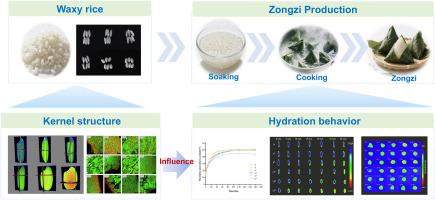
The hydration behavior of waxy rice, specifically water absorption and diffusion during soaking and cooking, plays an important role in determining the quality of Zongzi. However, the relationship between this hydration behavior and the kernel structure has not been fully clarified. In this study, high-resolution X-ray microtomography (XMT) and confocal laser scanning microscopy (CLSM) were used to analyze the kernel structure and density of three representative types of waxy rice, with particular attention to how structural features influence the hydration process. Results showed that Type III waxy rice, known for producing Zongzi of superior quality, exhibited uniformly small starch granules and a moderately distributed protein layer. This structural characteristic contributed to lower density and more homogeneous porosity, which was associated with improved moisture distribution and hydration efficiency. Mechanistic analysis suggested that the morphology and distribution of starch and protein may influence kernel density and internal porosity, thereby affecting water absorption and diffusion behaviors. These findings reveal the structural causes of quality differences in Zongzi among different types of waxy rice, providing a theoretical basis for the selection of waxy rice as a raw material for Zongzi and the setting of production parameters.
糯稻籽粒结构对粽子生产水化行为的影响
糯米的水化行为,特别是浸泡和蒸煮过程中的吸水和扩散,是决定粽子品质的重要因素。然而,这种水化行为与核结构之间的关系尚未完全阐明。本研究采用高分辨率x射线显微断层扫描(XMT)和共聚焦激光扫描显微镜(CLSM)分析了三种代表性糯稻的籽粒结构和密度,特别关注了结构特征对水化过程的影响。结果表明,生产优质粽子的III型糯稻淀粉粒均匀细小,蛋白质层分布适中;这一结构特征导致了较低的密度和更均匀的孔隙率,从而改善了水分分布和水化效率。机理分析表明,淀粉和蛋白质的形态和分布可能影响籽粒密度和内部孔隙率,从而影响籽粒的吸水和扩散行为。研究结果揭示了不同糯米品种粽子品质差异的结构原因,为糯米粽子原料的选择和生产参数的设置提供了理论依据。
本文章由计算机程序翻译,如有差异,请以英文原文为准。
求助全文
约1分钟内获得全文
求助全文
来源期刊
Journal of Cereal Science
工程技术-食品科技
CiteScore
7.80
自引率
2.60%
发文量
163
审稿时长
38 days
期刊介绍:
The Journal of Cereal Science was established in 1983 to provide an International forum for the publication of original research papers of high standing covering all aspects of cereal science related to the functional and nutritional quality of cereal grains (true cereals - members of the Poaceae family and starchy pseudocereals - members of the Amaranthaceae, Chenopodiaceae and Polygonaceae families) and their products, in relation to the cereals used. The journal also publishes concise and critical review articles appraising the status and future directions of specific areas of cereal science and short communications that present news of important advances in research. The journal aims at topicality and at providing comprehensive coverage of progress in the field.
 求助内容:
求助内容: 应助结果提醒方式:

 京公网安备 11010802042870号


