{"title":"Termination of figure-of-eight reentry via resonant feedback pacing.","authors":"Navneet Roshan, Rupamanjari Majumder","doi":"10.3389/fnetp.2025.1692372","DOIUrl":null,"url":null,"abstract":"<p><p>Sudden cardiac death (SCD) is often precipitated by reentrant arrhythmias such as ventricular tachycardia (VT) and ventricular fibrillation (VF), whose underlying dynamics are frequently sustained by spiral waves of electrical activity. Disrupting these waves can restore normal rhythm, but conventional low-energy pacing strategies are often ineffective in VF, where high-frequency, multi-wave interactions dominate. Resonant feedback-controlled antitachycardia pacing (rF-ATP), which times global electrical stimuli based on real-time feedback from the tissue, has been shown to robustly terminate single spirals under diverse conditions. However, its impact on interacting spiral waves-arguably a more realistic substrate for life-threatening arrhythmias-remains unexplored. Here, we use numerical simulations to investigate the effect of rF-ATP on figure-of-eight reentry, a clinically relevant configuration consisting of two counter-rotating spirals. We show that rF-ATP consistently terminates this pattern, regardless of feedback point location, through two distinct dynamical pathways: mutual collision of phase singularities or annihilation at inexcitable boundaries. We further demonstrate the method's efficacy across variations in feedback point and spiral arrangement, indicating robustness to geometrical and positional heterogeneity. These results highlight rF-ATP as a promising low-energy intervention for complex reentrant structures and provide mechanistic insight into feedback-driven control of multi-core spiral wave dynamics in cardiac tissue.</p>","PeriodicalId":73092,"journal":{"name":"Frontiers in network physiology","volume":"5 ","pages":"1692372"},"PeriodicalIF":3.0000,"publicationDate":"2025-11-19","publicationTypes":"Journal Article","fieldsOfStudy":null,"isOpenAccess":false,"openAccessPdf":"https://www.ncbi.nlm.nih.gov/pmc/articles/PMC12672457/pdf/","citationCount":"0","resultStr":null,"platform":"Semanticscholar","paperid":null,"PeriodicalName":"Frontiers in network physiology","FirstCategoryId":"1085","ListUrlMain":"https://doi.org/10.3389/fnetp.2025.1692372","RegionNum":0,"RegionCategory":null,"ArticlePicture":[],"TitleCN":null,"AbstractTextCN":null,"PMCID":null,"EPubDate":"2025/1/1 0:00:00","PubModel":"eCollection","JCR":"","JCRName":"","Score":null,"Total":0}
引用次数: 0
Abstract
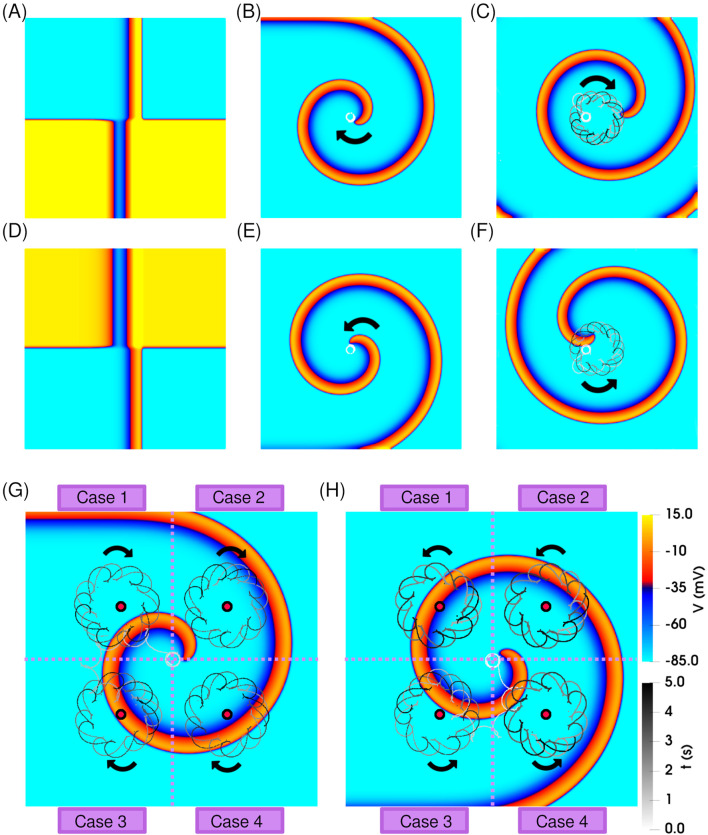
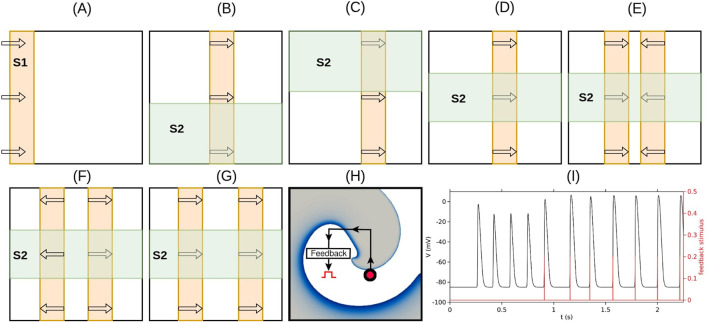
Sudden cardiac death (SCD) is often precipitated by reentrant arrhythmias such as ventricular tachycardia (VT) and ventricular fibrillation (VF), whose underlying dynamics are frequently sustained by spiral waves of electrical activity. Disrupting these waves can restore normal rhythm, but conventional low-energy pacing strategies are often ineffective in VF, where high-frequency, multi-wave interactions dominate. Resonant feedback-controlled antitachycardia pacing (rF-ATP), which times global electrical stimuli based on real-time feedback from the tissue, has been shown to robustly terminate single spirals under diverse conditions. However, its impact on interacting spiral waves-arguably a more realistic substrate for life-threatening arrhythmias-remains unexplored. Here, we use numerical simulations to investigate the effect of rF-ATP on figure-of-eight reentry, a clinically relevant configuration consisting of two counter-rotating spirals. We show that rF-ATP consistently terminates this pattern, regardless of feedback point location, through two distinct dynamical pathways: mutual collision of phase singularities or annihilation at inexcitable boundaries. We further demonstrate the method's efficacy across variations in feedback point and spiral arrangement, indicating robustness to geometrical and positional heterogeneity. These results highlight rF-ATP as a promising low-energy intervention for complex reentrant structures and provide mechanistic insight into feedback-driven control of multi-core spiral wave dynamics in cardiac tissue.



 求助内容:
求助内容: 应助结果提醒方式:

 京公网安备 11010802042870号


