{"title":"Pulse Oximetry Screening for Critical Congenital Heart Defects: Effectiveness and Implementation across Clinical Settings.","authors":"Gauri Gurumurthy, Devendra K Agrawal","doi":"10.26502/fccm.92920468","DOIUrl":null,"url":null,"abstract":"<p><p>Congenital heart defects are the most prevalent congenital anomalies, occurring in approximately 1% of live births and accounting for nearly one-third of all major congenital disorders worldwide. Within this spectrum, critical congenital heart defects (CCHDs) represent the most severe forms, often necessitating surgical or catheter-based intervention within the first year of life. Delayed or missed diagnosis of CCHDs remains a major cause of preventable neonatal morbidity and mortality, underscoring the importance of timely detection. Pulse oximetry screening has emerged as a noninvasive, inexpensive, and highly specific method to identify hypoxemia, particularly in duct-dependent lesions that may otherwise escape early clinical recognition. Since its universal adoption in the United States in 2011, pulse oximetry screening has consistently demonstrated value as a complementary tool to prenatal ultrasound and physical examination, improving detection rates, reducing emergency hospitalizations, and lowering infant mortality. Despite its proven clinical impact, important challenges remain. Screening sensitivity is limited, especially for conditions such as coarctation of the aorta that may not produce early hypoxemia. Variability in protocols, including timing of screening, pre- versus post-ductal measurement, and thresholds for repeat testing, contributes to inconsistent performance across hospitals. Moreover, recent evidence of racial bias in pulse oximetry accuracy, along with persistent disparities in early detection across demographic groups, highlights the need for inclusive device validation and standardized protocols. In low- and middle-income countries, pilot studies from Rwanda, Nigeria, and India demonstrate feasibility and dual benefits for detecting both cardiac and non-cardiac hypoxemic conditions, but widespread implementation is hindered by resource constraints, inadequate referral pathways, and limited access to confirmatory echocardiography. Emerging strategies, including integration with electronic medical records, computerized clinical decision support systems, and mobile health technologies, hold promise for standardizing workflows, improving compliance, and extending reach to resource-limited settings. This article presents a synthesisis of current evidence on the effectiveness, limitations, and global implementation of pulse oximetry screening for the detection of congenital heart defect detection, highlighting both its established role in neonatal care and the urgent need for innovations to address disparities, optimize protocols, and ensure equitable access to screening worldwide.</p>","PeriodicalId":72523,"journal":{"name":"Cardiology and cardiovascular medicine","volume":"9 5","pages":"444-456"},"PeriodicalIF":0.0000,"publicationDate":"2025-01-01","publicationTypes":"Journal Article","fieldsOfStudy":null,"isOpenAccess":false,"openAccessPdf":"https://www.ncbi.nlm.nih.gov/pmc/articles/PMC12674206/pdf/","citationCount":"0","resultStr":null,"platform":"Semanticscholar","paperid":null,"PeriodicalName":"Cardiology and cardiovascular medicine","FirstCategoryId":"1085","ListUrlMain":"https://doi.org/10.26502/fccm.92920468","RegionNum":0,"RegionCategory":null,"ArticlePicture":[],"TitleCN":null,"AbstractTextCN":null,"PMCID":null,"EPubDate":"2025/8/8 0:00:00","PubModel":"Epub","JCR":"","JCRName":"","Score":null,"Total":0}
引用次数: 0
Abstract
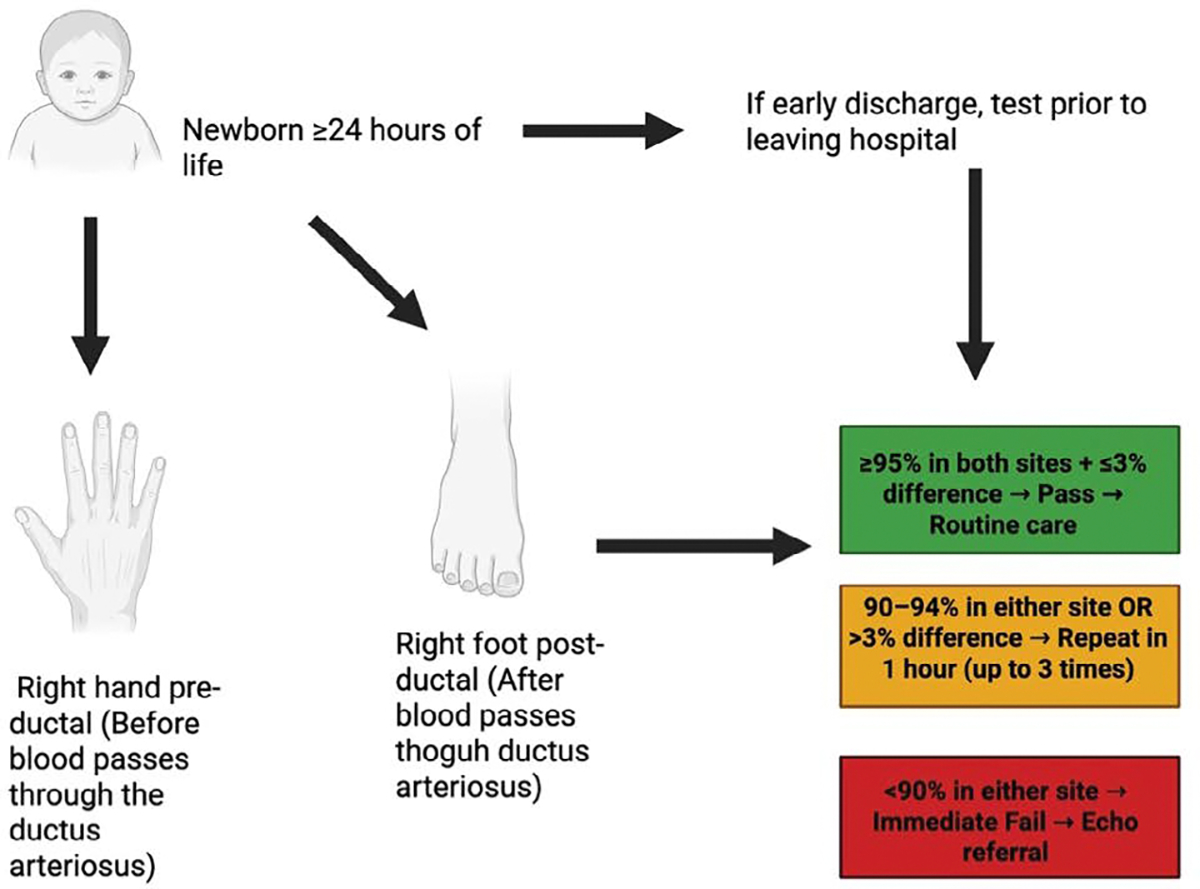
Congenital heart defects are the most prevalent congenital anomalies, occurring in approximately 1% of live births and accounting for nearly one-third of all major congenital disorders worldwide. Within this spectrum, critical congenital heart defects (CCHDs) represent the most severe forms, often necessitating surgical or catheter-based intervention within the first year of life. Delayed or missed diagnosis of CCHDs remains a major cause of preventable neonatal morbidity and mortality, underscoring the importance of timely detection. Pulse oximetry screening has emerged as a noninvasive, inexpensive, and highly specific method to identify hypoxemia, particularly in duct-dependent lesions that may otherwise escape early clinical recognition. Since its universal adoption in the United States in 2011, pulse oximetry screening has consistently demonstrated value as a complementary tool to prenatal ultrasound and physical examination, improving detection rates, reducing emergency hospitalizations, and lowering infant mortality. Despite its proven clinical impact, important challenges remain. Screening sensitivity is limited, especially for conditions such as coarctation of the aorta that may not produce early hypoxemia. Variability in protocols, including timing of screening, pre- versus post-ductal measurement, and thresholds for repeat testing, contributes to inconsistent performance across hospitals. Moreover, recent evidence of racial bias in pulse oximetry accuracy, along with persistent disparities in early detection across demographic groups, highlights the need for inclusive device validation and standardized protocols. In low- and middle-income countries, pilot studies from Rwanda, Nigeria, and India demonstrate feasibility and dual benefits for detecting both cardiac and non-cardiac hypoxemic conditions, but widespread implementation is hindered by resource constraints, inadequate referral pathways, and limited access to confirmatory echocardiography. Emerging strategies, including integration with electronic medical records, computerized clinical decision support systems, and mobile health technologies, hold promise for standardizing workflows, improving compliance, and extending reach to resource-limited settings. This article presents a synthesisis of current evidence on the effectiveness, limitations, and global implementation of pulse oximetry screening for the detection of congenital heart defect detection, highlighting both its established role in neonatal care and the urgent need for innovations to address disparities, optimize protocols, and ensure equitable access to screening worldwide.



 求助内容:
求助内容: 应助结果提醒方式:

 京公网安备 11010802042870号


