
Genomic and transcriptomic dynamics in the stepwise progression of lung adenocarcinoma
IF 25.9
1区 生物学
Q1 CELL BIOLOGY
引用次数: 0
Abstract
Lung adenocarcinoma (LUAD) progresses from pre-invasive to invasive stages, as well as from ground-glass opacities (GGOs) to solid nodules. However, the dynamic genomic and transcriptomic changes underlying LUAD progression are incompletely understood. Here, we performed whole-genome and transcriptome sequencing on 1008 LUAD samples from 954 patients who underwent surgery at Fudan University Shanghai Cancer Center, with comprehensive follow-up data. There was one atypical adenomatous hyperplasia, 42 adenocarcinomas in situ, 116 minimally invasive adenocarcinomas, and 849 invasive adenocarcinomas spanning all pathological stages. EGFR was the most frequently mutated gene in the study cohort, followed by TP53, RBM10, KRAS, and KMT2D. Mutation frequencies of tumor suppressor genes, such as TP53, RB1, MGA, KEAP1, and STK11, increased as the disease progressed to higher stages. A higher level of genomic instability was seen in LUAD compared with AAH/AIS/MIA samples, characterized by a higher tumor mutation burden, increased somatic copy number alteration burden, and increased structural variation burden. Notably, MAP2K1 E102–I103 deletion was frequently observed in pre-invasive samples, which endowed alveolar type II cells with increased growth potential and initiated tumor formation, suggesting that it is a potential driver mutation of LUAD. In summary, our study highlights key molecular changes during the stepwise progression of LUAD, provides insights into the identification of novel therapeutic targets, and helps to define the curative time window for this disease.
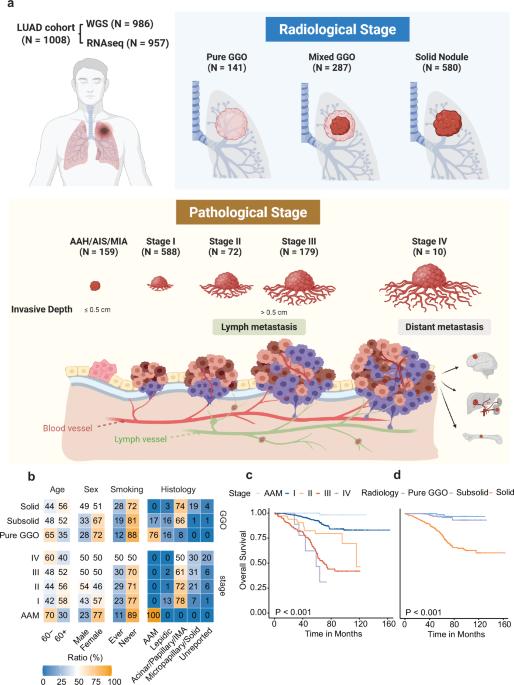
肺腺癌逐步发展的基因组和转录组动力学。
肺腺癌(LUAD)可以从侵袭前发展到侵袭期,也可以从磨玻璃样混浊(GGOs)发展到实性结节。然而,LUAD进展背后的动态基因组和转录组变化尚不完全清楚。在这里,我们对954名在复旦大学上海癌症中心接受手术的患者的1008个LUAD样本进行了全基因组和转录组测序,并进行了全面的随访数据。非典型腺瘤性增生1例,原位腺癌42例,微创腺癌116例,侵袭性腺癌849例。EGFR是研究队列中最常见的突变基因,其次是TP53、RBM10、KRAS和KMT2D。肿瘤抑制基因如TP53、RB1、MGA、KEAP1和STK11的突变频率随着疾病进展到较高阶段而增加。与AAH/AIS/MIA样本相比,LUAD的基因组不稳定性水平更高,其特征是更高的肿瘤突变负担、增加的体细胞拷贝数改变负担和增加的结构变异负担。值得注意的是,在侵袭前样本中经常观察到MAP2K1 E102-I103缺失,这赋予肺泡II型细胞增加的生长潜力并启动肿瘤形成,这表明它是LUAD的潜在驱动突变。总之,我们的研究突出了LUAD逐步发展过程中的关键分子变化,为确定新的治疗靶点提供了见解,并有助于确定该疾病的治疗时间窗。
本文章由计算机程序翻译,如有差异,请以英文原文为准。
求助全文
约1分钟内获得全文
求助全文
来源期刊

Cell Research
生物-细胞生物学
CiteScore
53.90
自引率
0.70%
发文量
2420
审稿时长
2.3 months
期刊介绍:
Cell Research (CR) is an international journal published by Springer Nature in partnership with the Center for Excellence in Molecular Cell Science, Chinese Academy of Sciences (CAS). It focuses on publishing original research articles and reviews in various areas of life sciences, particularly those related to molecular and cell biology. The journal covers a broad range of topics including cell growth, differentiation, and apoptosis; signal transduction; stem cell biology and development; chromatin, epigenetics, and transcription; RNA biology; structural and molecular biology; cancer biology and metabolism; immunity and molecular pathogenesis; molecular and cellular neuroscience; plant molecular and cell biology; and omics, system biology, and synthetic biology. CR is recognized as China's best international journal in life sciences and is part of Springer Nature's prestigious family of Molecular Cell Biology journals.
 求助内容:
求助内容: 应助结果提醒方式:

 京公网安备 11010802042870号


